ECC Compliance After Approval in Bangladesh: Environmental Monitoring, Testing and Inspection Checklist for Industries
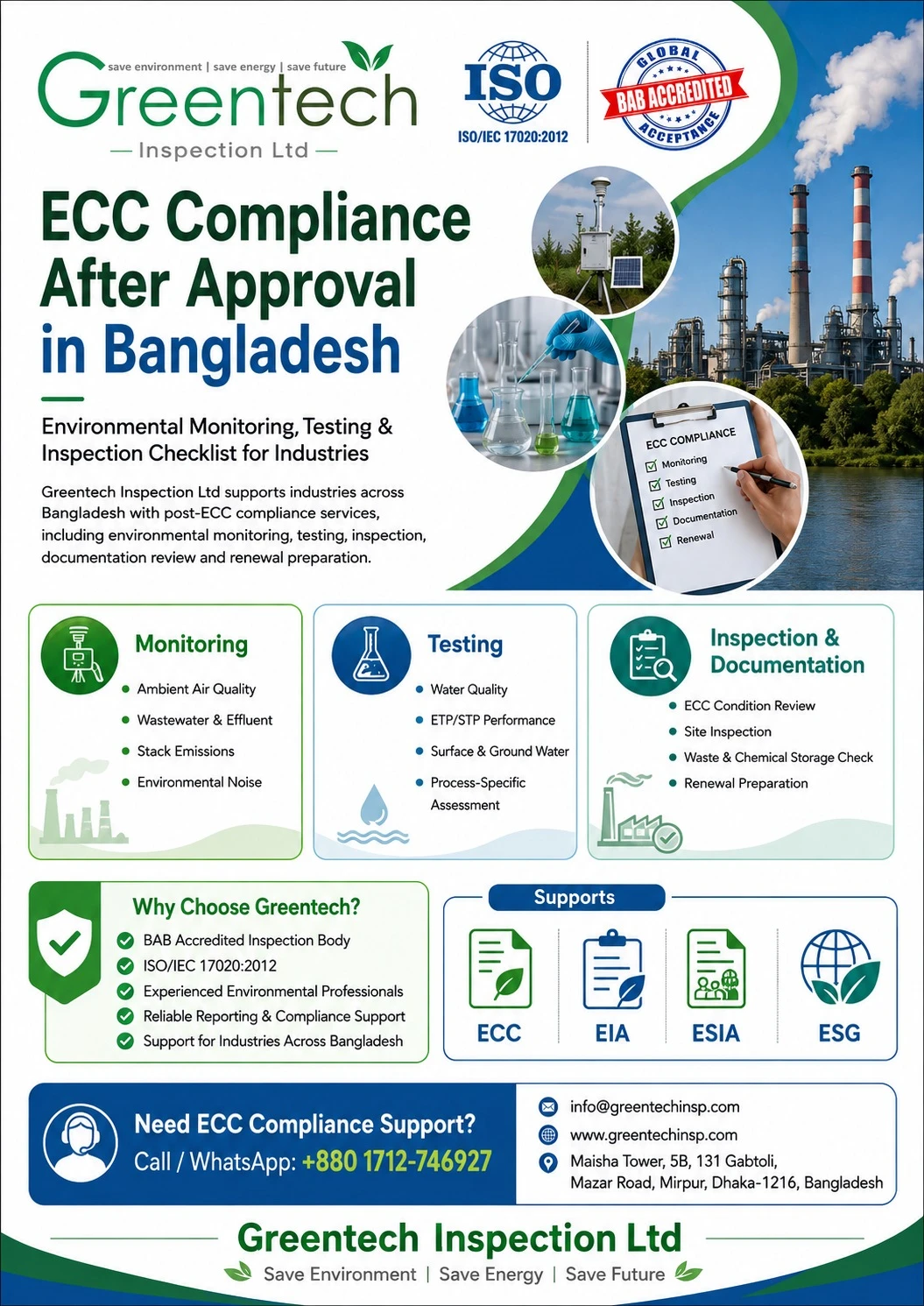
ECC Compliance After Approval in Bangladesh: Environmental Monitoring, Testing and Inspection Checklist for Industries
Receiving an Environmental Clearance Certificate, commonly known as an ECC, is an important milestone for an industrial facility or development project in Bangladesh. However, obtaining the certificate is not the final step in environmental compliance.
After approval, the project owner must operate the facility in accordance with the conditions stated in the ECC, applicable environmental requirements and any commitments included in the approved IEE, EIA, ESIA, EMP or ESMP.
This may require regular environmental monitoring, laboratory testing, site inspection, pollution-control system operation, recordkeeping, corrective action and timely preparation for ECC renewal.
Bangladesh’s environmental-clearance framework is based on the Bangladesh Environment Conservation Act, 1995 and the Environment Conservation Rules, 2023. The Department of Environment also lists other applicable instruments, including the Air Pollution Control Rules, 2022, Solid Waste Management Rules, 2021 and Noise Pollution Rules, 2025. The exact obligations applicable to a particular facility depend on its activities, emissions, discharges, waste streams, location and ECC conditions.
This guide provides a practical post-approval checklist for factories and projects in Bangladesh.
Important: Not every item in this checklist applies to every industry. The project owner should first review the exact conditions written in its ECC and any subsequent instructions issued by the Department of Environment.
What Does ECC Compliance After Approval Mean?
ECC compliance means continuously operating an industry or project according to:
Conditions written in the Environmental Clearance Certificate
Approved project information
Approved production capacity
Approved industrial process
Pollution-control commitments
Environmental Management Plan
EIA, ESIA or IEE commitments
Applicable discharge and emission requirements
Environmental monitoring obligations
Department of Environment instructions
Renewal and reporting requirements
An ECC is issued based on the information submitted by the project owner. Therefore, any significant difference between the approved information and the actual operation may create a compliance concern.
For example, compliance issues may arise when a facility:
Expands production without updating its environmental documents
Installs additional boilers or generators
Introduces a new production process
Increases wastewater generation
Changes its fuel type
Changes the wastewater-discharge location
Operates an ETP below its required capacity
Stores hazardous waste improperly
Fails to conduct required environmental monitoring
Allows its ECC to expire
Post-approval compliance should therefore be treated as an ongoing management process rather than a one-time administrative activity.
First Step: Read Every Condition in the ECC
The first action after receiving an ECC should be a detailed review of the certificate.
Management should identify:
Certificate number
Issue date
Validity period
Renewal deadline
Approved project name
Approved location
Approved production or service capacity
Approved fuel and utility information
Required pollution-control systems
Required environmental monitoring
Required testing parameters
Required reporting frequency
Special conditions
Restrictions on expansion or modification
Any requirement to obtain further approval
The conditions should be converted into a simple compliance tracker.
A compliance tracker may contain:
| Requirement | Responsible person | Frequency | Required evidence | Current status |
|---|---|---|---|---|
| ECC validity review | Compliance officer | Monthly | ECC copy | Open/Closed |
| ETP operation | ETP manager | Daily | Logbook | Open/Closed |
| Effluent testing | Environment team | As required | Test report | Open/Closed |
| Stack-emission testing | Utility manager | As required | Inspection report | Open/Closed |
| Waste documentation | Store/environment team | Monthly | Waste register | Open/Closed |
| Corrective-action review | Management | Monthly | Action tracker | Open/Closed |
This converts the ECC from a document stored in a file into a practical management tool.
Complete ECC Compliance Checklist for Industries
1. Maintain a Valid ECC
The facility should maintain a clear copy of its latest Environmental Clearance Certificate and any renewal letter.
Management should regularly check:
ECC issue date
Certificate-expiry date
Renewal-submission status
Conditions attached to the latest renewal
Any pending DoE observation
Any required additional approval
Do not wait until the certificate is about to expire. Environmental testing, document collection and corrective actions may require time.
A practical approach is to begin the internal review well before the expiry date.
2. Display and Control the ECC Document
A controlled copy of the ECC should be available at the facility.
Recommended practices include:
Keep the original certificate in secure custody.
Maintain a scanned copy.
Display a copy where appropriate.
Keep the latest renewal letter with the certificate.
Remove outdated copies from operational files.
Make the document available during inspections.
Record who is responsible for renewal.
The certificate number and validity status should also be included in the organization’s legal-compliance register.
3. Verify Actual Operations Against Approved Information
The factory should compare its current operation with the information submitted during the ECC process.
Review the following:
Current production capacity
Number of production lines
Raw materials
Finished products
Machinery
Boilers
Generators
Furnaces
Fuel type and consumption
Water consumption
Wastewater generation
ETP and STP capacity
Air-emission sources
Waste-generation volume
Chemical-storage arrangements
Site layout
Building expansion
Any material change should be reviewed to determine whether updated environmental documentation or approval is needed.
A factory should not assume that an existing ECC automatically covers every future expansion or process modification.
Environmental Monitoring for ECC Compliance
Environmental monitoring means collecting environmental information repeatedly to understand whether a facility is operating within its required conditions.
A monitoring program should identify:
What will be monitored
Where monitoring will occur
How it will be measured
How often it will be monitored
Who will conduct it
Which standard or condition will be used
Who will review the results
What action will be taken when a problem is found
The monitoring scope should be based on the facility’s actual pollution sources and ECC conditions.
Common monitoring areas
Depending on the industry, the program may cover:
Ambient air quality
Stack emissions
Wastewater and effluent
Surface water
Groundwater
Environmental noise
ETP and STP performance
Solid waste
Hazardous waste
Chemical storage
Fuel storage
Drainage
Dust
Odour
Spills and leakage
Community complaints
Environmental incidents
Monitoring data should be reviewed, not merely collected. A test report that remains unread in a file provides little environmental-management value.
Environmental Testing Checklist
Environmental testing produces measurable data about emissions, discharge quality and surrounding environmental conditions.
Testing should be planned according to:
ECC conditions
Facility processes
Pollution sources
DoE instructions
EIA or ESIA commitments
Environmental Management Plan
Previous test results
Buyer or lender requirements
Environmental complaints
Operational changes
1. Wastewater and effluent testing
Industries that generate process wastewater should evaluate the performance of their treatment and discharge systems.
Depending on the industrial process, testing may include:
pH
Biochemical Oxygen Demand
Chemical Oxygen Demand
Total Suspended Solids
Total Dissolved Solids
Dissolved oxygen
Colour
Temperature
Oil and grease
Relevant metals
Process-specific chemicals
The final parameter list must be selected according to the industrial process and applicable requirements.
The factory should maintain:
Sampling date
Sampling location
Sample identification
Laboratory or inspection report
ETP operational condition
Production condition during sampling
Result comparison
Corrective-action records
Follow-up test report
2. Stack-emission testing
Potential stack-emission sources include:
Boilers
Generators
Furnaces
Kilns
Incinerators
Process exhausts
Thermal-oil heaters
Testing may assess parameters such as:
Particulate matter
Carbon monoxide
Sulphur dioxide
Nitrogen oxides
Carbon dioxide
Oxygen
Flue-gas temperature
Gas velocity
Process-specific pollutants
Each emission source should be properly identified.
The report should state:
Equipment name and capacity
Fuel type
Load during testing
Stack location
Stack condition
Testing method
Instrument information
Test results
Applicable criteria
Recommended corrective measures
3. Ambient air-quality testing
Ambient air testing helps evaluate environmental conditions around the facility.
Monitoring points may include:
Factory boundary
Main gate
Production surroundings
Nearby residential locations
Schools or hospitals
Downwind locations
Busy traffic areas
Locations affected by dust
Potential parameters may include:
PM2.5
PM10
Sulphur dioxide
Nitrogen dioxide
Carbon monoxide
Ozone
Relevant industrial pollutants
Sampling locations should represent actual environmental conditions rather than being selected only for convenience.
4. Environmental noise testing
Noise monitoring may be required around:
Factory boundaries
Generator rooms
Boiler areas
Production buildings
Loading and unloading areas
Construction zones
Nearby residential areas
Other sensitive locations
The report should record:
Monitoring location
Date and time
Measurement duration
Daytime or nighttime condition
Nearby noise sources
Instrument details
Weather conditions
Results and observations
A high noise result should be followed by investigation and appropriate noise-control measures.
5. Surface-water and groundwater testing
Water testing may be required when a project:
Discharges treated wastewater
Uses groundwater
Is located near a river, canal, pond or wetland
Stores chemicals or fuel
Has contamination risks
Has received community complaints
Has monitoring commitments in its EIA or ESIA
Upstream and downstream locations may be needed where a facility discharges near a surface-water body.
The report should clearly identify the source, location and intended use of the tested water.
ETP and STP Compliance Checklist
Facilities that generate industrial wastewater or sewage should maintain appropriate treatment arrangements.
ETP compliance review
Check whether:
The ETP is operational during wastewater-generating production.
Treatment capacity is adequate.
Inlet and outlet points are clearly identified.
Flow information is maintained.
Chemical dosing is controlled.
Operators are properly assigned.
Operational logbooks are updated.
Equipment receives preventive maintenance.
Sludge is properly handled.
Treated wastewater is discharged through the approved route.
Bypass arrangements are prevented.
Test reports are available.
Corrective actions are documented.
STP compliance review
Check whether:
Sewage sources are connected correctly.
The treatment system is operational.
Treatment capacity is sufficient.
Odour is controlled.
Sludge is managed appropriately.
Discharge conditions are maintained.
Maintenance records are available.
Monitoring results are reviewed.
ETP or STP operation should not begin only when an inspection is expected. Pollution-control equipment should operate whenever the relevant wastewater or sewage is generated.
Air-Emission and Dust-Control Checklist
The facility should identify all potential air-pollution sources.
These may include:
Boilers
Generators
Furnaces
Production exhausts
Chemical processes
Material handling
Unpaved roads
Construction activity
Loading and unloading
Waste handling
Vehicle movement
Recommended checks include:
Stack condition
Chimney condition
Fuel quality
Visible smoke
Unusual odour
Dust accumulation
Exhaust-system operation
Filter or scrubber condition
Preventive-maintenance records
Emission-testing reports
Complaints from surrounding communities
Bangladesh’s Department of Environment separately lists the Environment Conservation Rules, Air Pollution Control Rules, Solid Waste Management Rules and Noise Pollution Rules among its current regulatory materials. Facilities should identify which requirements apply to their specific operations. (Department of Environment)
Solid and Hazardous Waste Checklist
Every factory should understand what waste it generates and how that waste is managed.
Solid-waste checklist
Verify that:
Waste types are identified.
Waste bins are labelled.
Waste is segregated.
Storage areas are clean.
Recyclable waste is separated.
Disposal records are maintained.
Waste collectors are documented.
Open burning is prevented.
Waste does not block drains.
Waste quantities are recorded where appropriate.
Hazardous-waste checklist
Hazardous waste may include:
Used oil
Chemical containers
Contaminated absorbent material
Paint or solvent waste
Laboratory chemicals
ETP sludge
Batteries
Electronic waste
Contaminated packaging
Process-specific hazardous materials
Check whether:
Hazardous waste is identified and labelled.
The storage area has restricted access.
Containers are compatible and closed.
Secondary containment is available.
Storage dates are recorded.
Spill materials are available.
Disposal or transfer records are maintained.
Hazardous and general waste are not mixed.
The requirements should be adjusted to the actual waste characteristics and applicable rules.
Chemical and Fuel Storage Checklist
Poor chemical or fuel storage can lead to soil contamination, drainage pollution, fire risks and regulatory concerns.
Inspect whether:
Containers are properly labelled.
Safety Data Sheets are available.
Chemicals are segregated according to compatibility.
Fuel tanks have suitable containment.
Containers are protected from damage.
Spill kits are available.
Drainage channels are protected.
Employees understand spill-response procedures.
Leakage is reported and corrected.
Empty containers are managed appropriately.
Emergency contact information is displayed.
Storage inventory is updated.
Any spill should be recorded, contained, cleaned and investigated.
Environmental Inspection After ECC Approval
Environmental inspection examines the overall condition of the site, including physical facilities, pollution-control systems, work practices and records.
It differs from environmental testing:
Testing measures a parameter or analyzes a sample.
Monitoring tracks environmental performance over time.
Inspection evaluates the overall compliance condition.
Corrective action addresses identified deficiencies.
Greentech Inspection Ltd’s listed environmental-inspection services include air quality, stack emissions, noise, light, temperature, humidity, ozone-depleting substances and greenhouse-gas assessment. (Greentech Inspection)
Internal environmental-inspection checklist
During an internal inspection, check:
Documents
Current ECC
Renewal letter
EIA, ESIA or IEE
EMP or ESMP
Environmental test reports
Monitoring records
Waste records
ETP/STP logbooks
Equipment-maintenance records
Corrective-action records
Incident records
Training records
Complaint register
Site conditions
Drainage
Waste-storage areas
Chemical stores
Fuel stores
ETP and STP
Generator and boiler areas
Stack condition
Production exhausts
Spill risks
Housekeeping
Odour
Dust
Noise
Wastewater-discharge points
Nearby sensitive locations
Management controls
Assigned environmental responsibilities
Monitoring schedule
Legal-compliance review
Emergency preparedness
Management review
Corrective-action tracking
Contractor control
Worker awareness
Inspection findings should be classified according to their significance and assigned to responsible persons with completion deadlines.
Environmental Documents Industries Should Maintain
A well-organized environmental file may include:
Legal documents
Current ECC
Previous ECC or renewal letters
DoE correspondence
Approved ToR, where applicable
Approved EIA, ESIA or IEE
EMP or ESMP
Other project-specific approvals
Monitoring documents
Ambient air-quality reports
Stack-emission reports
Noise-assessment reports
Water-quality reports
Effluent-testing reports
Soil-testing reports, where applicable
ETP/STP performance reports
Operational records
ETP logbook
STP logbook
Flow records
Chemical-consumption records
Fuel-consumption records
Water-consumption records
Waste register
Hazardous-waste register
Equipment-maintenance records
Sludge-management records
Management records
Environmental policy
Responsibility matrix
Training records
Inspection reports
Corrective-action plan
Incident register
Complaint register
Management-review minutes
Emergency-response records
Documents should be current, consistent and connected to the actual operation of the facility.
Suggested Internal Monitoring Schedule
The following schedule is a practical management example. It is not a substitute for the frequency written in the ECC, an approved environmental plan or a DoE instruction.
Daily or every operating shift
ETP/STP operation check
Chemical-dosing check
Flow or discharge observation
Waste-storage inspection
Spill and leakage check
Visible-emission observation
Abnormal odour check
Logbook update
Weekly
Drainage inspection
Chemical-storage inspection
Hazardous-waste-area inspection
Generator and boiler-area review
Spill-kit check
Pollution-control equipment review
Housekeeping inspection
Monthly
Environmental compliance meeting
Utility-data review
Waste-data review
Complaint review
Incident review
Corrective-action update
ECC validity review
Monitoring-plan review
Periodically, as required
Wastewater testing
Stack-emission testing
Ambient air-quality testing
Environmental noise testing
Surface-water or groundwater testing
ETP/STP performance assessment
Environmental compliance inspection
Before ECC renewal
Full ECC-condition review
Updated environmental monitoring
Document-gap assessment
Corrective-action closure
Updated project-information review
ETP/STP compliance review
Renewal-document preparation
What to Do When a Test Result Is Unsatisfactory
A non-compliant or unusual result should not be ignored or removed from the file.
The facility should:
Review the sampling and testing information.
Confirm the operational condition during testing.
Identify the affected pollution source.
Take immediate containment action where necessary.
Investigate the root cause.
Repair or improve the control system.
Update operating procedures.
Train responsible employees.
Conduct follow-up testing where appropriate.
Record the complete corrective action.
Report to the relevant authority when required.
Possible causes may include:
ETP operational failure
Incorrect chemical dosing
Overloaded treatment capacity
Equipment malfunction
Poor-quality fuel
Damaged filters
Process changes
Inadequate maintenance
Incorrect waste handling
Accidental discharge
Inappropriate sampling location
Corrective action should address the underlying cause, not only the test result.
Common ECC Compliance Problems
Industries commonly experience compliance gaps such as:
Expired ECC
Late renewal preparation
Failure to understand ECC conditions
Missing monitoring reports
Outdated testing results
Incomplete ETP records
ETP bypass or irregular operation
Poor sludge management
Missing stack-emission testing
Unlabelled waste containers
Improper hazardous-waste storage
Uncontrolled chemical leakage
Production expansion without environmental review
Additional machinery not reflected in documents
Inconsistent production and utility information
Lack of corrective-action evidence
Missing complaint records
Incomplete environmental training
Documents that do not match actual site conditions
A pre-renewal compliance audit can identify these gaps before they become part of a formal review.
Preparing for ECC Renewal
The Department of Environment’s citizen charter states that an ECC-renewal application may require:
An online application using the applicable parts of Form 5
Evidence of payment of the prescribed renewal fee and VAT
A compliance-monitoring report required under the ECC conditions, where applicable
A copy of the latest ECC or renewal letter
Other applicable information, depending on the type of establishment
The exact submission package can vary by facility and project conditions.
The DoE also maintains online services for Environmental Clearance Certificates, renewal, ToR approval, EIA approval, zero-discharge approval, ETP/STP design approval and laboratory reports.
Practical renewal-preparation checklist
Before applying, review:
Latest ECC and conditions
Certificate validity
Current production information
Current process description
Raw materials and products
Fuel and utility consumption
Water consumption
Wastewater generation
Air-emission sources
ETP/STP condition
Environmental monitoring results
Waste-management records
Site or layout changes
Machinery additions
Corrective-action status
Applicable licenses and supporting documents
Renewal fee and application requirements
Start early enough to correct problems identified during the review.
ECC Compliance During Factory Expansion
Expansion should receive environmental review before implementation.
Expansion may involve:
Increased production
Additional machinery
New product lines
New chemicals
Additional boilers or generators
Increased water consumption
Increased wastewater
Increased emissions
Additional waste
Expanded buildings
Modified drainage
Increased traffic
ETP or STP capacity changes
The environmental team should evaluate whether the existing pollution-control systems remain adequate.
The review may require:
Updated project profile
Revised process flow
Updated pollution calculations
Updated EMP
Additional environmental testing
ETP/STP capacity assessment
EIA or IEE update
DoE consultation or application support
Operating first and updating the environmental documents later can create unnecessary compliance risk.
Responsibilities Inside the Factory
ECC compliance should not be assigned to only one person.
Top management
Approve resources
Review compliance status
Support corrective action
Ensure legal obligations are considered in business decisions
Environmental or compliance team
Maintain the ECC
Track conditions
Coordinate monitoring
Review reports
Maintain documentation
Prepare renewal information
Production team
Operate within approved conditions
Report process changes
Reduce spills, emissions and waste
Support environmental monitoring
Utility and maintenance team
Maintain boilers and generators
Operate ETP/STP systems
Maintain pollution-control equipment
Keep operational records
Store and chemical-management team
Maintain inventories
Ensure proper labelling
Control storage
Maintain waste-transfer records
Workers and contractors
Follow environmental procedures
Report leaks and spills
Use designated waste containers
Follow emergency instructions
Environmental compliance is most effective when it is integrated into daily operations.
Benefits of Strong Post-Approval Compliance
An organized ECC-compliance system can help a facility:
Maintain regulatory readiness
Improve pollution-control performance
Prepare for ECC renewal
Respond to DoE inspections
Reduce documentation gaps
Identify environmental risks early
Improve ETP/STP operation
Support buyer assessments
Strengthen ESG information
Reduce community complaints
Improve emergency preparedness
Protect company reputation
Support responsible expansion
Demonstrate environmental accountability
It also helps management understand whether environmental investments are producing the expected results.
ECC Compliance Services by Greentech Inspection Ltd
Greentech Inspection Ltd provides environmental consultancy, inspection, testing and monitoring support for industries and development projects across Bangladesh.
Services may include:
ECC-condition review
ECC renewal support
Environmental compliance inspection
Environmental monitoring
Ambient air-quality assessment
Stack-emission testing
Environmental noise assessment
Water and wastewater assessment
ETP/STP compliance review
Environmental Management Plan support
IEE, EIA and ESIA support
Corrective-action planning
Pre-renewal gap assessment
Environmental documentation support
ESG environmental-data support
Greentech Inspection Ltd states that it is accredited by the Bangladesh Accreditation Board in environmental inspection under ISO/IEC 17020:2012. Its website lists environmental consultancy, environmental inspection, DoE consultancy, ECC, EIA, ESIA and ESG-related services. (Greentech Inspection)
Frequently Asked Questions
Is receiving an ECC enough to operate permanently?
No. The facility must continue to follow the conditions written in the certificate, maintain applicable environmental controls and complete renewal requirements within the relevant timeline.
Does every factory need the same environmental tests?
No. Testing depends on the industry, process, fuel, emissions, wastewater, location, ECC conditions and regulatory instructions.
Is environmental monitoring required for ECC renewal?
A compliance-monitoring report may be required where applicable under the conditions of the ECC. The DoE citizen charter includes this among the renewal documents where applicable.
What is the difference between testing and monitoring?
Testing measures a particular parameter or sample. Monitoring involves repeated or planned evaluation of environmental performance over time.
What is an environmental compliance inspection?
It is a systematic review of the facility, pollution-control equipment, environmental practices, records and compliance status.
Should the ETP operate continuously?
The ETP should operate appropriately whenever relevant wastewater is generated and treated. The operating arrangement should reflect the process, treatment design and approved discharge conditions.
What should a factory do after an unsatisfactory test result?
The factory should investigate the cause, implement corrective measures, document its actions and conduct follow-up testing where appropriate.
Can a factory expand under its existing ECC?
The environmental implications of the expansion should be reviewed first. Additional environmental documentation or approval may be needed depending on the nature and scale of the change.
When should ECC renewal preparation begin?
Preparation should begin well before expiry so that monitoring, testing, document updates and corrective actions can be completed properly.
Does ECC compliance support ESG reporting?
Yes. Environmental monitoring, emissions, wastewater, waste, compliance and corrective-action records can support the environmental component of ESG reporting.
Conclusion
Receiving an Environmental Clearance Certificate is the beginning of ongoing environmental responsibility.
After approval, industries should understand every ECC condition, maintain pollution-control systems, conduct applicable environmental testing, monitor performance, inspect the facility, keep accurate records and correct identified problems.
The most important post-approval actions are:
Maintain a valid ECC
Operate according to approved information
Implement the EMP or ESMP
Monitor pollution-control performance
Conduct applicable environmental testing
Maintain ETP/STP records
Control emissions, wastewater, noise and waste
Complete environmental inspections
Record corrective actions
Prepare early for renewal
A factory that follows these steps is better prepared for regulatory inspections, ECC renewal, buyer requirements, lender reviews and ESG reporting.
Need ECC Compliance Support in Bangladesh?
Greentech Inspection Ltd provides professional environmental monitoring, testing, inspection, ECC renewal, EIA, ESIA and environmental-compliance support across Bangladesh.
Greentech Inspection Ltd also provides:
SREDA-Certified Energy Auditor Bangladesh
Energy Efficiency Assessment Bangladesh
Green Financing Support Bangladesh
Bangladesh Bank Green Financing Support
GTF Documentation Support Bangladesh
TDF Documentation Support Bangladesh
LTFF Documentation Support Bangladesh
IDCOL Energy Efficiency Support Bangladesh
BIFFL Energy Efficiency Support Bangladesh
Higg Index Energy Support Bangladesh
ESG Consultancy Support Bangladesh
Environmental Consultant Bangladesh
Environmental Monitoring Bangladesh
Environmental Testing Bangladesh
Environmental Inspection Bangladesh
Environmental Consultant Bangladesh
EIA Consultant Bangladesh
ESIA Consultant Bangladesh
IEE Consultant Bangladesh
Environmental Management Plan Bangladesh
Environmental Monitoring Bangladesh
Environmental Inspection Bangladesh
Environmental Testing Bangladesh
Ambient Air Monitoring Bangladesh
Stack Emission Monitoring Bangladesh
Noise Level Assessment Bangladesh
Light Level Assessment Bangladesh
Water Quality Testing Bangladesh
Indoor Air Quality Monitoring Bangladesh
Industrial Hygiene Assessment Bangladesh
Energy Audit Bangladesh
ESG Consultancy Support Bangladesh
Traffic Impact Assessment Bangladesh
Industrial Hygiene Assessment Bangladesh
Energy Audit Bangladesh
ESG Consultancy Support Bangladesh
Traffic Impact Assessment (TIA) Bangladesh
DoE Consultancy
Environmental Management Plan Bangladesh
Industrial Hygiene Assessment Bangladesh
Environmental Management Plan Bangladesh
Address: Maisha Tower, 5B, 131 Gabtoli, Mazar Road, Mirpur, Dhaka-1216, Bangladesh
Call / WhatsApp: +8801712-746927 | +8801764-031809
Email: [email protected] | [email protected]
Website: www.greentechinsp.com
👉Fast | Accurate | Authority-Approved | Submission Ready | 12+ Years of Experience | 50+ TIA Projects Completed | 650+ EIA Projects Completed | 500+ EMP Projects Completed | 100+ Energy Audit | 20+ ESG Projects Completed | 40+ ESIA Projects Completed | 40+ Industrial Hygiene Assessment | 1000+ Customer | BAB Accredited | ISO/IEC 17020:2012 Certified |