Environmental Testing Requirements for ECC, EIA, ESIA & ESG in Bangladesh
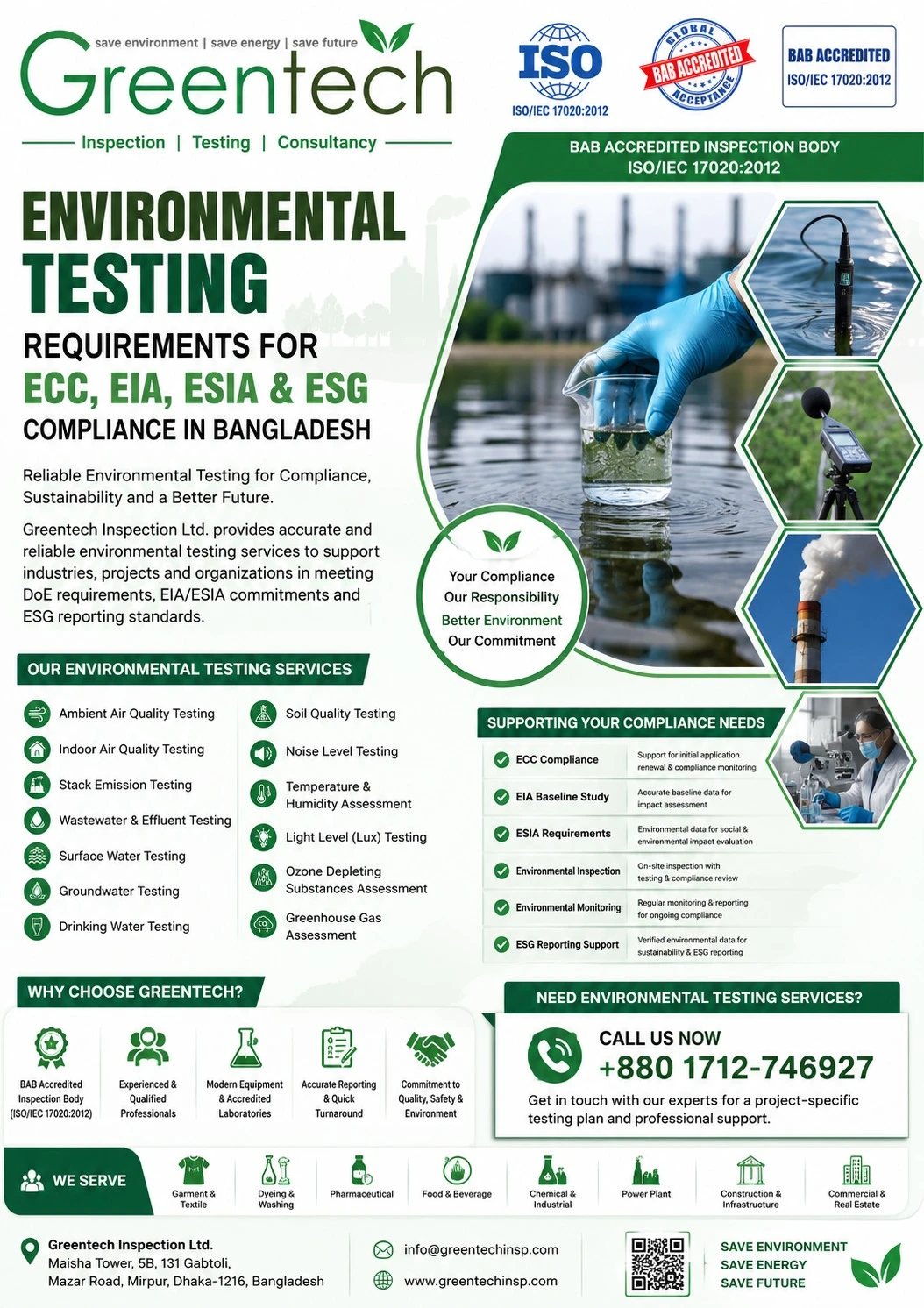
ECC environmental testing Bangladesh, EIA baseline testing, ESIA environmental testing, environmental laboratory testing Bangladesh, DoE environmental testing, ESG environmental data, stack-emission testing, wastewater testing Bangladesh
Environmental Testing for ECC, EIA, ESIA and ESG Compliance in Bangladesh
Environmental Testing
Environmental Testing Requirements for ECC, EIA, ESIA and ESG Compliance in Bangladesh
Environmental testing has become an essential part of regulatory compliance, industrial risk management and sustainable development in Bangladesh. Factories, infrastructure projects, commercial developments and other organizations need reliable environmental data to understand their pollution levels, demonstrate compliance and make informed environmental-management decisions.
Environmental testing can support an Environmental Clearance Certificate (ECC) application or renewal, establish baseline conditions for an Environmental Impact Assessment (EIA) or Environmental and Social Impact Assessment (ESIA), verify the effectiveness of environmental-control measures and provide evidence for Environmental, Social and Governance (ESG) reporting.
Bangladesh’s environmental regulatory framework is principally supported by the Bangladesh Environment Conservation Act, 1995 and the Environment Conservation Rules, 2023. The Department of Environment, commonly known as the DoE, manages environmental-clearance applications and other regulatory environmental services. (Bangladesh Legal Information System)
However, environmental-testing requirements are not identical for every organization. The required parameters, locations, frequency and reporting format depend on the type of project, industrial processes, pollution sources, environmental risks, applicable standards, approved Terms of Reference, EIA or ESIA commitments, ECC conditions and stakeholder requirements.
What Is Environmental Testing?
Environmental testing is the systematic measurement and analysis of environmental conditions, pollutants and emissions associated with a facility, project or surrounding area.
Testing may involve the collection of physical samples, field measurements, laboratory analysis, instrument-based monitoring or a combination of these methods.
Common environmental-testing activities include:
Ambient air-quality testing
Indoor air-quality testing
Stack-emission testing
Wastewater and effluent testing
Surface-water testing
Groundwater testing
Drinking-water testing
Soil-quality testing
Environmental noise measurement
Temperature and humidity assessment
Greenhouse-gas data assessment
Environmental testing produces measurable evidence. This evidence can then be used in environmental assessments, inspections, monitoring reports, pollution-control programs, clearance applications and sustainability disclosures.
Why Environmental Testing Is Important in Bangladesh
Bangladesh has experienced rapid industrial, infrastructure and urban development. Garment factories, textile mills, dyeing facilities, pharmaceutical manufacturers, food-processing plants, power projects, steel industries and commercial developments may generate emissions, wastewater, noise, waste and other environmental impacts.
Professional environmental testing helps an organization:
Understand its existing environmental condition
Identify pollution sources
Evaluate legal and operational compliance
Verify the performance of pollution-control systems
Establish environmental baseline data
Measure changes over time
Prepare evidence-based environmental reports
Support ECC applications and renewals
Fulfil EIA and ESIA commitments
Respond to buyer or lender requirements
Strengthen ESG and sustainability reporting
Develop corrective and preventive actions
Environmental testing should not be treated only as a document-submission activity. It is an important management tool for detecting problems before they result in complaints, production interruptions, financial losses or regulatory action.
Environmental Testing for ECC Compliance
An Environmental Clearance Certificate is an important regulatory requirement for applicable industrial units and development projects in Bangladesh.
Environmental testing may be required during:
Initial ECC applications
ECC renewal
Expansion or modification of operations
Responses to DoE observations
Environmental compliance inspections
Investigation of pollution complaints
Verification of pollution-control systems
The DoE’s online environmental-clearance application instructions state that, where applicable, applicants may need to complete Form 3 using the latest tested laboratory information. This demonstrates the practical connection between environmental test results and the environmental-clearance process. (DoE ECC System)
Tests That May Support ECC Applications or Renewals
Depending on the facility and its pollution sources, environmental testing may include:
Wastewater and effluent testing
Industries that generate process wastewater may need to test treated or discharged effluent.
Common parameters can include:
pH
Biochemical Oxygen Demand
Chemical Oxygen Demand
Total Suspended Solids
Total Dissolved Solids
Oil and grease
Dissolved oxygen
Colour
Temperature
Relevant metals or chemicals
The final parameters should be selected according to the industrial process, discharge characteristics and applicable regulatory conditions.
Stack-emission testing
Boilers, generators, furnaces, kilns and other combustion or process equipment may release pollutants into the atmosphere.
Stack testing may assess:
Particulate matter
Sulphur dioxide
Nitrogen oxides
Carbon monoxide
Carbon dioxide
Oxygen concentration
Flue-gas temperature
Gas-flow velocity
Process-specific pollutants
Ambient air-quality testing
Ambient air testing evaluates air quality around a facility, project site or nearby sensitive locations.
Possible parameters include:
PM2.5
PM10
Sulphur dioxide
Nitrogen dioxide
Carbon monoxide
Ozone
Relevant volatile or process-specific pollutants
Environmental noise testing
Noise measurement may be conducted at:
Project boundaries
Production areas
Generator or boiler locations
Construction sites
Nearby residential areas
Schools, hospitals or other sensitive locations
Water-quality testing
Testing may be needed for:
Surface water
Groundwater
Drinking water
Process water
Water near a discharge location
Soil testing
Soil-quality testing may be appropriate when a project involves:
Chemical handling
Fuel storage
Hazardous-material storage
Waste disposal
Contaminated land
Agricultural impacts
Major earthwork or land development
Not every ECC applicant requires every test. A project-specific assessment should identify the applicable pollution sources, testing parameters and monitoring locations.
Environmental Testing for EIA
An Environmental Impact Assessment evaluates the likely environmental effects of a proposed project before major development or operational decisions are finalized.
Environmental testing is especially important during the baseline-study stage of an EIA. Baseline testing establishes existing environmental conditions before construction, expansion or operation begins.
Without reliable baseline information, it becomes difficult to determine whether future environmental changes are caused by the project or were already present in the surrounding area.
Common EIA baseline tests
An EIA baseline study may include:
Ambient air-quality measurement
Surface-water analysis
Groundwater analysis
Soil-quality analysis
Daytime and nighttime noise measurement
Existing wastewater-quality assessment
Meteorological-data collection
Ecological and land-condition observations
The testing scope should reflect:
Project type
Site location
Nearby communities
Surrounding land use
Sensitive environmental receptors
Construction activities
Operational processes
Expected emissions and discharges
Seasonal environmental conditions
Greentech Inspection Ltd’s environmental consultancy services include baseline assessment of air, noise, surface water, groundwater, soil, land resources, ecosystems and socioeconomic conditions for environmental studies in Bangladesh. (greentechinsp.com)
How baseline testing improves an EIA
Reliable environmental testing helps the EIA team:
Describe existing environmental conditions
Identify sensitive locations and receptors
Predict potential project impacts
Compare project alternatives
Design appropriate mitigation measures
Establish monitoring indicators
Prepare an Environmental Management Plan
Measure environmental changes during construction and operation
Testing data should be supported by proper sampling records, location information, field observations, analytical methods and quality-control procedures.
Environmental Testing for ESIA
An Environmental and Social Impact Assessment evaluates both environmental and social risks associated with a project.
Environmental testing forms the technical foundation of many ESIA findings. Social impacts can be directly connected to environmental conditions, particularly when pollution affects community health, livelihoods, agriculture, fisheries, water resources or access to natural resources.
IFC Performance Standard 1 states that the process of identifying project risks and impacts should be based on recent environmental and social baseline data at an appropriate level of detail. (IFC)
Environmental tests commonly used in ESIA
Depending on the project, ESIA testing may include:
Ambient air testing near communities
Surface-water and groundwater testing
Drinking-water-quality assessment
Soil and sediment analysis
Environmental noise monitoring
Wastewater and discharge testing
Stack-emission testing
Construction dust assessment
Ecological habitat assessment
Community exposure assessment
Environmental testing and community impacts
Environmental results should be interpreted in relation to surrounding communities.
For example:
Poor groundwater quality may affect drinking-water users.
Industrial discharge may affect fisheries or agricultural irrigation.
Excessive noise may affect nearby residential areas, schools or hospitals.
Dust and air emissions may create health and nuisance concerns.
Soil contamination may affect land use, agriculture or livelihoods.
An effective ESIA therefore combines environmental-testing results with stakeholder consultation, social surveys, land-use information, health and safety considerations and livelihood assessments.
Environmental Testing for ESG Reporting
ESG reporting requires organizations to disclose measurable information about their environmental, social and governance performance.
Environmental testing supports the environmental component of ESG by providing evidence about pollution, emissions, water quality and operational environmental performance.
Testing data may support ESG indicators relating to:
Air emissions
Wastewater quality
Water discharge
Pollution-control performance
Environmental incidents
Noise impacts
Resource efficiency
Environmental compliance
Greenhouse-gas management
Environmental risks and corrective actions
The GRI Standards provide globally used reporting standards covering environmental topics such as water and effluents, emissions and waste. IFRS S2 also contains climate-related disclosure requirements, including disclosure of Scope 1, Scope 2 and Scope 3 greenhouse-gas emissions. (Global Reporting Initiative)
For banks and financial institutions, Bangladesh Bank has issued sustainability and climate-related financial-disclosure guidance based on IFRS S1 and IFRS S2, with implementation being introduced in phases.
Testing data alone is not a complete ESG report
Environmental testing provides important evidence, but an ESG report normally requires additional information, including:
Environmental policies
Governance responsibilities
Legal-compliance records
Energy and fuel consumption
Water withdrawal and consumption
Waste-generation records
GHG inventory calculations
Environmental targets
Corrective-action records
Risk-management processes
Performance trends
Management explanations
For example, stack testing can measure pollutants released from a specific emission point. A corporate GHG inventory, however, generally also requires electricity, fuel, refrigerant, transport, production and value-chain activity data.
The testing program and the ESG reporting framework should therefore be designed together.
Environmental Testing, Monitoring and Inspection: What Is the Difference?
These services are connected, but they are not identical.
Environmental testing
Testing measures a specific parameter or analyzes a sample.
Examples include:
Testing wastewater
Measuring stack emissions
Analyzing groundwater
Measuring environmental noise
Environmental monitoring
Monitoring involves repeated or continuous observation of environmental performance over time.
Examples include:
Quarterly wastewater testing
Periodic ambient-air monitoring
Construction noise monitoring
Routine stack-emission monitoring
Environmental inspection
Inspection evaluates the overall facility, equipment, operations, records and compliance condition.
An inspection may examine:
Pollution sources
ETP or STP operation
Boiler and generator conditions
Waste-storage areas
Chemical-management practices
Environmental records
ECC conditions
Monitoring results
Corrective-action implementation
Testing provides the data, monitoring identifies trends, and inspection evaluates the broader compliance situation.
Which Industries Need Environmental Testing?
Environmental testing may be needed by:
Garment factories
Textile mills
Dyeing and washing plants
Pharmaceutical industries
Food and beverage manufacturers
Chemical industries
Cement and ceramic plants
Steel and engineering industries
Power plants
Paper and pulp industries
Plastic and packaging manufacturers
Tanneries and leather industries
Hospitals and healthcare facilities
Real-estate developments
Commercial buildings
Infrastructure projects
Economic zones and industrial parks
Construction projects
Warehouses and logistics facilities
The exact testing requirement should be based on the facility’s processes, inputs, outputs, emissions, discharges and environmental risks.
How Often Should Environmental Testing Be Conducted?
There is no single testing frequency suitable for every organization.
Testing frequency may be determined by:
ECC conditions
DoE instructions
Approved EIA, ESIA, EMP or ESMP
Type and quantity of emissions or discharges
Industrial risk level
Production changes
Previous test results
Buyer requirements
Lender requirements
Environmental complaints
Internal environmental-management procedures
A facility with stable operations and consistently compliant results may have a different monitoring program from a high-risk facility with variable production or previous non-compliance.
Organizations should develop an environmental-monitoring schedule that clearly identifies:
Parameter
Monitoring location
Testing method
Responsible person
Monitoring frequency
Applicable standard
Reporting requirement
Corrective-action process
Professional Environmental-Testing Process
A professional environmental-testing assignment generally follows these stages:
1. Requirement review
The consultant reviews the project, industrial processes, ECC conditions, assessment requirements and intended use of the results.
2. Site assessment
Environmental specialists inspect the site to identify:
Emission points
Discharge points
Pollution-control equipment
Sensitive locations
Sampling access
Operational conditions
3. Testing-plan preparation
The plan defines:
Testing parameters
Sampling locations
Number of samples
Testing duration
Analytical methods
Applicable standards
Quality-control requirements
4. Sample collection and field measurement
Samples and measurements are collected using appropriate equipment, methods, containers and preservation procedures.
5. Laboratory or instrument analysis
Samples are analyzed using relevant technical methods. Field instruments should be suitable for the measurement and maintained or calibrated as required.
6. Data evaluation
Results are reviewed against:
Applicable legal limits
Project-specific requirements
Approved assessment commitments
Buyer or lender criteria
Previous monitoring results
Internal environmental targets
7. Report preparation
The final report should clearly present the methodology, locations, results, compliance comparison, observations and recommendations.
8. Corrective action and follow-up
When a result indicates a potential problem, the organization should identify the cause, implement corrective measures and conduct follow-up testing where necessary.
What Should an Environmental-Testing Report Include?
A professional report may include:
Client and facility information
Project or process description
Testing objectives
Date and time of testing
Operational condition during testing
Sampling and measurement locations
Location map or layout
Environmental conditions
Testing parameters
Equipment or instruments used
Sampling methodology
Analytical methodology
Test results
Applicable limits or criteria
Compliance evaluation
Photographic evidence
Observations
Corrective recommendations
Authorized review and approval
For EIA or ESIA baseline studies, the report should also explain the representativeness of the locations and any seasonal or technical limitations.
Common Environmental-Testing Mistakes
Organizations should avoid the following problems:
Selecting irrelevant parameters
Missing important pollution sources
Collecting samples from an incorrect location
Testing when equipment is not operating normally
Failing to record production conditions
Using unsuitable or poorly maintained instruments
Inadequate sample preservation
Missing sampling photographs or coordinates
Comparing results with an incorrect standard
Reporting results without technical interpretation
Conducting one-time testing but calling it monitoring
Reusing outdated results
Failing to investigate non-compliant findings
Submitting data that does not match the actual facility condition
Treating environmental testing and GHG accounting as the same activity
A strong testing program must be technically defensible, project-specific and connected to practical environmental management.
Benefits of Professional Environmental Testing
Professional environmental testing can help organizations achieve:
Better regulatory compliance
Stronger ECC applications and renewals
Reliable EIA and ESIA baseline data
Improved pollution-control performance
Early identification of environmental risks
Better environmental-monitoring plans
More credible ESG information
Greater confidence from buyers and lenders
Better community and stakeholder relationships
Evidence-based corrective actions
Reduced operational and reputational risk
Improved long-term sustainability performance
Environmental Testing Services by Greentech Inspection Ltd
Greentech Inspection Ltd provides environmental testing, inspection, monitoring and consultancy services for industries, businesses and development projects across Bangladesh.
Our environmental services include:
Ambient air-quality assessment
Indoor air-quality inspection
Stack-emission testing
Environmental noise assessment
Wastewater and effluent-quality assessment
Surface-water and groundwater assessment
Soil and baseline environmental assessment
Temperature and humidity assessment
Greenhouse-gas assessment
Environmental compliance inspection
Environmental monitoring
ECC consultancy
EIA preparation
ESIA preparation
ESG reporting support
Greentech Inspection Ltd is a Bangladesh Accreditation Board-accredited environmental inspection body under ISO/IEC 17020:2012 and provides environmental testing, inspection and consultancy services through qualified environmental professionals. (greentechinsp.com)
Our team supports clients from initial requirement identification and field assessment through testing, technical reporting, compliance evaluation and corrective-action planning.
Frequently Asked Questions
Is environmental testing mandatory for ECC applications?
Testing may be required depending on the project category, industrial process, pollution sources, application stage and DoE requirements. The DoE online ECC system can request the latest laboratory information where applicable.
What environmental tests are required for an EIA?
Common EIA baseline tests include ambient air, noise, surface water, groundwater and soil. The final scope depends on the project and surrounding environment.
What is the difference between EIA and ESIA testing?
Both may require environmental baseline testing. ESIA additionally evaluates social impacts, such as effects on community health, livelihoods, land use and access to natural resources.
Can environmental test results be used for ESG reporting?
Yes. Environmental results can support ESG disclosures related to emissions, wastewater, pollution and environmental compliance. Additional organizational and activity data will normally be required for a complete ESG report.
Does every factory need the same environmental tests?
No. Testing should be selected according to the factory’s operations, fuels, raw materials, wastewater, emissions, location and compliance conditions.
How often should wastewater or stack-emission testing be conducted?
The appropriate frequency depends on ECC conditions, regulatory instructions, approved environmental plans, operational risk and stakeholder requirements.
What happens when a test result exceeds an applicable limit?
The organization should investigate the cause, assess the operational and environmental risk, implement corrective measures and conduct follow-up testing as appropriate.
Can one environmental test report be used indefinitely?
No. Environmental conditions and industrial operations can change. Current data may be required for renewal, monitoring, assessment or stakeholder reporting.
Conclusion
Environmental testing is the technical foundation of effective environmental compliance and sustainable project management.
For ECC purposes, testing can provide evidence about actual emissions, discharges and pollution-control performance. For EIA and ESIA studies, it establishes the baseline conditions required to assess future impacts. For ESG reporting, it strengthens the accuracy and credibility of environmental performance information.
The most effective testing program is not the one with the largest number of parameters. It is the one designed around the project’s actual pollution sources, environmental risks, regulatory obligations and reporting objectives.
Organizations should therefore identify their requirements before testing, use suitable methods, maintain proper records, interpret the results correctly and connect all findings to corrective actions and long-term environmental improvement.
Need Environmental Testing Services in Bangladesh?
Greentech Inspection Ltd also provides:
SREDA-Certified Energy Auditor Bangladesh
Energy Efficiency Assessment Bangladesh
Green Financing Support Bangladesh
Bangladesh Bank Green Financing Support
GTF Documentation Support Bangladesh
TDF Documentation Support Bangladesh
LTFF Documentation Support Bangladesh
IDCOL Energy Efficiency Support Bangladesh
BIFFL Energy Efficiency Support Bangladesh
Higg Index Energy Support Bangladesh
ESG Consultancy Support Bangladesh
Environmental Consultant Bangladesh
Environmental Monitoring Bangladesh
Environmental Testing Bangladesh
Environmental Inspection Bangladesh
Environmental Consultant Bangladesh
EIA Consultant Bangladesh
ESIA Consultant Bangladesh
IEE Consultant Bangladesh
Environmental Management Plan Bangladesh
Environmental Monitoring Bangladesh
Environmental Inspection Bangladesh
Environmental Testing Bangladesh
Ambient Air Monitoring Bangladesh
Stack Emission Monitoring Bangladesh
Noise Level Assessment Bangladesh
Light Level Assessment Bangladesh
Water Quality Testing Bangladesh
Indoor Air Quality Monitoring Bangladesh
Industrial Hygiene Assessment Bangladesh
Energy Audit Bangladesh
ESG Consultancy Support Bangladesh
Traffic Impact Assessment Bangladesh
Industrial Hygiene Assessment Bangladesh
Energy Audit Bangladesh
ESG Consultancy Support Bangladesh
Traffic Impact Assessment (TIA) Bangladesh
DoE Consultancy
Environmental Management Plan Bangladesh
Industrial Hygiene Assessment Bangladesh
Environmental Management Plan Bangladesh
Address: Maisha Tower, 5B, 131 Gabtoli, Mazar Road, Mirpur, Dhaka-1216, Bangladesh
Call / WhatsApp: +8801712-746927 | +8801764-031809
Email: [email protected] | [email protected]
Website: www.greentechinsp.com
👉Fast | Accurate | Authority-Approved | Submission Ready | 12+ Years of Experience | 50+ TIA Projects Completed | 650+ EIA Projects Completed | 500+ EMP Projects Completed | 100+ Energy Audit | 20+ ESG Projects Completed | 40+ ESIA Projects Completed | 40+ Industrial Hygiene Assessment | 1000+ Customer | BAB Accredited | ISO/IEC 17020:2012 Certified |