Environmental Impact Assessment (EIA) Report in Bangladesh: Complete Guide for Industries (2026)
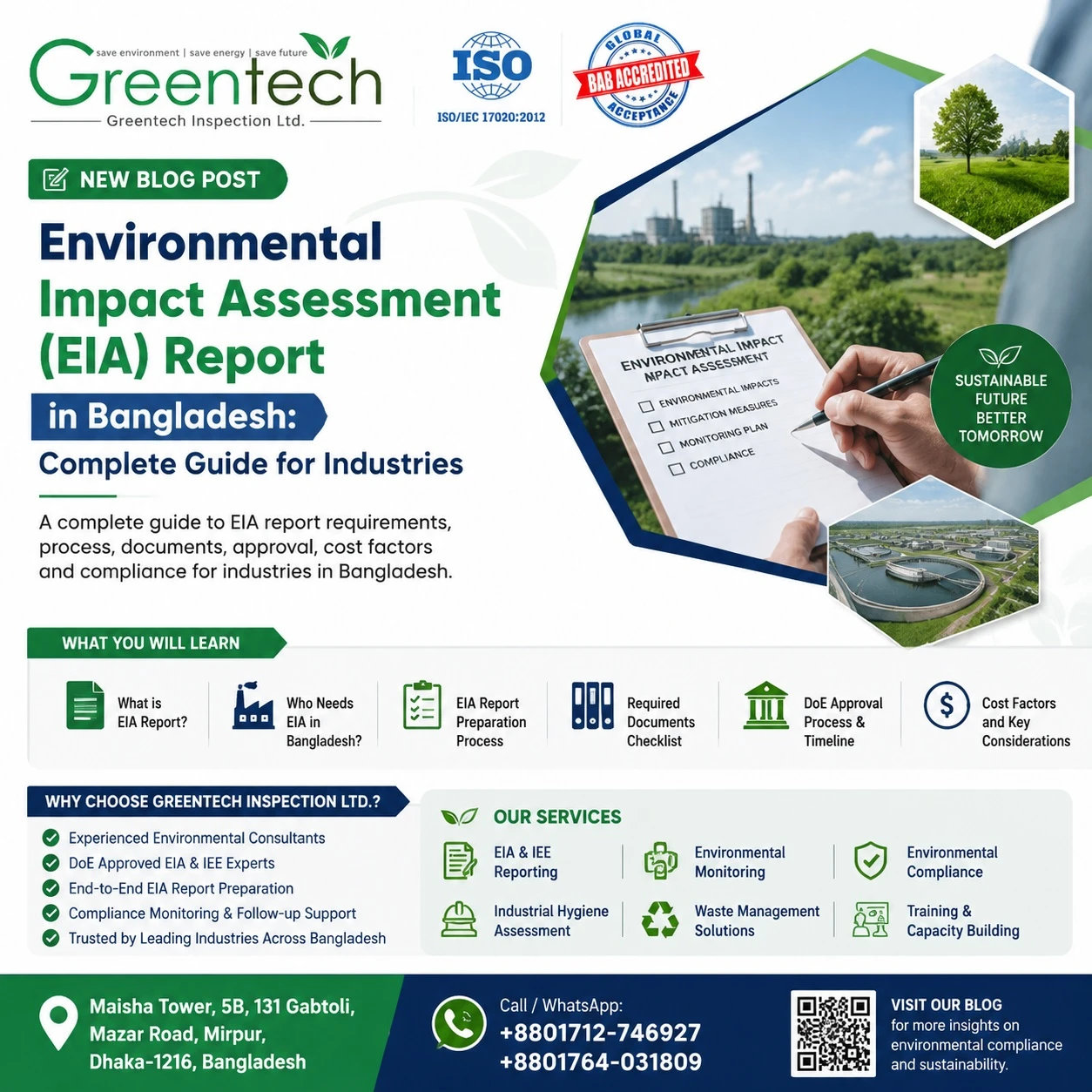
Environmental Impact Assessment (EIA) Report Bangladesh | 2026 Guide
Learn the complete EIA report process in Bangladesh, including requirements, procedures, documents, approval process, costs, and compliance guidance for industries.
Environmental Impact Assessment (EIA) Report in Bangladesh: Complete Guide for Industries
Introduction
Industrial development plays a vital role in Bangladesh's economic growth. The expansion of manufacturing industries, infrastructure projects, power generation facilities, and commercial developments has created thousands of employment opportunities and contributed significantly to national development.
However, rapid industrial growth can also create environmental challenges, including air pollution, water contamination, waste generation, noise pollution, ecosystem disruption, and public health risks.
To ensure sustainable development, the Government of Bangladesh requires certain projects to evaluate and manage their potential environmental impacts before starting operations. This process is known as Environmental Impact Assessment (EIA).
An Environmental Impact Assessment (EIA) Report is one of the most important environmental compliance documents required for high-impact projects in Bangladesh. It provides a detailed scientific evaluation of a project's possible environmental effects and identifies appropriate measures to prevent, reduce, or manage those impacts.
For industries classified under higher environmental risk categories, obtaining approval of the EIA report from the Department of Environment (DoE) is a critical step before receiving environmental clearance.
This guide explains everything industries need to know about the EIA Report Process in Bangladesh, including its purpose, requirements, preparation steps, approval process, required documents, and best practices.
What is an Environmental Impact Assessment (EIA)?
An Environmental Impact Assessment (EIA) is a systematic process used to identify, predict, evaluate, and manage the potential environmental impacts of a proposed project before implementation.
The purpose of an EIA is not to stop industrial development but to ensure that development occurs in an environmentally responsible manner.
An EIA helps decision-makers understand:
What environmental impacts may occur?
How severe those impacts could be?
What mitigation measures are required?
How can pollution and environmental risks be minimized?
The final outcome of this process is an EIA Report, which presents the findings of environmental studies and proposes an Environmental Management Plan (EMP) for controlling identified impacts.
Why is an EIA Report Important in Bangladesh?
An EIA report serves several important purposes for industries, regulators, and communities.
1. Legal Compliance
For certain categories of projects, especially high-risk industries, EIA approval is a mandatory requirement before obtaining environmental clearance.
Without proper approval, industries may face:
Regulatory complications
Delays in project approval
Penalties
Operational restrictions
2. Environmental Risk Identification
An EIA identifies potential risks related to:
Air emissions
Industrial wastewater
Hazardous waste
Noise pollution
Soil contamination
Biodiversity impacts
Occupational and community health risks
Early identification allows industries to design effective control measures.
3. Sustainable Industrial Development
Modern industries are increasingly expected to follow sustainable practices.
A properly prepared EIA helps organizations:
Reduce pollution
Improve resource efficiency
Minimize environmental liabilities
Meet international buyer requirements
Improve corporate reputation
Who Requires an EIA Report in Bangladesh?
Not every project requires a full EIA. The requirement depends on the environmental category, project type, size, and potential impact.
Generally, projects under the Red Category require detailed environmental assessment, including EIA.
Examples include:
Textile and Garment Sector
Dyeing industries
Washing plants
Textile processing units
Chemical Industries
Chemical manufacturing
Fertilizer plants
Pharmaceutical production facilities
For the "Industries requiring EIA" section, you can expand it to include healthcare and medical sectors as follows:
Chemical and Healthcare Industries
Chemical Industries
Industries involved in chemical production and processing generally require detailed environmental assessment due to the potential risks associated with hazardous substances, chemical waste, air emissions, and wastewater generation.
Examples include:
Chemical manufacturing industries
Fertilizer manufacturing plants
Pesticide and agrochemical industries
Paint and coating industries
Industrial chemical processing facilities
Pharmaceutical and Medical Industries
Pharmaceutical and healthcare facilities may require environmental assessment due to biomedical waste generation, chemical usage, wastewater discharge, laboratory waste, and public health considerations.
Examples include:
Pharmaceutical manufacturing facilities
Active Pharmaceutical Ingredient (API) manufacturing plants
Hospitals and medical centers
Diagnostic centers
Medical laboratories
Medical waste treatment facilities
Healthcare service facilities
Vaccine and biotechnology production facilities
Healthcare and Hospital Sector
Large healthcare facilities generate different types of environmental impacts, including:
Biomedical waste generation
Infectious waste management requirements
Wastewater discharge
Chemical and pharmaceutical waste
Laboratory emissions
Radiation-related risks (where applicable)
Therefore, hospitals and medical institutions must implement proper environmental management systems and comply with Department of Environment requirements.
This addition will make the article more complete because hospital, pharmaceutical, and medical waste management compliance is a growing environmental concern in Bangladesh. It also creates opportunities for Greentech Inspection Ltd. to attract clients from the healthcare sector.
Heavy Industries
Cement factories
Ship breaking yards
Large manufacturing facilities
Energy Projects
Power plants
Fuel storage facilities
LPG projects
Infrastructure Development
Large housing projects
Industrial parks
Roads and highways
Large commercial developments
The Department of Environment determines whether an EIA is required based on the project's environmental classification and characteristics.
Difference Between IEE and EIA
Many industries are confused about the difference between Initial Environmental Examination (IEE) and Environmental Impact Assessment (EIA).
| IEE | EIA |
|---|---|
| Preliminary environmental assessment | Detailed environmental study |
| Used for lower/moderate impact projects | Used for high-impact projects |
| Limited data collection | Extensive field investigation |
| Identifies major impacts | Provides detailed impact prediction |
| Simpler approval process | More comprehensive review |
An IEE may be required before conducting an EIA depending on project requirements.
Key Components of an EIA Report
A professional EIA report generally contains the following sections:
1. Executive Summary
Provides a brief overview of:
Project description
Major environmental impacts
Proposed mitigation measures
2. Project Description
Includes:
Project location
Production capacity
Technology used
Raw materials
Manufacturing process
Utilities requirement
3. Baseline Environmental Study
This section evaluates existing environmental conditions before project implementation.
It may include:
Air Quality Assessment
Parameters such as:
PM10
PM2.5
SO₂
NOx
CO
Water Quality Assessment
Parameters such as:
pH
BOD
COD
TDS
Heavy metals
Noise Monitoring
Assessment of existing noise levels around the project area.
Ecological Study
Evaluation of:
Flora
Fauna
Biodiversity
Sensitive areas
4. Environmental Impact Identification
The assessment identifies possible impacts during:
Construction phase
Operation phase
Maintenance activities
Examples:
Wastewater generation
Air emissions
Solid waste
Noise generation
Traffic impacts
5. Environmental Management Plan (EMP)
The EMP describes how identified impacts will be controlled.
It includes:
Pollution control measures
Waste management procedures
Monitoring plans
Emergency response procedures
Occupational health and safety measures
6. Environmental Monitoring Plan
A monitoring schedule is developed to ensure continuous compliance.
Monitoring may include:
Air quality testing
Stack emission monitoring
Wastewater analysis
Noise monitoring
Workplace environment assessment
EIA Approval Process in Bangladesh
The general EIA approval process includes:
Step 1: Project Screening
The project is reviewed to determine:
Environmental category
Required studies
Applicable requirements
Step 2: Preparation of Terms of Reference (ToR)
The scope of the EIA study is developed.
The ToR defines:
Study methodology
Environmental parameters
Assessment requirements
Step 3: Environmental Baseline Study
Field investigations are conducted to collect environmental data.
Step 4: Preparation of EIA Report
The report is prepared based on:
Field data
Environmental analysis
Impact assessment
Mitigation plans
Step 5: Submission to Department of Environment
The completed report is submitted for review and evaluation.
Step 6: Review and Approval
The DoE reviews:
Technical quality
Environmental risks
Proposed mitigation measures
After successful evaluation, approval is provided.
Greentech Inspection Ltd also provides:
SREDA-Certified Energy Auditor Bangladesh
Energy Efficiency Assessment Bangladesh
Green Financing Support Bangladesh
Bangladesh Bank Green Financing Support
GTF Documentation Support Bangladesh
TDF Documentation Support Bangladesh
LTFF Documentation Support Bangladesh
IDCOL Energy Efficiency Support Bangladesh
BIFFL Energy Efficiency Support Bangladesh
Higg Index Energy Support Bangladesh
ESG Consultancy Support Bangladesh
Environmental Consultant Bangladesh
Environmental Monitoring Bangladesh
Environmental Testing Bangladesh
Environmental Inspection Bangladesh
Environmental Consultant Bangladesh
EIA Consultant Bangladesh
ESIA Consultant Bangladesh
IEE Consultant Bangladesh
Environmental Management Plan Bangladesh
Environmental Monitoring Bangladesh
Environmental Inspection Bangladesh
Environmental Testing Bangladesh
Ambient Air Monitoring Bangladesh
Stack Emission Monitoring Bangladesh
Noise Level Assessment Bangladesh
Light Level Assessment Bangladesh
Water Quality Testing Bangladesh
Indoor Air Quality Monitoring Bangladesh
Industrial Hygiene Assessment Bangladesh
Energy Audit Bangladesh
ESG Consultancy Support Bangladesh
Traffic Impact Assessment Bangladesh
Industrial Hygiene Assessment Bangladesh
Energy Audit Bangladesh
ESG Consultancy Support Bangladesh
Traffic Impact Assessment (TIA) Bangladesh
DoE Consultancy
Environmental Management Plan Bangladesh
Industrial Hygiene Assessment Bangladesh
Environmental Management Plan Bangladesh
Address: Maisha Tower, 5B, 131 Gabtoli, Mazar Road, Mirpur, Dhaka-1216, Bangladesh
Call / WhatsApp: +8801712-746927 | +8801764-031809
Email: [email protected] | [email protected]
Website: www.greentechinsp.com
👉Fast | Accurate | Authority-Approved | Submission Ready | 12+ Years of Experience | 50+ TIA Projects Completed | 650+ EIA Projects Completed | 500+ EMP Projects Completed | 100+ Energy Audit | 20+ ESG Projects Completed | 40+ ESIA Projects Completed | 40+ Industrial Hygiene Assessment | 1000+ Customer | BAB Accredited | ISO/IEC 17020:2012 Certified |