IEE vs EIA vs ECC – What's the Difference?
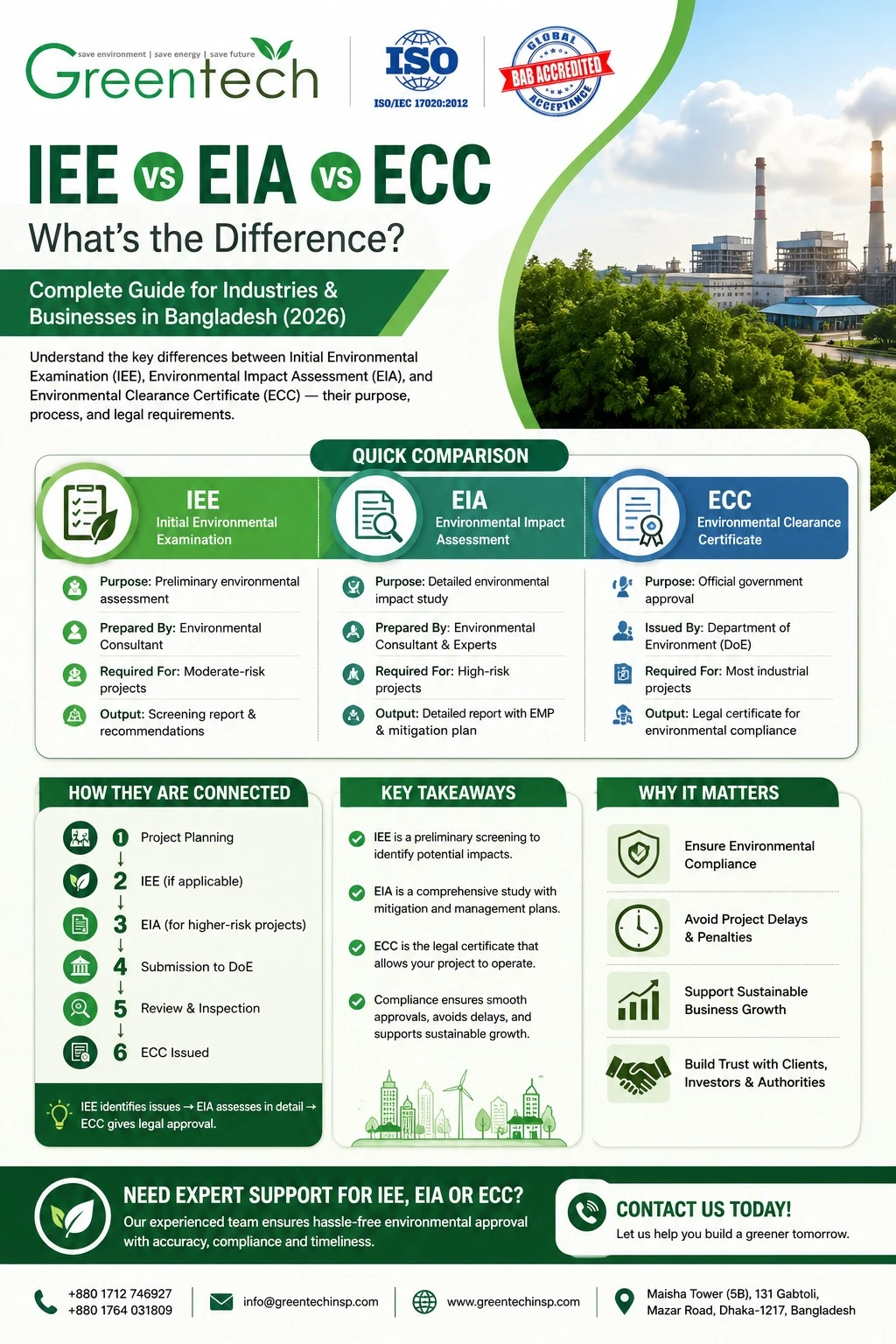
Complete Guide for Industries & Businesses in Bangladesh (2026)
IEE vs EIA vs ECC in Bangladesh | Complete 2026 Guide
Learn the differences between Initial Environmental Examination (IEE), Environmental Impact Assessment (EIA), and Environmental Clearance Certificate (ECC) in Bangladesh, including purpose, process, and legal requirements.
Introduction
Many business owners and project developers in Bangladesh often confuse IEE (Initial Environmental Examination), EIA (Environmental Impact Assessment), and ECC (Environmental Clearance Certificate). While these three terms are closely related, they serve different purposes within the environmental approval process.
Understanding the differences is essential for ensuring compliance with the Department of Environment (DoE) and avoiding delays in obtaining environmental approval.
In this guide, we'll explain what each document means, when it is required, and how they fit into the environmental clearance process.
Quick Comparison
| Feature | IEE | EIA | ECC |
|---|---|---|---|
| Full Form | Initial Environmental Examination | Environmental Impact Assessment | Environmental Clearance Certificate |
| Purpose | Preliminary environmental assessment | Detailed environmental study | Official government approval |
| Prepared By | Environmental Consultant | Environmental Consultant | Issued by DoE |
| Issued By | Not issued | Not issued | Department of Environment |
| Required For | Moderate-risk projects | High-risk projects | Most industrial projects |
| Legal Status | Supporting document | Supporting document | Legal operating certificate |
| Validity | Project-specific | Project-specific | 1–5 years depending on category |
What is an Initial Environmental Examination (IEE)?
An Initial Environmental Examination (IEE) is a preliminary environmental study conducted to identify the likely environmental impacts of a proposed project.
It acts as the first screening stage before determining whether a full Environmental Impact Assessment (EIA) is necessary.
The IEE typically evaluates:
Air quality
Water resources
Noise levels
Waste generation
Land use
Ecological impacts
Community concerns
Pollution control measures
Purpose of an IEE
The primary objectives are to:
Identify potential environmental impacts
Recommend mitigation measures
Determine if significant impacts exist
Decide whether a detailed EIA is required
Common Projects Requiring an IEE
Small manufacturing facilities
Commercial buildings
Warehouses
Medium-scale industries
Some infrastructure developments
What is an Environmental Impact Assessment (EIA)?
An Environmental Impact Assessment (EIA) is a comprehensive scientific study that evaluates the potential environmental and social impacts of a proposed development project before implementation.
Compared with an IEE, an EIA is much more detailed and includes extensive field surveys, technical analyses, stakeholder consultations, and mitigation planning.
Typical Contents of an EIA
Project description
Baseline environmental conditions
Air quality assessment
Water quality assessment
Noise analysis
Biodiversity assessment
Traffic impact assessment
Social impact assessment
Risk assessment
Environmental Management Plan (EMP)
Monitoring plan
Emergency response measures
Projects That Usually Require an EIA
Textile dyeing industries
Chemical factories
Tanneries
Power plants
Cement plants
Steel mills
Large industrial parks
Ports and terminals
Major highways
Large housing projects
What is an Environmental Clearance Certificate (ECC)?
An Environmental Clearance Certificate (ECC) is the official approval issued by the Department of Environment (DoE) that allows an eligible project or industry to operate legally from an environmental compliance perspective.
Unlike an IEE or EIA—which are technical studies—the ECC is the legal certificate granted after the DoE reviews the required documentation and confirms compliance with applicable environmental regulations.
An ECC is often required for:
Factory operation
Trade licensing support
Utility connections
Bank financing
Buyer compliance
Environmental inspections
Regulatory audits
How Are IEE, EIA, and ECC Connected?
Think of the process as a sequence:
Project Planning
⬇️
Initial Environmental Examination (IEE) (if applicable)
⬇️
Environmental Impact Assessment (EIA) (for higher-risk projects)
⬇️
Submission to the Department of Environment
⬇️
Review and Inspection
⬇️
Environmental Clearance Certificate (ECC) Issued
In simple terms:
IEE helps identify environmental issues.
EIA provides a detailed assessment and mitigation plan when required.
ECC is the official approval that permits legal operation.
Key Differences
IEE
Purpose: Preliminary environmental screening
Prepared By: Environmental consultants
Output: A report identifying potential impacts and recommending next steps
EIA
Purpose: Comprehensive environmental impact study
Prepared By: Environmental specialists and multidisciplinary experts
Output: A detailed report with technical analyses, mitigation measures, and an Environmental Management Plan (EMP)
ECC
Purpose: Legal environmental approval
Issued By: Department of Environment (DoE)
Output: An official certificate authorizing environmentally compliant operation
Which Projects Need an IEE?
Projects with moderate environmental impacts may require an IEE to determine the level of environmental assessment needed.
Examples include:
Commercial developments
Medium-sized manufacturing facilities
Certain service industries
Light industrial projects
Which Projects Need an EIA?
Projects with significant potential environmental impacts typically require a full EIA.
Examples include:
Power generation plants
Textile dyeing units
Chemical manufacturing facilities
Cement factories
Steel industries
Large infrastructure developments
Which Projects Need an ECC?
Most industrial and commercial projects categorized under Bangladesh's environmental regulations require an ECC before commencing operations.
Examples include:
Garment factories
Textile mills
Food processing plants
Pharmaceutical industries
Hospitals
LPG facilities
Industrial parks
Commercial developments
Manufacturing industries
Why Businesses Often Get Confused
A common misconception is that preparing an IEE or EIA automatically grants approval to operate. In reality:
An IEE is only a screening study.
An EIA is a detailed assessment report.
An ECC is the official authorization issued by the DoE after reviewing the required documentation.
Without a valid ECC, an industry may not meet the environmental approval requirements set by the authorities.
How Greentech Inspection Ltd. Can Help
Greentech Inspection Ltd. provides professional environmental compliance support, including:
Environmental consultancy
IEE preparation
EIA preparation
Environmental Management Plans (EMP)
Environmental monitoring
ECC application assistance
ECC renewal support
Regulatory compliance guidance
Coordination with the Department of Environment
Our experienced team helps businesses navigate the environmental approval process efficiently while maintaining compliance with applicable regulations.
Frequently Asked Questions (FAQs)
Is an IEE mandatory for every project?
No. The requirement depends on the project's environmental category and regulatory obligations.
Is an EIA always required?
No. Only projects with significant potential environmental impacts generally require a full EIA.
Can I apply for an ECC without an IEE or EIA?
It depends on the project's classification. Some lower-risk projects may not require these studies, while higher-risk projects typically do.
How long is an ECC valid?
The validity depends on the environmental category:
Green: 5 years
Yellow: 2 years
Orange: 1 year
Red: 1 year
Final Thoughts
IEE, EIA, and ECC are distinct but interconnected components of Bangladesh's environmental compliance framework. An IEE serves as a preliminary assessment, an EIA provides an in-depth analysis for higher-risk projects, and the ECC is the official certificate issued by the Department of Environment that authorizes compliant operation.
Understanding these differences can help businesses plan projects more effectively, reduce approval delays, and maintain environmental compliance throughout the project lifecycle.
Related Services
Greentech Inspection Ltd. also provides:
SREDA-Certified Energy Auditor Bangladesh
Energy Efficiency Assessment Bangladesh
Green Financing Support Bangladesh
Bangladesh Bank Green Financing Support
GTF Documentation Support Bangladesh
TDF Documentation Support Bangladesh
LTFF Documentation Support Bangladesh
IDCOL Energy Efficiency Support Bangladesh
BIFFL Energy Efficiency Support Bangladesh
Higg Index Energy Support Bangladesh
ESG Consultancy Support Bangladesh
Environmental Consultant Bangladesh
Environmental Monitoring Bangladesh
Environmental Testing Bangladesh
Environmental Inspection Bangladesh
Environmental Consultant Bangladesh
EIA Consultant Bangladesh
ESIA Consultant Bangladesh
IEE Consultant Bangladesh
Environmental Management Plan Bangladesh
Environmental Monitoring Bangladesh
Environmental Inspection Bangladesh
Environmental Testing Bangladesh
Ambient Air Monitoring Bangladesh
Stack Emission Monitoring Bangladesh
Noise Level Assessment Bangladesh
Light Level Assessment Bangladesh
Water Quality Testing Bangladesh
Indoor Air Quality Monitoring Bangladesh
Industrial Hygiene Assessment Bangladesh
Energy Audit Bangladesh
ESG Consultancy Support Bangladesh
Traffic Impact Assessment Bangladesh
Industrial Hygiene Assessment Bangladesh
Energy Audit Bangladesh
ESG Consultancy Support Bangladesh
Traffic Impact Assessment (TIA) Bangladesh
DoE Consultancy
Environmental Management Plan Bangladesh
Industrial Hygiene Assessment Bangladesh
Environmental Management Plan Bangladesh
Address:
Maisha Tower, 5B, 131 Gabtoli, Mazar Road, Mirpur, Dhaka-1216, Bangladesh.
Call / WhatsApp: +8801712-746927, | +8801764-031809
Email: [email protected] | [email protected]
Website: www.greentechinsp.com
👉Fast | Accurate | Authority-Approved | Submission Ready | 12+ Years of Experience | 50+ TIA Projects Completed | 650+ EIA Projects Completed | 500+ EMP Projects Completed | 100+ Energy Audit | 20+ ESG Projects Completed | 40+ ESIA Projects Completed | 40+ Industrial Hygiene Assessment | 1000+ Customer | BAB Accredited | ISO/IEC 17020:2012 Certified |