Environmental Clearance Certificate (ECC) Renewal in Bangladesh: Complete 2026 Step-by-Step Guide
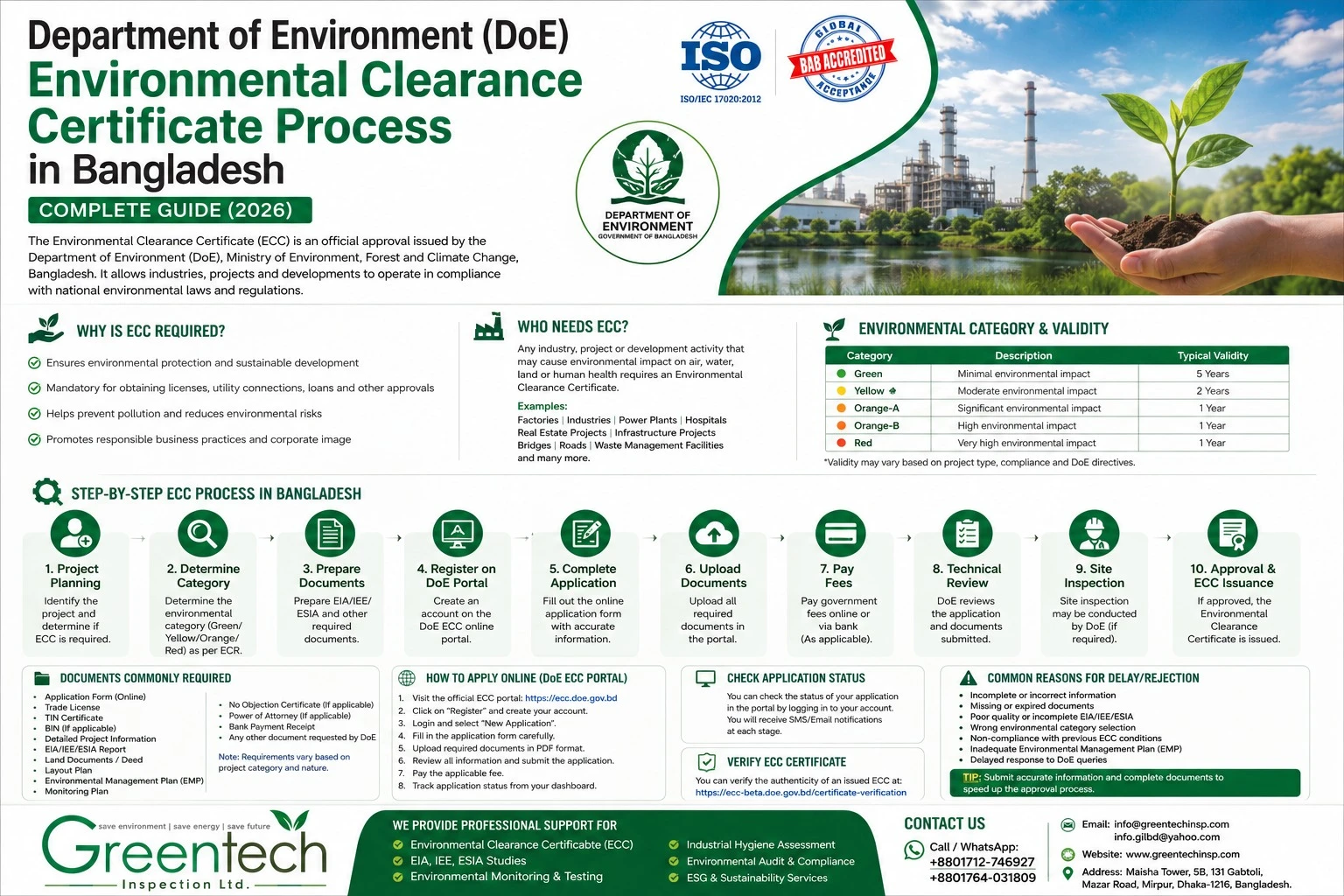
Environmental Clearance Certificate Renewal Bangladesh | 2026 Complete Guide.
Learn the complete Environmental Clearance Certificate (ECC) renewal process in Bangladesh. Find required documents, validity periods, application steps, fees, common mistakes, and expert tips to ensure timely renewal.
Environmental Clearance Certificate Renewal in Bangladesh
Complete 2026 Guide for Industries, Businesses & Project Owners
Environmental compliance has become one of the most critical legal obligations for industries, factories, commercial establishments, infrastructure projects, and manufacturing facilities operating in Bangladesh. Among all environmental permits issued by the Department of Environment (DoE), the Environmental Clearance Certificate (ECC) is one of the most important.
Holding a valid ECC is not only a legal requirement under Bangladesh's environmental laws but also demonstrates an organization's commitment to sustainable operations and responsible environmental management. Without a valid Environmental Clearance Certificate, many industrial facilities may face regulatory action, including delays in business operations, suspension of activities, financial penalties, or complications during inspections and audits.
Obtaining an ECC is only the first step. Every organization must ensure that the certificate remains valid by completing the renewal process before its expiration date. Unfortunately, many businesses delay renewal until the last moment, resulting in unnecessary complications, rejected applications, or operational disruptions.
This comprehensive guide explains everything you need to know about Environmental Clearance Certificate Renewal in Bangladesh, including legal requirements, validity periods, required documents, renewal procedures, common mistakes, practical compliance tips, and expert recommendations.
Whether you operate a textile factory, garment manufacturing unit, pharmaceutical company, food processing plant, steel mill, hospital, real estate development project, power plant, or any other industrial establishment, this guide will help you understand the complete renewal process.
What Is an Environmental Clearance Certificate (ECC)?
An Environmental Clearance Certificate (ECC) is an official approval issued by the Department of Environment (DoE) under the Ministry of Environment, Forest and Climate Change (MoEFCC), Government of Bangladesh.
The certificate confirms that a project or industrial facility has fulfilled the environmental requirements specified under the applicable environmental laws and regulations. It demonstrates that the proposed or existing activities have been assessed for their environmental impacts and that suitable mitigation measures are in place to minimize pollution and protect public health and the environment.
Depending on the nature, scale, and environmental risk of a project, obtaining an ECC may require supporting studies such as:
Initial Environmental Examination (IEE)
Environmental Impact Assessment (EIA)
Environmental Management Plan (EMP)
Environmental Monitoring Plan (EMoP)
Pollution Control Measures
Waste Management Plan
Occupational Health & Safety Considerations
The exact documentation required varies according to the project's environmental category and the applicable legal framework.
Why Is ECC Renewal Important?
Many business owners mistakenly assume that obtaining an Environmental Clearance Certificate is a one-time requirement. In reality, the certificate is valid only for a specified period and must be renewed before it expires.
Timely renewal helps organizations:
Maintain uninterrupted legal compliance.
Avoid delays in industrial operations.
Reduce the risk of enforcement actions.
Demonstrate commitment to environmental responsibility.
Support successful government inspections.
Facilitate participation in international supply chains.
Meet buyer and investor expectations regarding environmental compliance.
A valid ECC is also commonly required during applications for financing, industrial licensing, export compliance, environmental audits, and sustainability assessments.
Legal Framework Governing ECC Renewal in Bangladesh
Environmental Clearance Certificate renewal is governed by several key environmental laws and regulations in Bangladesh, including:
Bangladesh Environment Conservation Act, 1995 (as amended)
Environment Conservation Rules
Relevant notifications issued by the Department of Environment
Applicable guidelines published by the Ministry of Environment, Forest and Climate Change
The Department of Environment is the competent authority responsible for reviewing applications, verifying compliance, conducting inspections when necessary, and issuing renewed certificates.
Businesses should regularly monitor regulatory updates because environmental requirements may evolve through amendments, circulars, or revised guidelines.
Which Businesses Require ECC Renewal?
Environmental Clearance Certificate renewal applies to a wide range of sectors, including but not limited to:
Manufacturing Industries
Textile Mills
Garment Factories
Dyeing Industries
Washing Plants
Spinning Mills
Knitting Factories
Heavy Industries
Steel Mills
Cement Plants
Shipyards
Chemical Industries
Glass Manufacturing
Ceramic Industries
Food & Beverage
Beverage Plants
Food Processing Industries
Dairy Processing Facilities
Cold Storage Facilities
Healthcare
Hospitals
Diagnostic Centers
Medical Waste Treatment Facilities
Infrastructure Projects
Housing Projects
Commercial Buildings
Industrial Parks
Roads
Bridges
Power Plants
Energy Sector
Power Generation Facilities
LPG Plants
Fuel Storage Facilities
Renewable Energy Projects
Many service industries may also require environmental clearance depending on the scale and nature of their operations.
Environmental Categories in Bangladesh
The Department of Environment classifies projects into different environmental categories based on their potential environmental impacts.
The classification determines the level of environmental assessment required and influences the renewal process.
The principal categories include:
Green Category
Projects with minimal environmental impact.
Examples include:
Small offices
Educational institutions
Certain commercial facilities
Yellow Category
Projects with relatively low environmental impacts that require limited environmental control measures.
Orange Category
Projects with moderate environmental impacts requiring more comprehensive environmental documentation and monitoring.
Red Category
Projects with significant environmental impacts that generally require detailed environmental studies, including Environmental Impact Assessment (EIA), Environmental Management Plan (EMP), and ongoing monitoring.
Examples include:
Textile dyeing
Chemical manufacturing
Tanneries
Large industrial plants
Steel manufacturing
Power plants
The environmental category assigned to a project determines the documentation required during both initial application and renewal.
ECC Validity Period in Bangladesh
One of the most frequently asked questions concerns the validity period of an Environmental Clearance Certificate.
Under the current regulatory framework, the validity period depends on the environmental category:
| Environmental Category | Validity Period |
|---|---|
| Green | 5 Years |
| Yellow | 2 Years |
| Orange | 1 Year |
| Red | 1 Year |
Because Orange and Red category industries have shorter validity periods, they should maintain a compliance calendar and begin preparing renewal documents well before the expiry date. Current DoE guidance also recommends submitting renewal applications at least 30 days before the certificate expires, helping reduce the risk of lapses in approval.
When Should You Apply for ECC Renewal?
Waiting until the last week before the certificate expires is one of the most common mistakes businesses make.
Preparing a complete renewal application often involves gathering environmental monitoring reports, updating compliance records, obtaining supporting documents, and verifying operational information. These activities take time.
As a best practice, organizations should begin internal preparation 60–90 days before expiry and submit the renewal application at least 30 days before the certificate expires, in line with DoE guidance.
Starting early provides sufficient time to address document deficiencies, respond to queries from the Department of Environment, and avoid interruptions to business operations.
Related Services
Greentech Inspection Ltd. also provides:
SREDA-Certified Energy Auditor Bangladesh
Energy Efficiency Assessment Bangladesh
Green Financing Support Bangladesh
Bangladesh Bank Green Financing Support
GTF Documentation Support Bangladesh
TDF Documentation Support Bangladesh
LTFF Documentation Support Bangladesh
IDCOL Energy Efficiency Support Bangladesh
BIFFL Energy Efficiency Support Bangladesh
Higg Index Energy Support Bangladesh
ESG Consultancy Support Bangladesh
Environmental Consultant Bangladesh
Environmental Monitoring Bangladesh
Environmental Testing Bangladesh
Environmental Inspection Bangladesh
Environmental Consultant Bangladesh
EIA Consultant Bangladesh
ESIA Consultant Bangladesh
IEE Consultant Bangladesh
Environmental Management Plan Bangladesh
Environmental Monitoring Bangladesh
Environmental Inspection Bangladesh
Environmental Testing Bangladesh
Ambient Air Monitoring Bangladesh
Stack Emission Monitoring Bangladesh
Noise Level Assessment Bangladesh
Light Level Assessment Bangladesh
Water Quality Testing Bangladesh
Indoor Air Quality Monitoring Bangladesh
Industrial Hygiene Assessment Bangladesh
Energy Audit Bangladesh
ESG Consultancy Support Bangladesh
Traffic Impact Assessment Bangladesh
Industrial Hygiene Assessment Bangladesh
Energy Audit Bangladesh
ESG Consultancy Support Bangladesh
Traffic Impact Assessment (TIA) Bangladesh
DoE Consultancy
Environmental Management Plan Bangladesh
Industrial Hygiene Assessment Bangladesh
Environmental Management Plan Bangladesh
Address:
Maisha Tower, 5B, 131 Gabtoli, Mazar Road, Mirpur, Dhaka-1216, Bangladesh.
Call / WhatsApp: +8801712-746927, | +8801764-031809
Email: [email protected] | [email protected]
Website: www.greentechinsp.com
👉Fast | Accurate | Authority-Approved | Submission Ready | 12+ Years of Experience | 50+ TIA Projects Completed | 650+ EIA Projects Completed | 500+ EMP Projects Completed | 100+ Energy Audit | 20+ ESG Projects Completed | 40+ ESIA Projects Completed | 40+ Industrial Hygiene Assessment | 1000+ Customer | BAB Accredited | ISO/IEC 17020:2012 Certified |