Factory Environmental Compliance Checklist in Bangladesh: A Complete Guide for Factory Owners
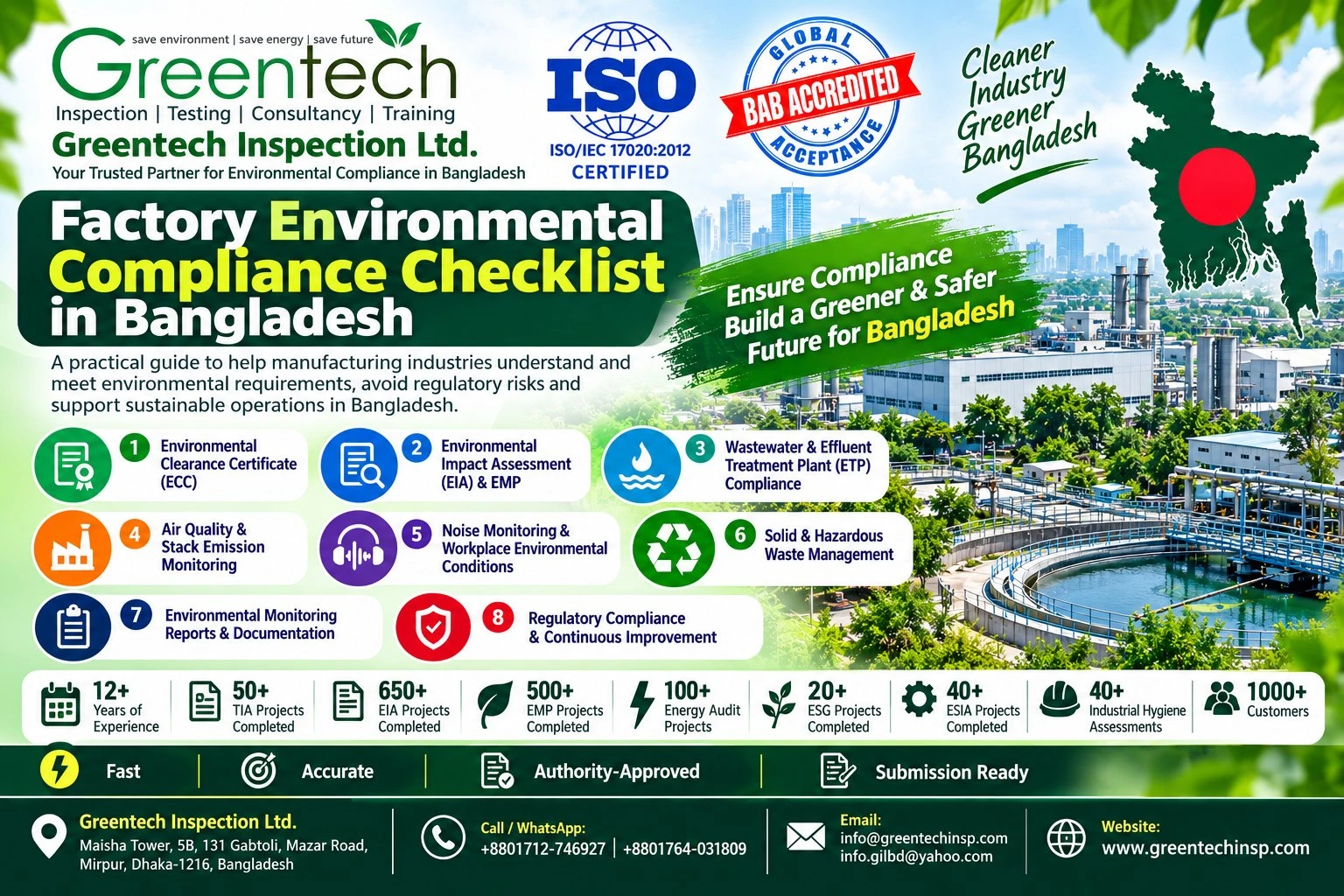
Factory Environmental Compliance Checklist in Bangladesh| Greentech Inspection Ltd.
Environmental compliance is an essential responsibility for manufacturing businesses in Bangladesh. Whether operating a textile factory, garment manufacturing facility, dyeing unit, food processing plant, or chemical manufacturing facility, businesses must understand and meet the environmental requirements applicable to their operations.
Failing to maintain environmental compliance can lead to regulatory penalties, operational disruptions, environmental damage, and difficulties meeting international buyers' requirements.
This guide provides a practical factory environmental compliance checklist in Bangladesh, covering environmental clearance, wastewater management, air emissions, workplace environmental monitoring, waste management, and documentation.
1. Environmental Clearance Certificate (ECC)
An Environmental Clearance Certificate (ECC) is one of the key regulatory requirements for industrial establishments in Bangladesh.
Factories should verify their applicable environmental classification and clearance obligations under the Bangladesh Environment Conservation Act, 1995, and the Environment Conservation Rules, 2023.
Factory compliance checklist:
Confirm the factory's environmental category.
Verify whether the required environmental clearance has been obtained.
Check the certificate's validity and renewal requirements.
Ensure the approved activities match actual factory operations.
Maintain copies of clearance certificates and supporting documents.
Review whether expansion or changes in production require additional environmental approval.
Factories should not assume that one clearance certificate automatically covers every new production line, expansion, or operational change.
2. Environmental Impact Assessment (EIA) and Environmental Management Plan (EMP)
Depending on the factory's environmental category and activities, an Environmental Impact Assessment (EIA), Initial Environmental Examination (IEE), or Environmental Management Plan (EMP) may be required.
Under the Environment Conservation Rules, 2023, industrial projects are classified as Green, Yellow, Orange, or Red according to their environmental impacts.
UNEP Law and Environment Assistance Platform
+1
Factory compliance checklist:
Determine whether an EIA, IEE, or EMP is required.
Verify applicable approvals and Terms of Reference.
Identify significant environmental risks.
Establish mitigation and monitoring measures.
Review implementation of the approved environmental management plan.
3. Wastewater and Effluent Treatment Plant (ETP) Compliance
Factories generating industrial wastewater should evaluate their wastewater treatment and discharge obligations.
Textile dyeing, washing, food processing, and chemical manufacturing operations may require wastewater treatment facilities and regular effluent monitoring.
Factory compliance checklist:
Verify whether an ETP or STP is required.
Check treatment plant operating conditions.
Conduct wastewater testing at appropriate sampling points.
Monitor relevant parameters such as pH, BOD, COD, TSS, and oil and grease.
Maintain treatment plant operational records.
Investigate abnormal laboratory results.
Verify compliance with applicable discharge limits.
Testing parameters and permissible limits must be determined according to the factory's activities, clearance conditions, and current regulatory requirements.
4. Air Quality and Stack Emission Monitoring
Industrial operations involving boilers, generators, furnaces, or other combustion equipment can release air pollutants.
Regular monitoring helps factories understand their emissions and evaluate compliance with applicable standards.
Factory compliance checklist:
Identify significant emission sources.
Assess applicable stack emission testing requirements.
Monitor relevant pollutants where required.
Check boiler and generator maintenance records.
Evaluate dust collection and air pollution control equipment.
Maintain air monitoring reports.
5. Noise Monitoring and Workplace Environmental Conditions
Excessive industrial noise can affect employees and surrounding communities.
Factories should assess environmental noise and workplace exposure risks, taking account of applicable regulatory and occupational safety requirements.
Factory compliance checklist:
Identify high-noise production areas.
Conduct noise assessments where applicable.
Evaluate ventilation and indoor environmental conditions.
Assess workplace dust, fumes, or chemical exposure risks.
Implement corrective measures when required.
Maintain monitoring and assessment reports.
Environmental noise compliance and occupational noise exposure are different assessments and may involve different standards.
6. Solid and Hazardous Waste Management
Manufacturing operations may generate scrap materials, packaging waste, sludge, chemical containers, used oil, and other potentially hazardous waste.
Factories should identify and manage waste according to its characteristics and applicable legal requirements.
Factory compliance checklist:
Identify major waste streams.
Segregate waste according to type and hazard.
Provide appropriate storage arrangements.
Label hazardous materials and waste containers.
Maintain waste disposal and transfer records.
Review disposal contractor arrangements.
Train responsible personnel in waste handling.
7. Environmental Monitoring Reports and Documentation
Environmental compliance involves more than obtaining approvals. Factories also need to demonstrate that their environmental management practices are being implemented.
A centralized environmental compliance file can simplify internal reviews, regulatory inspections, and buyer assessments.
Recommended documents to maintain:
| Document | What to verify |
|---|---|
| Environmental Clearance Certificate | Validity and conditions |
| EIA / IEE / EMP | Approval and implementation status |
| Wastewater testing reports | Applicable discharge parameters |
| Air emission reports | Relevant emission sources |
| Noise monitoring reports | Environmental and workplace conditions |
| ETP / STP operational logs | Treatment performance |
| Waste management records | Storage and disposal arrangements |
| Environmental inspection reports | Findings and corrective actions |
The required documentation and testing frequency vary by industry, environmental classification, approval conditions, and applicable regulations.
8. Common Environmental Compliance Mistakes
Factories may encounter environmental compliance problems when documentation and actual operational practices are not aligned.
Common issues include expired clearances, incomplete monitoring records, poor ETP maintenance, inadequate waste segregation, unaddressed inspection findings, and failure to review environmental requirements after production expansion.
A practical way to reduce these risks is to assign clear responsibilities, maintain a compliance calendar, conduct periodic internal assessments, and close corrective actions with supporting evidence.
9. How Greentech Inspection Ltd. Can Help
Environmental compliance can involve technical assessments, regulatory documentation, laboratory testing, and continuous monitoring.
Greentech Inspection Ltd. provides environmental inspection, testing, and consultancy services to support industrial facilities in understanding and managing their environmental responsibilities.
Depending on project requirements, relevant support may include environmental assessment, monitoring, industrial hygiene evaluation, and compliance consultancy.
Working with experienced environmental professionals can help factories identify potential gaps, organize necessary documentation, and prepare appropriate corrective action plans.
Conclusion
Maintaining environmental compliance in Bangladesh requires an ongoing approach rather than a one-time inspection.
Factory owners and management teams should regularly review environmental approvals, wastewater treatment, emissions, noise, waste handling, and monitoring records.
By identifying environmental risks early and maintaining effective compliance procedures, industrial facilities can improve operational performance and reduce avoidable regulatory and environmental risks.
Greentech Inspection Ltd also provides:
SREDA-Certified Energy Auditor Bangladesh
Energy Efficiency Assessment Bangladesh
Green Financing Support Bangladesh
Bangladesh Bank Green Financing Support
GTF Documentation Support Bangladesh
TDF Documentation Support Bangladesh
LTFF Documentation Support Bangladesh
IDCOL Energy Efficiency Support Bangladesh
BIFFL Energy Efficiency Support Bangladesh
Higg Index Energy Support Bangladesh
ESG Consultancy Support Bangladesh
Environmental Consultant Bangladesh
Environmental Monitoring Bangladesh
Environmental Testing Bangladesh
Environmental Inspection Bangladesh
Environmental Consultant Bangladesh
EIA Consultant Bangladesh
ESIA Consultant Bangladesh
IEE Consultant Bangladesh
Environmental Management Plan Bangladesh
Environmental Monitoring Bangladesh
Environmental Inspection Bangladesh
Environmental Testing Bangladesh
Ambient Air Monitoring Bangladesh
Stack Emission Monitoring Bangladesh
Noise Level Assessment Bangladesh
Light Level Assessment Bangladesh
Water Quality Testing Bangladesh
Indoor Air Quality Monitoring Bangladesh
Industrial Hygiene Assessment Bangladesh
Energy Audit Bangladesh
ESG Consultancy Support Bangladesh
Traffic Impact Assessment Bangladesh
Industrial Hygiene Assessment Bangladesh
Energy Audit Bangladesh
ESG Consultancy Support Bangladesh
Traffic Impact Assessment (TIA) Bangladesh
DoE Consultancy
Environmental Management Plan Bangladesh
Industrial Hygiene Assessment Bangladesh
Environmental Management Plan Bangladesh
Greentech Inspection Ltd
Address: Maisha Tower, 5B, 131 Gabtoli, Mazar Road, Mirpur, Dhaka-1216, Bangladesh
Call / WhatsApp: +8801712-746927 | +8801764-031809
Email: [email protected] | [email protected]
Website: www.greentechinsp.com
👉Fast | Accurate | Authority-Approved | Submission Ready | 12+ Years of Experience | 50+ TIA Projects Completed | 650+ EIA Projects Completed | 500+ EMP Projects Completed | 100+ Energy Audit | 20+ ESG Projects Completed | 40+ ESIA Projects Completed | 40+ Industrial Hygiene Assessment | 1000+ Customer | BAB Accredited | ISO/IEC 17020:2012 Certified |