Traffic Impact Assessment (TIA) in Bangladesh
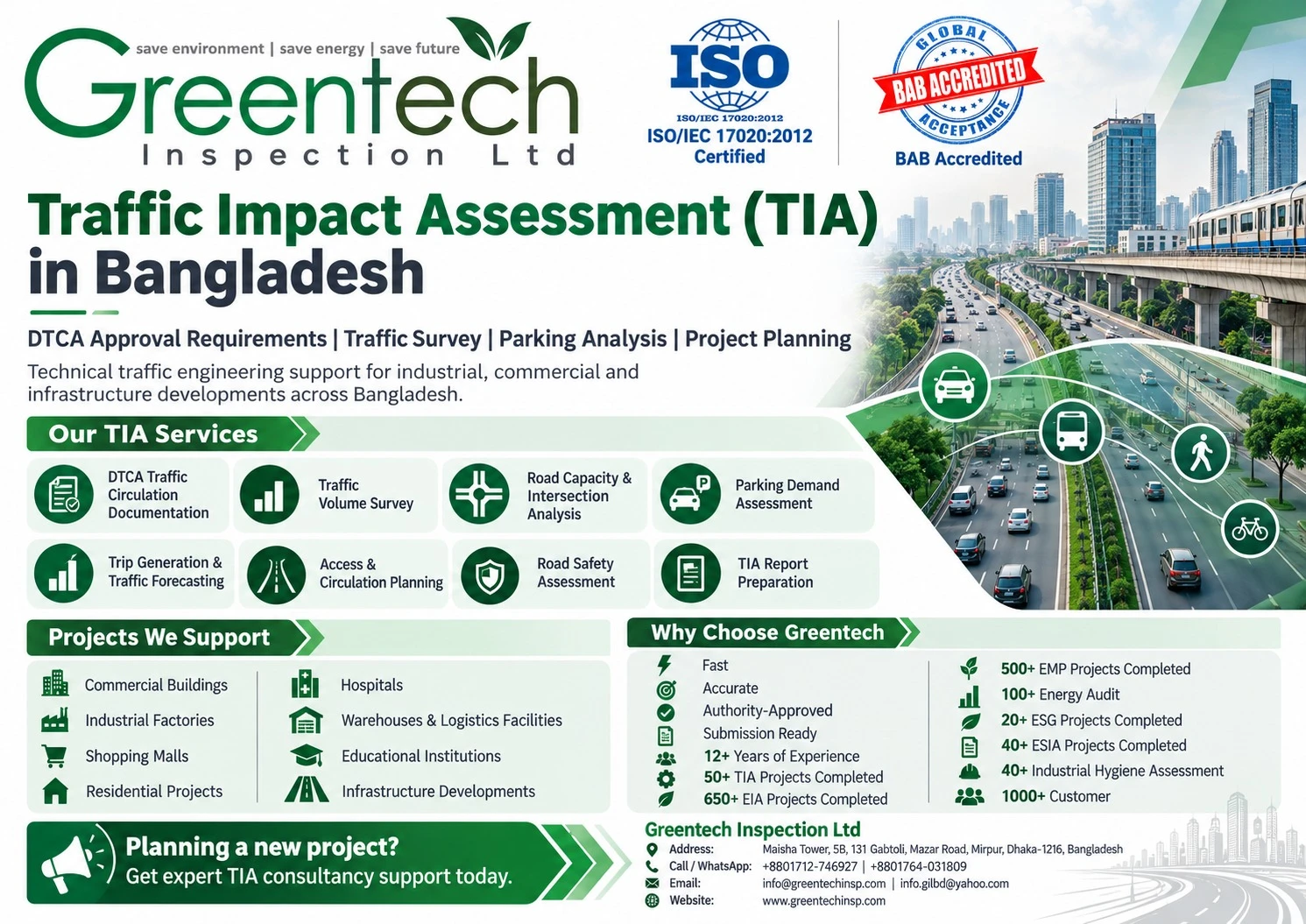
Traffic Impact Assessment (TIA) in Bangladesh: DTCA Approval Requirements, Traffic Survey, Parking Analysis & Project Planning
Introduction
Rapid urbanization, industrial expansion and growing transportation demand are creating significant traffic management challenges in Bangladesh. Major cities such as Dhaka, Gazipur, Narayanganj and Chattogram experience increasing pressure on roads, intersections, parking facilities and public transportation infrastructure.
New commercial buildings, industrial factories, shopping malls, hospitals, educational institutions, residential developments and logistics facilities can generate additional vehicle movements that affect surrounding communities and transport networks.
To understand and manage these impacts, project developers increasingly rely on Traffic Impact Assessment (TIA).
A Traffic Impact Assessment is a technical transportation engineering study that evaluates the potential effects of a proposed development on existing and future traffic conditions.
A properly prepared TIA report helps identify road congestion risks, estimate project-generated traffic, assess parking requirements, evaluate road safety and recommend appropriate traffic management measures.
In Bangladesh, TIA studies can also form part of the documentation needed for certain development and traffic circulation approvals.
This guide from Greentech Inspection Ltd explains Traffic Impact Assessment in Bangladesh, including DTCA requirements, traffic survey methods, parking demand calculations, road capacity analysis, reporting procedures and practical recommendations for industrial and commercial developments.
1. What Is Traffic Impact Assessment (TIA)?
Traffic Impact Assessment (TIA) is a systematic engineering study used to evaluate how a new development, expansion or change in land use may affect surrounding transportation infrastructure.
It considers both existing traffic conditions and additional traffic expected to be generated by the proposed development.
A comprehensive TIA generally evaluates:
Existing traffic volume and road conditions
Road network capacity
Intersection performance
Project-generated vehicle trips
Peak-hour traffic demand
Parking requirements
Entry and exit arrangements
Pedestrian and cyclist safety
Public transport access
Loading and unloading operations
Heavy vehicle circulation
Emergency vehicle accessibility
Future traffic conditions
Traffic mitigation measures
The primary objective of TIA is to determine whether a proposed development can operate safely and efficiently within the surrounding transportation network and identify improvements where necessary.
2. Why Traffic Impact Assessment Is Important in Bangladesh
Bangladesh's growing industrial and urban development creates significant pressure on transportation infrastructure.
Many development projects are located near already congested roads, busy intersections, industrial corridors or densely populated communities.
Without proper traffic planning, additional vehicle movements can increase congestion, create safety hazards and affect business operations.
Managing Traffic Congestion
TIA helps identify whether project-generated traffic may exceed the practical capacity of nearby roads and intersections.
Improving Road Safety
Traffic studies identify potential conflicts between private vehicles, trucks, buses, pedestrians, cyclists and other road users.
Supporting Project Planning
Traffic findings can influence building access arrangements, internal roads, parking facilities and loading areas before construction.
Improving Industrial Logistics
Manufacturing facilities depend on reliable transportation for raw materials, employee movement and product deliveries.
Supporting Regulatory Documentation
Certain development applications in Greater Dhaka require traffic circulation documentation and a TIA report under the applicable DTCA procedures.
Reducing Community Impacts
Effective traffic planning can help reduce roadside parking, obstruction, excessive vehicle queues and unsafe pedestrian movements near proposed developments.
3. TIA Requirements and Regulatory Authorities in Bangladesh
Traffic Impact Assessment requirements depend on the project type, location, proposed land use and applicable planning or transportation approvals.
Dhaka Transport Coordination Authority (DTCA)
The Dhaka Transport Coordination Authority plays a central role in coordinating urban transportation planning within its jurisdiction.
Under the applicable framework, DTCA handles traffic circulation-related clearance processes for certain multistorey buildings and housing developments in Greater Dhaka.
Its published service charter identifies a Traffic Impact Assessment report among the supporting documents for relevant applications.
The DTCA traffic circulation system is available online:
Rajdhani Unnayan Kartripakkha (RAJUK)
RAJUK is responsible for relevant urban planning and development control functions within its jurisdiction.
Where a project requires RAJUK development permission and DTCA traffic circulation clearance, the developer should coordinate the respective documentation and approval processes.
A RAJUK building approval and a DTCA traffic circulation clearance should not automatically be treated as the same approval.
Other Relevant Authorities
Depending on the location and nature of the project, other applicable bodies may include:
City corporations
Local development authorities
Roads and Highways Department (RHD)
Local government engineering authorities
Road-owning or infrastructure management agencies
Other authorities responsible for the relevant development
Important: A TIA is not universally mandatory for every factory or building in Bangladesh. The applicable obligation should be confirmed with the responsible authority using the current project-specific requirements.
4. Which Projects May Need a Traffic Impact Assessment?
TIA studies are especially useful for developments expected to generate substantial traffic or significantly alter existing transport conditions.
Commercial Buildings and Office Complexes
Large commercial developments can create significant peak-hour vehicle demand from employees, visitors, customers and service vehicles.
Shopping Malls and Retail Developments
Shopping malls may generate concentrated traffic during evenings, weekends, festivals and holiday periods.
Industrial Factories
Manufacturing facilities can generate traffic associated with employees, delivery vehicles, heavy trucks, raw materials and finished goods.
Residential and Mixed-Use Developments
High-rise residential projects and mixed-use complexes can increase local vehicle movements and parking demand.
Hospitals and Healthcare Facilities
Hospitals require safe ambulance access, patient drop-off areas, visitor parking and reliable emergency circulation.
Educational Institutions
Universities, schools and colleges can generate significant traffic during opening and closing hours.
Warehouses and Logistics Facilities
Warehouses, distribution centers, inland container facilities and industrial logistics hubs require careful heavy-vehicle access planning.
Economic Zones and Industrial Parks
Large industrial developments can significantly influence regional transport demand, freight movements and road infrastructure requirements.
5. Step-by-Step Traffic Impact Assessment Process
A professional TIA follows a structured engineering methodology.
Step 1: Project Information Collection
The first stage involves reviewing the proposed development's characteristics.
Information may include:
Project location
Land use
Site area
Total floor area
Number of floors
Proposed operational activities
Employee population
Expected visitors
Parking arrangements
Vehicle access locations
Estimated heavy vehicle movements
Step 2: Site Inspection and Road Network Review
Traffic engineers conduct a field inspection to assess surrounding transportation conditions.
Key observations include road width, intersection geometry, pavement conditions, access restrictions, pedestrian facilities and existing congestion.
Step 3: Traffic Survey and Data Collection
Traffic counts are conducted at relevant roads and intersections.
Survey duration and coverage should reflect the project type, observed traffic patterns and the applicable study requirements.
Step 4: Existing Traffic Condition Analysis
The collected data is used to evaluate existing traffic demand, intersection performance, capacity limitations and road safety concerns.
Step 5: Trip Generation Estimation
Traffic engineers estimate the additional vehicle trips associated with the proposed development.
Trip generation should be based on appropriate local data, comparable developments or justified engineering methods.
Step 6: Future Traffic Forecasting
The study develops future traffic scenarios by combining projected background traffic with estimated project-generated trips.
Step 7: Traffic Impact Evaluation
Existing and future conditions are compared to identify potential congestion, queueing, access and safety impacts.
Step 8: Mitigation Planning
Engineering recommendations are developed to address significant traffic impacts.
Step 9: Traffic Impact Assessment Report Preparation
The findings are compiled into a technical report supported by traffic survey data, calculations, maps, diagrams and recommendations.
6. Traffic Volume Survey in Bangladesh
Traffic volume surveys form the foundation of most Traffic Impact Assessments.
A traffic survey measures the number and types of vehicles using a road or intersection during a defined observation period.
Common Traffic Survey Methods
Classified Traffic Count: Records vehicles by category, such as passenger cars, buses, trucks, motorcycles, rickshaws and other relevant road users.
Turning Movement Count: Measures the number of vehicles turning left, going straight or turning right at an intersection.
Peak-Hour Traffic Survey: Identifies periods when traffic demand is highest.
Queue Length Survey: Records vehicle queue lengths at intersections or access points.
Pedestrian Survey: Measures pedestrian movements and identifies crossing requirements.
Parking Survey: Evaluates parking occupancy, turnover, duration and demand.
Travel Time and Delay Survey: Helps measure congestion and operational performance on relevant roads.
Survey methods should reflect local traffic characteristics. Bangladesh's heterogeneous traffic conditions may require additional attention to mixed motorized and non-motorized movements.
7. Peak Hour Traffic Analysis
Peak-hour analysis is particularly important because road congestion often occurs during a relatively short period of high transportation demand.
Common peak periods include:
Morning office and school arrival periods
Evening office departure periods
Factory shift changes
Retail shopping peaks
Freight dispatch periods
The appropriate peak hours should be determined from actual survey observations and the proposed development's operating characteristics.
Peak Hour Factor (PHF)
The Peak Hour Factor helps describe how traffic volume varies within the peak hour.
For four 15-minute intervals, a commonly used expression is:
PHF = Hourly Traffic Volume ÷ (4 × Highest 15-Minute Volume)
For example, assume a surveyed road carries 1,200 vehicles during an hour, with the highest 15-minute interval recording 360 vehicles.
PHF = 1,200 ÷ (4 × 360)
PHF = 0.833
This illustrative calculation indicates that the traffic demand is concentrated unevenly within the hour.
Actual analysis should apply the appropriate traffic engineering methodology and vehicle classification treatment.
8. Trip Generation Analysis for Development Projects
Trip generation analysis estimates how many new vehicle movements a project is expected to produce.
Traffic generation depends on several factors, including:
Land use
Development size
Employment
Visitors and customers
Operational hours
Transport accessibility
Vehicle ownership
Freight activities
Travel mode choices
Example: Commercial Development
Consider a proposed commercial project with an assumed peak-hour trip generation rate of 8 vehicle trips per 100 square metres of relevant floor area.
If the relevant floor area is 5,000 square metres:
Trip Generation = (5,000 ÷ 100) × 8
Estimated Peak-Hour Trips = 400 vehicle trips
This is a hypothetical example illustrating the calculation only.
The assumed rate is not an official Bangladesh or DTCA trip-generation standard. An actual TIA should use justified rates supported by appropriate observations or accepted references.
Additional analysis may be necessary to distribute these trips across approach roads and determine entering and exiting movements.
9. Parking Demand Assessment
Parking demand assessment evaluates whether a development provides sufficient and appropriately designed parking facilities.
Inadequate parking can contribute to roadside congestion, unauthorized parking and vehicle conflicts.
A parking study may examine:
Car parking
Motorcycle parking
Truck parking
Visitor parking
Employee parking
Accessible parking
Loading and unloading bays
Pick-up and drop-off areas
Parking access and circulation
Example: Parking Demand Calculation
Suppose a development is expected to generate a peak parking demand of 180 vehicles.
If the proposed design provides 150 suitable spaces:
Parking Deficit = 180 − 150
Estimated Parking Deficit = 30 spaces
The actual assessment should also consider parking turnover, shared parking opportunities, mode share, local regulations and operational arrangements.
Providing additional parking is not always the only or preferred solution. Demand management, transport access and improved circulation may also be evaluated.
10. Road Capacity and Intersection Performance Assessment
Road capacity analysis determines how well existing and proposed transportation infrastructure can accommodate traffic demand.
A comprehensive assessment may include:
Traffic volume-to-capacity relationships
Intersection delay
Vehicle queue lengths
Traffic signal operation
Road geometry
Lane configurations
Turning movements
Pedestrian conflicts
Heavy vehicle maneuverability
Volume-to-Capacity Ratio
A simplified measure is:
V/C Ratio = Traffic Volume ÷ Road Capacity
For illustration, assume traffic demand is 1,500 equivalent vehicles per hour and the estimated capacity is 1,800 equivalent vehicles per hour.
V/C = 1,500 ÷ 1,800
V/C = 0.83
This means estimated traffic demand represents approximately 83% of the assumed capacity.
The result alone does not establish an official level of service or regulatory compliance. Detailed analysis must consider appropriate capacity methods, intersection controls and heterogeneous traffic conditions.
11. Access and Traffic Circulation Assessment
Proper access planning is essential for safe and efficient site operation.
Poorly located entrances and exits can create significant congestion even when the surrounding road network has adequate capacity.
A TIA may evaluate:
Entry and exit locations
Driveway width and geometry
Vehicle turning radius
Pedestrian conflict points
Internal road layout
Ramp circulation
Truck movement
Emergency vehicle access
On-site queue storage
Loading and unloading arrangements
For industrial developments, separate truck and employee access routes may be considered where operationally appropriate.
For hospitals, emergency access and patient drop-off arrangements require particular attention.
12. Road Safety Assessment
A Traffic Impact Assessment should address road safety alongside traffic capacity.
Important considerations include:
Pedestrian Safety: Safe crossings, continuous walkways, pedestrian visibility and reduced vehicle conflicts.
Heavy Vehicle Safety: Appropriate maneuvering areas, safe turning movements and access separation.
Intersection Safety: Visibility, conflict points, turning arrangements and suitable traffic-control measures.
School and Hospital Access: Safe pick-up, drop-off and vulnerable road-user movements.
Emergency Access: Reliable access for fire services, ambulances and emergency response vehicles.
Where relevant, a separate Road Safety Audit may also be recommended.
13. Traffic Management and Mitigation Measures
When a TIA identifies potential transport impacts, the report should recommend measures proportionate to those impacts.
Possible mitigation strategies include:
Improving site entry and exit design
Adjusting access locations
Improving internal traffic circulation
Providing suitable loading and unloading space
Developing truck movement schedules
Improving pedestrian access
Managing parking demand
Providing appropriate traffic signage
Improving intersection geometry
Evaluating signal timing changes
Developing employee transport arrangements
Managing construction-stage traffic
Changes to public roads, intersections or traffic signals require coordination with the responsible authorities.
Recommendations should be technically justified and feasible within the applicable project constraints.
14. Documents Commonly Needed for TIA Preparation
Project developers can reduce preparation difficulties by organizing necessary technical information before commissioning a TIA.
A typical project information package may include:
| Required Information | Purpose |
|---|---|
| Project location map | Identify the surrounding road network |
| Site layout plan | Review access and internal circulation |
| Architectural drawings | Understand development characteristics |
| Land-use information | Support trip generation analysis |
| Floor area and occupancy | Estimate travel demand |
| Parking layout | Assess parking supply |
| Road access drawings | Evaluate entrances and exits |
| Existing traffic data | Establish baseline conditions |
| Employee and visitor estimates | Support travel demand calculations |
| Delivery and truck information | Evaluate freight movements |
| Relevant approval documents | Align the study with applicable requirements |
For DTCA traffic circulation applications, the authority's current checklist and online submission instructions should be followed.
15. DTCA Traffic Circulation Clearance and TIA Submission
For applicable development projects within the DTCA's jurisdiction, traffic circulation approval can be an important part of project planning.
The DTCA's published service information identifies requirements that can include:
Application in the prescribed format
Project layout plan
Site access and exit layout
Traffic Impact Assessment report
Relevant land and project documents
Other documents specified in the current checklist
For certain housing developments, land-use documentation and information related to RAJUK planning may also be relevant.
General Application Preparation Process
Confirm whether the proposed development falls within the relevant DTCA approval requirements.
Review the latest traffic circulation guidelines and application checklist.
Prepare the required site and traffic information.
Conduct the Traffic Impact Assessment.
Finalize traffic circulation and access drawings.
Submit the application through the applicable online procedure.
Address any technical comments or requests for clarification.
Obtain the authority's decision before treating the clearance as approved.
DTCA Online Portal: https://tcc.dtca.gov.bd
Approval timing, documentation and fees should be checked against the latest official instructions. Submission of a TIA report does not guarantee regulatory approval.
16. Common Problems in Traffic Impact Assessment Reports
Poor-quality TIA reports can create design and review difficulties.
Inadequate Traffic Surveys
Surveying the wrong location or an unrepresentative period may produce misleading results.
Incorrect Trip Generation Estimates
Using unjustified trip rates can underestimate or overestimate project traffic.
Ignoring Non-Motorized Transport
Bangladesh's mixed traffic environment requires appropriate consideration of pedestrians, rickshaws and other road users.
Incomplete Parking Assessment
A parking analysis that overlooks motorcycles, service vehicles and loading demand may fail to represent actual operating conditions.
Poor Access Design
Insufficient turning space, unsafe driveway placement or limited queue storage can affect road safety and traffic circulation.
Missing Future Traffic Forecasts
Existing traffic data alone may not represent future conditions after project completion.
Weak Mitigation Recommendations
Generic recommendations without engineering justification may not adequately address identified impacts.
Inconsistency Between Drawings and Reports
Differences between approved layouts, architectural drawings and the TIA can create unnecessary clarification requirements.
17. Traffic Impact Assessment for Industrial Factories in Bangladesh
Industrial TIA studies require particular attention to freight operations and employee movement.
Factories may generate traffic from:
Raw material delivery trucks
Finished goods transportation
Container vehicles
Employee buses
Staff motorcycles
Visitor vehicles
Supplier vehicles
Shift-change traffic
Important Industrial TIA Considerations
Truck Access: Evaluate whether access roads and entrances can safely accommodate expected heavy vehicles.
Loading Areas: Ensure loading and unloading operations do not routinely obstruct public roads.
Shift Changes: Analyze the potential concentration of employee movements during shift changes.
Internal Circulation: Evaluate turning areas, parking arrangements and conflict points.
Community Safety: Consider the effects of truck operations near residential areas, schools and other sensitive locations.
A factory-specific TIA can help management improve logistics efficiency while reducing transport-related impacts on surrounding communities.
18. How Traffic Impact Assessment Supports EIA and ESIA
Traffic considerations are often relevant to broader Environmental Impact Assessment (EIA) and Environmental and Social Impact Assessment (ESIA) studies.
Project-related transportation can contribute to:
Traffic congestion
Noise impacts
Vehicle emissions
Pedestrian safety risks
Construction disturbance
Community access restrictions
Heavy vehicle movement risks
A TIA can provide technical evidence for evaluating these effects and developing mitigation measures within an EIA, ESIA or Environmental Management Plan.
However, a TIA is not automatically a substitute for any separately required environmental or planning approval.
19. What Should a Professional TIA Report Include?
A well-structured Traffic Impact Assessment report commonly contains:
Executive Summary
Introduction and Project Background
Study Objectives and Scope
Project Location and Land Use
Existing Road Network Description
Traffic Survey Methodology
Existing Traffic Conditions
Traffic Volume and Peak Hour Analysis
Trip Generation and Distribution
Future Traffic Forecasts
Road Capacity and Intersection Analysis
Parking Demand Assessment
Access and Internal Circulation Analysis
Road Safety Considerations
Traffic Impact Evaluation
Mitigation Measures
Traffic Management Recommendations
Conclusions
Drawings, Survey Data and Technical Annexes
The final structure should follow the applicable authority's terms of reference and reporting requirements.
20. Traffic Impact Assessment Consultancy by Greentech Inspection Ltd
Greentech Inspection Ltd provides professional Traffic Impact Assessment and traffic engineering consultancy services for industrial, commercial and infrastructure developments in Bangladesh.
Our TIA-related service capabilities include:
Traffic Volume and Classification Surveys
Collection and analysis of relevant vehicle movement data.
Road Network Assessment
Evaluation of surrounding roads, intersections and traffic operating conditions.
Trip Generation and Traffic Forecasting
Estimation of additional development traffic and potential future impacts.
Parking Demand Analysis
Assessment of parking supply, demand and circulation arrangements.
Road Capacity and Intersection Analysis
Technical evaluation of road and intersection performance.
Site Access and Traffic Circulation Review
Assessment of site entrances, exits, internal roads, vehicle movement and loading arrangements.
Road Safety Assessment
Identification of traffic-related safety concerns affecting vehicles and vulnerable road users.
Traffic Management Planning
Preparation of practical engineering recommendations for reducing identified transport impacts.
TIA Report Preparation
Development of technical reports and supporting documentation for project planning and applicable authority review.
Greentech Inspection Ltd supports clients in developing accurate, practical and technically structured traffic studies suited to their project requirements.
21. Frequently Asked Questions (FAQs)
Q1. What is Traffic Impact Assessment (TIA)?
Traffic Impact Assessment is a technical study used to evaluate the effects of a proposed development on traffic flow, road capacity, parking demand, transportation access and road safety.
Q2. Is TIA mandatory for all buildings in Bangladesh?
No. TIA requirements depend on project characteristics, location and applicable authority procedures. Certain developments may require traffic circulation approval supported by a TIA.
Q3. What is the role of DTCA in TIA approval?
DTCA administers traffic circulation-related approval procedures for applicable projects within its jurisdiction. Its published application requirements include TIA documentation for relevant development categories.
Q4. Is a RAJUK building approval the same as DTCA traffic clearance?
No. Building development approval and traffic circulation clearance are distinct regulatory functions, although they may be related within a project's approval process.
Q5. How long does a TIA study take?
The study duration varies according to project scale, number of survey locations, survey requirements, data quality and engineering analysis complexity.
Q6. How much does a TIA report cost in Bangladesh?
The cost depends on the project location, survey scope, number of intersections, traffic forecasting requirements, parking analysis and reporting complexity. A project-specific quotation is generally required.
Q7. What is a traffic volume survey?
A traffic volume survey measures vehicle movement at selected roads or intersections during specified periods.
Q8. Does TIA include parking assessment?
Parking demand and circulation assessments are commonly included where relevant to the project.
Q9. Can TIA help with industrial project planning?
Yes. TIA can help factories evaluate truck movements, employee transport, loading operations, site access and surrounding road conditions.
Q10. Can a consultant guarantee traffic clearance?
No. Consultants can prepare technical studies and support application readiness, but approval decisions are made by the competent authority.
Conclusion
Traffic Impact Assessment is an important engineering tool for responsible industrial, commercial and infrastructure development in Bangladesh.
A comprehensive TIA provides valuable information about existing road conditions, traffic generation, parking demand, access safety and future transportation impacts.
For project developers, early traffic assessment can identify design problems before construction and support better decisions about entrances, parking facilities, internal circulation and transportation management.
For industrial organizations, TIA can also improve logistics planning, employee transportation and road safety.
Greentech Inspection Ltd provides traffic engineering and Traffic Impact Assessment consultancy support for clients seeking technically grounded project planning and suitable documentation for applicable regulatory review.
Contact Greentech Inspection Ltd — Professional TIA Consultant in Bangladesh
Planning a commercial building, industrial factory, residential project, warehouse, shopping mall, hospital or major development in Bangladesh?
Greentech Inspection Ltd provides professional support for:
Traffic Impact Assessment (TIA)
DTCA Traffic Circulation Documentation
Traffic Volume Survey
Road Capacity Analysis
Parking Demand Assessment
Trip Generation and Traffic Forecasting
Intersection Performance Assessment
Road Safety Assessment
Access and Circulation Planning
Traffic Management Plan
TIA Report Preparation
Greentech Inspection Ltd also provides:
SREDA-Certified Energy Auditor Bangladesh
Energy Efficiency Assessment Bangladesh
Green Financing Support Bangladesh
Bangladesh Bank Green Financing Support
GTF Documentation Support Bangladesh
TDF Documentation Support Bangladesh
LTFF Documentation Support Bangladesh
IDCOL Energy Efficiency Support Bangladesh
BIFFL Energy Efficiency Support Bangladesh
Higg Index Energy Support Bangladesh
ESG Consultancy Support Bangladesh
Environmental Consultant Bangladesh
Environmental Monitoring Bangladesh
Environmental Testing Bangladesh
Environmental Inspection Bangladesh
Environmental Consultant Bangladesh
EIA Consultant Bangladesh
ESIA Consultant Bangladesh
IEE Consultant Bangladesh
Environmental Management Plan Bangladesh
Environmental Monitoring Bangladesh
Environmental Inspection Bangladesh
Environmental Testing Bangladesh
Ambient Air Monitoring Bangladesh
Stack Emission Monitoring Bangladesh
Noise Level Assessment Bangladesh
Light Level Assessment Bangladesh
Water Quality Testing Bangladesh
Indoor Air Quality Monitoring Bangladesh
Industrial Hygiene Assessment Bangladesh
Energy Audit Bangladesh
ESG Consultancy Support Bangladesh
Traffic Impact Assessment Bangladesh
Industrial Hygiene Assessment Bangladesh
Energy Audit Bangladesh
ESG Consultancy Support Bangladesh
Traffic Impact Assessment (TIA) Bangladesh
DoE Consultancy
Environmental Management Plan Bangladesh
Industrial Hygiene Assessment Bangladesh
Environmental Management Plan Bangladesh
Greentech Inspection Ltd
Address: Maisha Tower, 5B, 131 Gabtoli, Mazar Road, Mirpur, Dhaka-1216, Bangladesh
Call / WhatsApp: +8801712-746927 | +8801764-031809
Email: [email protected] | [email protected]
Website: www.greentechinsp.com
👉Fast | Accurate | Authority-Approved | Submission Ready | 12+ Years of Experience | 50+ TIA Projects Completed | 650+ EIA Projects Completed | 500+ EMP Projects Completed | 100+ Energy Audit | 20+ ESG Projects Completed | 40+ ESIA Projects Completed | 40+ Industrial Hygiene Assessment | 1000+ Customer | BAB Accredited | ISO/IEC 17020:2012 Certified |