DoE Environmental Approval & ECC Renewal Bangladesh.
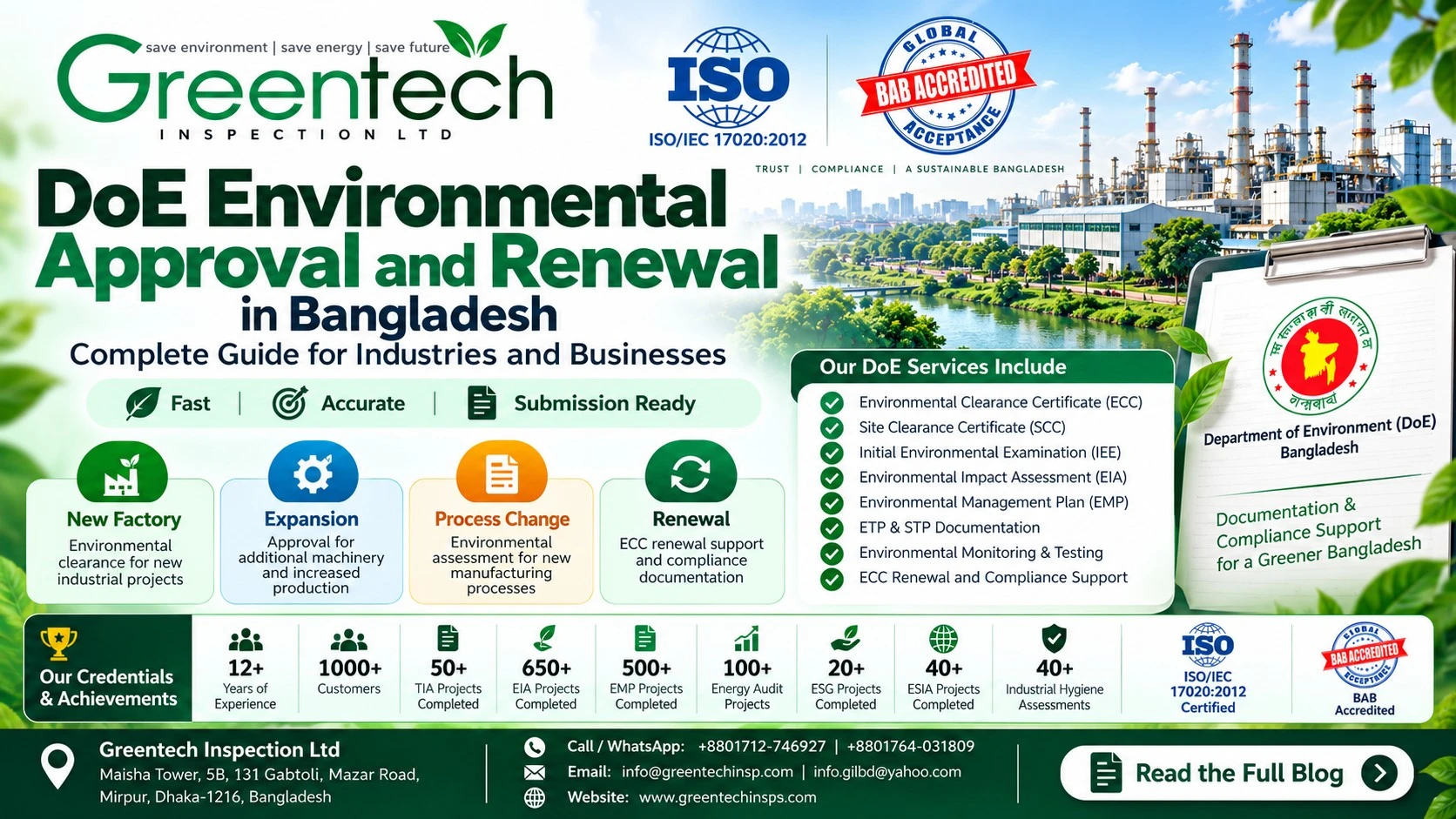
DoE Environmental Approval and Renewal in Bangladesh: Complete Guide for Industries and Businesses.
Environmental compliance is an essential responsibility for industries, manufacturing facilities, commercial establishments and development projects in Bangladesh.
Whether a company is establishing a new factory, expanding production capacity, installing additional machinery or renewing an existing Environmental Clearance Certificate (ECC), understanding the Department of Environment (DoE) approval process is important for regulatory compliance and responsible industrial operations.
Under Bangladesh's environmental regulatory framework, qualifying industries and projects are required to obtain applicable environmental clearances and comply with the conditions imposed by the competent authority.
However, businesses frequently encounter challenges involving incomplete documentation, environmental monitoring, EIA requirements, pollution-control systems and delayed renewal preparation.
This guide from Greentech Inspection Ltd explains DoE environmental approval, Environmental Clearance Certificate renewal, documentation requirements, environmental monitoring, approval readiness and practical compliance strategies for businesses operating in Bangladesh.
1. What Is DoE Environmental Approval in Bangladesh?
DoE environmental approval refers to the environmental clearance, assessment, permission or regulatory review processes administered by the Department of Environment under the Ministry of Environment, Forest and Climate Change, Government of Bangladesh.
Depending on the nature and classification of an industrial facility or development project, DoE-related approvals and assessments may involve:
Environmental Clearance Certificate (ECC)
Site Clearance Certificate (SCC), where applicable
Initial Environmental Examination (IEE)
Environmental Impact Assessment (EIA)
Environmental Management Plan (EMP)
Environmental monitoring and laboratory testing
Effluent Treatment Plant (ETP) documentation
Sewage Treatment Plant (STP) documentation
Environmental clearance renewal
Other activity-specific environmental approvals
Not every industry requires every assessment or certificate. Applicable requirements depend on factors such as project category, industrial activity, environmental impacts, location and regulatory conditions.
2. Environmental Laws and Regulations Governing DoE Approval
Environmental clearance processes in Bangladesh are principally governed by the Bangladesh Environment Conservation Act, 1995, and the Environment Conservation Rules, 2023, together with applicable amendments, government notifications and regulatory instructions.
The Environment Conservation Rules, 2023 provide an important framework for classifying industries and projects, determining environmental documentation requirements and managing environmental clearance procedures.
Companies should assess the regulatory framework applicable to their particular industrial activity rather than assume that every project follows the same approval process.
Regulatory requirements should also be reviewed whenever substantial changes are made to production processes, project capacity, manufacturing activities or pollution-control systems.
Official regulatory reference: https://doe.gov.bd
3. Environmental Categories Under the DoE Framework
Under the Environment Conservation Rules, 2023, applicable industries and projects are classified into environmental categories based on prescribed classifications and potential environmental impacts.
The principal categories are:
| Environmental Category | General Description |
|---|---|
| Green | Activities generally associated with comparatively lower environmental impacts |
| Yellow | Activities requiring a greater level of environmental review than Green-category activities |
| Orange | Activities with potentially more significant environmental impacts and corresponding regulatory requirements |
| Red | Activities associated with higher environmental risks and more extensive assessment requirements |
The applicable classification must be determined from the relevant schedules and provisions of the current rules.
Important: A factory should not determine its official DoE category solely from a general description of its industry. Production processes, specific operations and applicable regulatory classifications must be considered.
4. When Is Environmental Clearance Required?
Environmental clearance requirements can arise during different stages of industrial and project development.
Establishment of a New Factory
Businesses developing a new industrial facility should identify the applicable environmental approval requirements before implementing relevant project activities.
Environmental documentation may include location details, process descriptions, pollution-source assessments and appropriate management measures.
Expansion of an Existing Facility
A factory planning additional machinery, higher production capacity, new manufacturing processes or expanded buildings should review whether its current environmental approval adequately covers the proposed changes.
Changes in Industrial Processes
Introducing dyeing, washing, chemical processing, surface treatment or other new industrial operations can alter a facility's environmental impact profile.
Such changes may require additional environmental assessment or approval.
Installation or Modification of Pollution-Control Systems
Substantial changes to ETPs, STPs, discharge arrangements or emission-control systems may require updated technical documentation or regulatory review.
Renewal of Existing Environmental Clearance
Facilities holding time-limited Environmental Clearance Certificates must manage their renewal obligations in accordance with applicable regulations and certificate conditions.
5. Documents Commonly Required for DoE Environmental Approval
The exact document requirements depend on project classification, location, scale, activities and the type of approval requested.
A typical documentation package may include:
Business and legal documents
Trade License
Company registration documents, where applicable
TIN or other required tax-related documents
Land ownership or tenancy information
Relevant local authority clearances or NOCs, where required
Project information
Project profile
Site location map
Layout plan
Production process flow diagram
Production capacity details
Raw material information
Machinery and equipment list
Fuel and electricity requirements
Water consumption information
Environmental documentation
IEE or EIA, where required
Environmental Management Plan
Environmental monitoring data
Wastewater and discharge information
Air emission information
Noise assessment
Waste-management arrangements
ETP/STP technical information, where applicable
Submission of documents does not automatically guarantee approval. The Department of Environment evaluates applications against applicable requirements.
6. Step-by-Step DoE Environmental Approval Process
Step 1: Review Project Classification
The first step is determining the project's applicable environmental category.
The review should consider industrial activities, manufacturing processes, location, size and potential environmental impacts.
Step 2: Identify Regulatory Requirements
After confirming the category, determine the required environmental studies, supporting documents and regulatory approvals.
Step 3: Conduct an Environmental Site Assessment
A site assessment may examine:
Surrounding land uses
Nearby residential areas
Water bodies and drainage systems
Sensitive environmental receptors
Existing pollution sources
Wastewater discharge pathways
Air emission sources
Noise-generating equipment
Step 4: Prepare Environmental Studies
Depending on regulatory requirements, the applicant may need to prepare an IEE, EIA, EMP or other supporting technical documentation.
Step 5: Conduct Environmental Monitoring
Relevant testing may include wastewater quality, ambient air quality, stack emissions, noise levels and other environmental indicators.
Step 6: Submit the Application
Applicants should use the applicable DoE online system and follow the current submission instructions.
Official DoE online application portal:
Step 7: Respond to DoE Observations
The Department of Environment may request additional information, corrections, technical clarification or supporting documentation.
Step 8: Regulatory Review and Inspection
The DoE may undertake additional evaluation or site inspection depending on the application and applicable requirements.
Step 9: Approval and Certificate Issuance
Following satisfactory regulatory review, the authority may issue the applicable environmental clearance subject to relevant conditions.
Step 10: Maintain Ongoing Compliance
After approval, the organization should monitor environmental performance, maintain necessary records and follow the certificate conditions.
7. What Is Environmental Clearance Certificate Renewal?
Environmental Clearance Certificate renewal is the process of extending the validity of an existing environmental clearance through the applicable DoE regulatory procedure.
Receiving an ECC does not eliminate the obligation to maintain pollution-control systems or comply with environmental standards.
An industrial facility may be required to demonstrate continued compliance with previously approved environmental conditions when seeking renewal.
Depending on the facility, renewal preparation can involve:
Reviewing the existing ECC
Confirming the expiry date
Reviewing approval conditions
Updating operational information
Preparing environmental monitoring results
Reviewing ETP/STP operations
Assessing waste-management arrangements
Documenting corrective actions
Preparing the applicable renewal application
The required renewal documentation should be confirmed against the latest DoE instructions and the facility's specific certificate conditions.
8. How to Prepare for ECC Renewal in Bangladesh
A structured renewal process can reduce avoidable documentation delays.
90–60 Days Before Expiry: Internal Preparation
As an internal planning target, companies can begin reviewing their approval status approximately two to three months before expiry.
Activities may include reviewing the ECC, identifying applicable renewal requirements and checking previous compliance commitments.
60–30 Days Before Expiry: Documentation and Testing
During this period, facilities can complete relevant environmental monitoring, update required information and address identified deficiencies.
Before the Applicable Submission Deadline: Apply for Renewal
Submit the application using the current DoE procedure and ensure that the prescribed documents and fees are provided.
The actual legal submission deadline, certificate validity and renewal conditions must be checked against the current regulatory requirements.
After Submission: Track Application Status
Applicants should monitor the submission status, maintain payment records and respond promptly to official requests.
Important: The planning periods above are recommended internal management targets, not a substitute for official renewal deadlines.
9. Environmental Monitoring Requirements for DoE Approval and Renewal
Environmental monitoring may play an important role in both initial clearance and renewal.
The types of monitoring required depend on the facility's environmental risks, industrial processes and approval conditions.
Wastewater and Effluent Testing
Factories generating industrial wastewater may need to assess parameters such as:
pH
Biological Oxygen Demand (BOD)
Chemical Oxygen Demand (COD)
Total Suspended Solids (TSS)
Oil and grease
Other relevant parameters depending on the industrial process
Ambient Air Quality Assessment
Relevant parameters may include particulate matter and gaseous pollutants according to applicable assessment requirements.
Stack Emission Monitoring
Industrial boilers, generators, furnaces and other combustion systems may require applicable emission monitoring.
Environmental Noise Assessment
Noise monitoring can help evaluate industrial noise emissions and compliance with relevant environmental requirements.
ETP and STP Performance Review
Where wastewater treatment systems are required, facilities should maintain operating information, treatment records and relevant performance data.
Environmental monitoring should use appropriate methods, locations, frequencies and standards for the intended regulatory purpose.
10. Common Reasons for DoE Approval and Renewal Delays
Environmental approval applications can be delayed by deficiencies in documentation, technical information or environmental management.
Common problems include:
Incomplete application information: Missing or inconsistent project details can require additional clarification.
Incorrect project classification: Using an inappropriate environmental category can affect the required assessment and approval pathway.
Inadequate environmental studies: Reports that do not adequately describe project impacts or mitigation measures may require revision.
Missing environmental monitoring results: Required test results may be incomplete, outdated or inconsistent with the facility's actual operations.
Pollution-control deficiencies: ETP, STP or air pollution control arrangements may require further technical review.
Unreported operational changes: Changes in production capacity, fuel use, machinery or manufacturing processes can create inconsistencies with existing approvals.
Late renewal preparation: Waiting until a certificate is close to expiry can leave insufficient time for testing and documentation.
Early compliance review and technically accurate documentation can help businesses identify and address these issues.
11. DoE Environmental Approval Checklist for Factory Owners
Before beginning an approval or renewal application, factory management can use the following practical checklist.
| Compliance Area | Items to Verify |
|---|---|
| Environmental clearance | Existing approval status and certificate conditions |
| Project classification | Applicable category under current regulations |
| Business records | Valid and consistent supporting documents |
| Production details | Current machinery, capacity and processes |
| Water management | Water consumption and wastewater discharge |
| ETP/STP | System adequacy and operating records |
| Air pollution | Emission sources and control arrangements |
| Noise | Applicable monitoring results |
| Waste management | Storage, handling and disposal practices |
| Environmental assessment | Required IEE, EIA or EMP documentation |
| Monitoring records | Relevant reports and laboratory results |
| Renewal schedule | Expiry date and submission requirements |
This checklist is intended as a preliminary readiness tool. It does not replace the applicable regulatory requirements.
12. DoE Approval Considerations for Major Bangladesh Industries
Different industrial sectors may face different environmental risks and documentation requirements.
Textile and Dyeing Industries
Key environmental considerations may include process wastewater, chemical handling, boiler emissions, water consumption and wastewater treatment.
Garment Manufacturing Facilities
Depending on factory activities, relevant concerns may include generators, boilers, solid waste, wastewater, air emissions and noise.
Pharmaceutical Industries
Environmental review may consider process effluent, chemical waste, emissions and applicable waste-treatment arrangements.
Food and Beverage Industries
Important considerations can include organic wastewater, cleaning chemicals, solid waste and wastewater treatment capacity.
Chemical and Engineering Industries
Potential concerns may include industrial emissions, chemical storage, wastewater, hazardous waste and process safety-related environmental risks.
Infrastructure and Development Projects
Environmental review may involve land use, drainage, construction impacts, sensitive receptors, traffic and long-term environmental management.
In every case, actual approval requirements should be determined according to project-specific activities and the applicable regulatory framework.
13. Why Environmental Compliance Matters Beyond Approval
Environmental clearance should be treated as part of an ongoing environmental management program.
Effective compliance management can help industries:
Meet applicable environmental obligations
Maintain pollution-control performance
Improve wastewater management
Identify environmental risks
Strengthen internal recordkeeping
Prepare for inspections
Address buyer and lender environmental information requests
Support ESG and sustainability reporting
Plan facility expansion more effectively
An organized compliance program can also help management identify environmental deficiencies before they become more complex operational problems.
14. DoE Environmental Approval and Renewal Support by Greentech Inspection Ltd
Greentech Inspection Ltd provides environmental consultancy, inspection, monitoring and compliance support for industries and development projects across Bangladesh.
Our technical support services include:
Environmental Clearance Documentation
Assistance with project information review, environmental documentation and supporting materials for applicable DoE clearance processes.
Environmental Impact Assessment
Preparation and technical support for relevant IEE, EIA, EMP and other environmental assessment requirements.
Environmental Monitoring and Testing
Support for wastewater, ambient air, stack emissions, noise and other applicable environmental monitoring activities.
ETP and STP Compliance Assessment
Review of pollution-control arrangements, wastewater treatment performance and supporting operational records.
ECC Renewal Documentation
Review of existing clearance conditions, updated project information and required supporting environmental documentation.
Environmental Compliance Gap Assessment
Identification of relevant documentation, monitoring and operational compliance gaps, with recommendations for corrective action.
Factory Expansion Environmental Review
Support for evaluating proposed changes in industrial processes, production capacity and environmental impacts.
Our approach focuses on accurate technical assessment, transparent reporting and practical environmental management recommendations.
All regulatory decisions, approvals and certificate renewals remain subject to the Department of Environment.
15. Frequently Asked Questions (FAQs)
Q1. What is DoE approval in Bangladesh?
DoE approval refers to applicable environmental clearances, permissions and related regulatory procedures administered by the Department of Environment in Bangladesh.
Q2. Who issues an Environmental Clearance Certificate?
The Department of Environment issues Environmental Clearance Certificates under the applicable regulatory framework.
Q3. Does every factory require an EIA?
No. The requirement for an Environmental Impact Assessment depends on the applicable project classification and regulatory provisions.
Q4. Can a factory operate with an expired ECC?
Factories should maintain the required environmental clearance. Expiry can create regulatory and operational compliance risks. Where an ECC has expired, the operator should seek guidance from the DoE regarding the applicable procedure and lawful operating status.
Q5. How can a company apply for DoE environmental clearance online?
Applicants can access the official environmental clearance automation system at https://ecc.doe.gov.bd and follow the current registration and application instructions.
Q6. What documents are required for ECC renewal?
Documents may include the existing certificate, applicable renewal application, proof of prescribed payment, required environmental monitoring or compliance information and additional project-specific documents.
Q7. Are environmental monitoring reports always mandatory?
Requirements depend on the project, clearance conditions and applicable regulations. Not all facilities require identical monitoring parameters or reporting arrangements.
Q8. Can a company expand production under its existing ECC?
The company should review whether the proposed changes remain within the approved project scope and whether additional environmental approval is necessary before implementation.
Q9. How long does DoE environmental approval take?
Processing time varies depending on the project category, technical documentation, application completeness, inspection requirements and regulatory review.
Q10. Can an environmental consultant guarantee DoE approval?
No. Environmental consultants can support technical assessments, document preparation and application readiness, but the final approval decision rests with the competent authority.
Conclusion
DoE environmental approval and Environmental Clearance Certificate renewal are important elements of industrial environmental compliance in Bangladesh.
For factories, commercial facilities and development projects, successful compliance management requires more than submitting an application. It involves appropriate project classification, reliable documentation, environmental monitoring, pollution-control performance and continuous management of certificate conditions.
By reviewing environmental requirements early and maintaining accurate operational records, industries can reduce avoidable compliance problems and improve their environmental management practices.
Greentech Inspection Ltd supports businesses in navigating the technical and documentation requirements associated with environmental approvals, monitoring and renewal preparation.
Contact Greentech Inspection Ltd for DoE Approval and ECC Renewal Support
Are you planning a new industrial project, preparing an Environmental Clearance Certificate application or approaching your ECC renewal date?
Greentech Inspection Ltd provides environmental consultancy and technical support for industrial and commercial organizations throughout Bangladesh.
Greentech Inspection Ltd also provides:
SREDA-Certified Energy Auditor Bangladesh
Energy Efficiency Assessment Bangladesh
Green Financing Support Bangladesh
Bangladesh Bank Green Financing Support
GTF Documentation Support Bangladesh
TDF Documentation Support Bangladesh
LTFF Documentation Support Bangladesh
IDCOL Energy Efficiency Support Bangladesh
BIFFL Energy Efficiency Support Bangladesh
Higg Index Energy Support Bangladesh
ESG Consultancy Support Bangladesh
Environmental Consultant Bangladesh
Environmental Monitoring Bangladesh
Environmental Testing Bangladesh
Environmental Inspection Bangladesh
Environmental Consultant Bangladesh
EIA Consultant Bangladesh
ESIA Consultant Bangladesh
IEE Consultant Bangladesh
Environmental Management Plan Bangladesh
Environmental Monitoring Bangladesh
Environmental Inspection Bangladesh
Environmental Testing Bangladesh
Ambient Air Monitoring Bangladesh
Stack Emission Monitoring Bangladesh
Noise Level Assessment Bangladesh
Light Level Assessment Bangladesh
Water Quality Testing Bangladesh
Indoor Air Quality Monitoring Bangladesh
Industrial Hygiene Assessment Bangladesh
Energy Audit Bangladesh
ESG Consultancy Support Bangladesh
Traffic Impact Assessment Bangladesh
Industrial Hygiene Assessment Bangladesh
Energy Audit Bangladesh
ESG Consultancy Support Bangladesh
Traffic Impact Assessment (TIA) Bangladesh
DoE Consultancy
Environmental Management Plan Bangladesh
Industrial Hygiene Assessment Bangladesh
Environmental Management Plan Bangladesh
Greentech Inspection Ltd
Address: Maisha Tower, 5B, 131 Gabtoli, Mazar Road, Mirpur, Dhaka-1216, Bangladesh
Call / WhatsApp: +8801712-746927 | +8801764-031809
Email: [email protected] | [email protected]
Website: www.greentechinsp.com
👉Fast | Accurate | Authority-Approved | Submission Ready | 12+ Years of Experience | 50+ TIA Projects Completed | 650+ EIA Projects Completed | 500+ EMP Projects Completed | 100+ Energy Audit | 20+ ESG Projects Completed | 40+ ESIA Projects Completed | 40+ Industrial Hygiene Assessment | 1000+ Customer | BAB Accredited | ISO/IEC 17020:2012 Certified |