Carbon Footprint Assessment in Bangladesh | Scope 1, 2 & 3 Guide
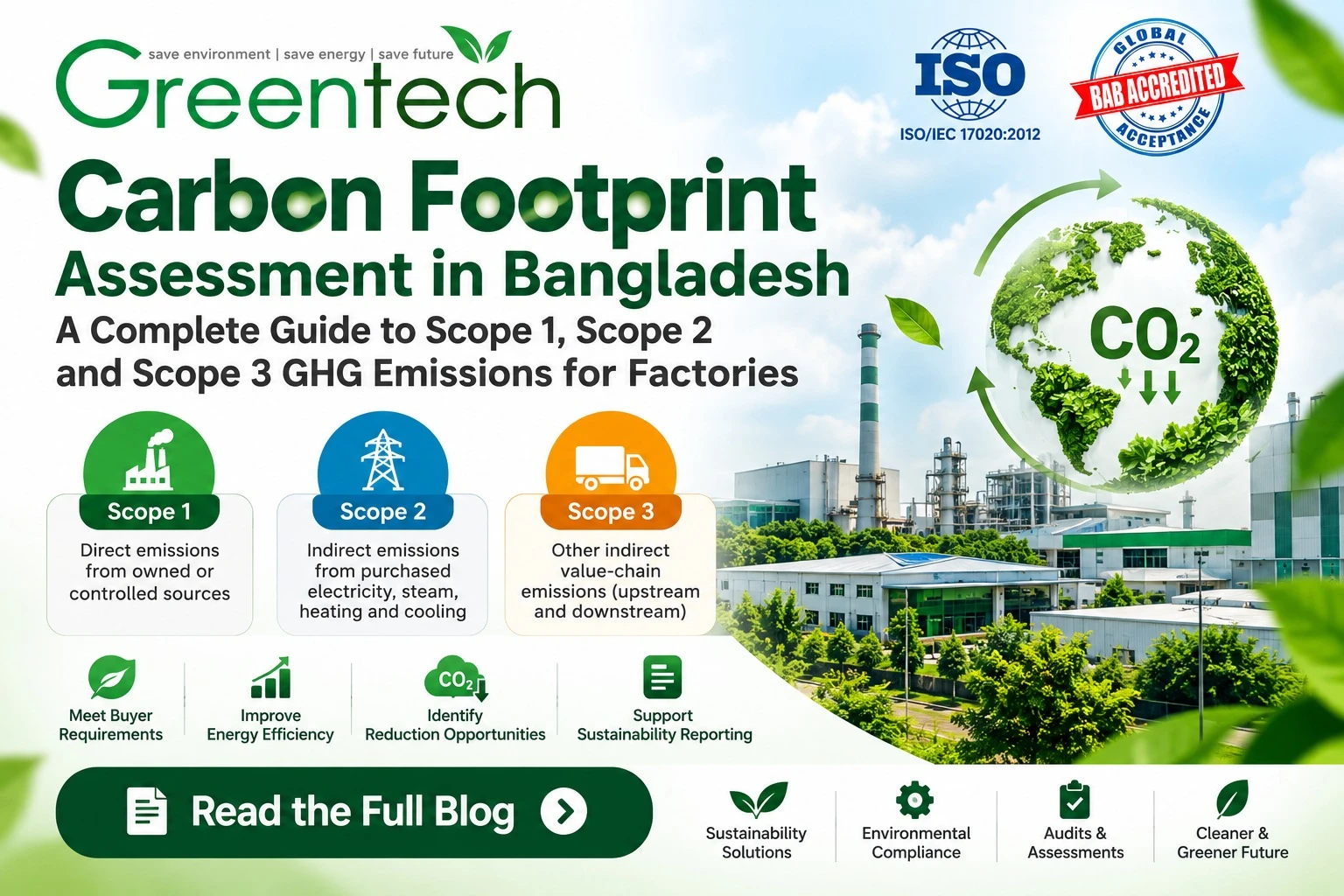
Carbon Footprint Assessment in Bangladesh: A Complete Guide to Scope 1, Scope 2 and Scope 3 GHG Emissions for Factories.
Bangladesh's industrial sector is becoming increasingly connected to international sustainability expectations. Manufacturing companies, particularly those operating in the ready-made garment (RMG), textile, leather, pharmaceutical, food processing, chemical and engineering sectors, are facing growing requests for environmental performance data from international buyers, investors and supply-chain partners.
One increasingly important area is Carbon Footprint Assessment, also known as Greenhouse Gas (GHG) Emissions Assessment.
A carbon footprint assessment helps organizations identify, calculate and report the greenhouse gas emissions associated with their business activities. It also provides valuable insights into energy consumption, operational efficiency, supply-chain emissions and potential carbon reduction opportunities.
For industrial facilities in Bangladesh, understanding Scope 1, Scope 2 and Scope 3 emissions is an important step toward developing a reliable GHG inventory and improving environmental sustainability performance.
In this guide, Greentech Inspection Ltd explains how carbon footprint assessment works, which data factories need, how GHG emissions are calculated and how businesses can use their results for effective carbon management.
1. What Is a Carbon Footprint Assessment?
A Carbon Footprint Assessment is a systematic evaluation of greenhouse gas emissions generated directly and indirectly by an organization, industrial facility, product or activity.
For companies, this assessment typically involves developing a GHG inventory covering emissions within defined organizational and operational boundaries.
The results are generally expressed in tonnes of carbon dioxide equivalent (tCO₂e), allowing different greenhouse gases to be reported using a common measurement unit.
Greenhouse gases considered in corporate GHG accounting include:
Carbon dioxide (CO₂)
Methane (CH₄)
Nitrous oxide (N₂O)
Hydrofluorocarbons (HFCs)
Perfluorocarbons (PFCs)
Sulfur hexafluoride (SF₆)
Nitrogen trifluoride (NF₃)
These gases have different global warming impacts. Their emissions are converted to CO₂e using applicable Global Warming Potential (GWP) values.
A well-prepared carbon footprint assessment can help businesses understand their emissions sources, establish a baseline year, prioritize carbon reduction measures and improve the quality of sustainability reporting.
2. What Are Scope 1, Scope 2 and Scope 3 Emissions?
The Greenhouse Gas Protocol, one of the most widely used international frameworks for corporate GHG accounting, classifies greenhouse gas emissions into three scopes.
Scope 1: Direct Greenhouse Gas Emissions
Scope 1 includes direct emissions from sources owned or controlled by the reporting organization.
Typical Scope 1 emission sources in Bangladesh factories include:
Natural gas combustion in industrial boilers
Diesel consumption in generators
Fuel combustion in furnaces and other industrial equipment
Petrol or diesel consumption in company-owned vehicles
Refrigerant leakage from air conditioning and cooling systems
Direct greenhouse gas emissions from applicable industrial processes
Example: A garment factory operating its own diesel generator produces direct emissions from burning diesel. Those emissions normally fall under Scope 1.
Similarly, natural gas combustion in a factory-owned boiler produces Scope 1 emissions.
Scope 2: Indirect Emissions from Purchased Energy
Scope 2 covers indirect emissions associated with generating purchased or acquired electricity, steam, heating and cooling consumed by the reporting organization.
For many industrial facilities in Bangladesh, purchased grid electricity is an important Scope 2 emission source.
Although the electricity is consumed inside the factory, the associated generation emissions occur at the electricity-producing facility.
Example: A textile factory purchases electricity from the national grid to operate sewing machines, compressors, lighting, pumps and production equipment. The associated electricity generation emissions are accounted for under Scope 2.
The GHG Protocol Scope 2 Guidance provides two accounting approaches:
Location-based method: Uses emission factors representing the average emissions intensity of the relevant electricity grid.
Market-based method: Uses qualifying contractual instruments and supplier-specific data, where applicable and consistent with GHG Protocol quality requirements.
Organizations should apply the relevant Scope 2 reporting requirements and transparently document their methods and emission-factor sources.
Scope 3: Other Indirect Value-Chain Emissions
Scope 3 includes other indirect greenhouse gas emissions occurring across the organization's upstream and downstream value chain.
These emissions are associated with the organization's activities but arise from sources outside its owned or controlled operations.
For Bangladesh manufacturing companies, relevant Scope 3 sources may include:
Purchased fabric, yarn, chemicals and packaging materials
Production of purchased machinery and capital equipment
Transportation of raw materials
Third-party logistics and product distribution
Waste treatment by external service providers
Employee commuting
Business travel
Fuel- and energy-related activities not included in Scope 1 or Scope 2
Processing or use of sold products, where applicable
End-of-life treatment of products
The GHG Protocol Corporate Value Chain (Scope 3) Standard provides 15 categories covering upstream and downstream value-chain activities.
Not every category will be relevant to every business. Organizations should assess category applicability, document exclusions and calculate applicable categories according to the relevant accounting requirements.
3. Scope 1 vs Scope 2 vs Scope 3: Key Differences
| Criteria | Scope 1 | Scope 2 | Scope 3 |
|---|---|---|---|
| Emission type | Direct | Indirect | Indirect |
| Main sources | Owned or controlled operations | Purchased energy | Upstream and downstream value chain |
| Factory examples | Boiler, generator, company vehicles | Purchased grid electricity | Purchased fabric, transportation, waste |
| Common data | Fuel consumption, refrigerants | Electricity bills, energy meters | Procurement, supplier, logistics and waste records |
| Main management approach | Improve internal operations | Energy efficiency and electricity sourcing | Supplier and value-chain engagement |
Accurately distinguishing between these scopes is important for avoiding inappropriate classification and producing a transparent GHG inventory.
4. How Is a Factory's Carbon Footprint Calculated?
Most industrial GHG inventories use activity-based calculation methods supported by appropriate emission factors.
The fundamental calculation is:
GHG Emissions = Activity Data × Emission Factor
Depending on the emission factor and greenhouse gas involved, additional unit conversions and GWP calculations may be required.
Example: Scope 1 Diesel Generator Emissions
Assume a factory consumes 12,000 litres of diesel during a reporting year.
For illustration, suppose an applicable emission factor is 2.68 kg CO₂ per litre.
Annual CO₂ emissions:
12,000 × 2.68 = 32,160 kg CO₂
Converting into tonnes:
32,160 ÷ 1,000 = 32.16 tonnes CO₂
This calculation illustrates the basic method for estimating diesel-related CO₂ emissions. A complete GHG assessment should also consider applicable non-CO₂ greenhouse gases, relevant factor boundaries and appropriate conversion methods.
Note: The emission factor in this example is illustrative and must not be substituted for an appropriately selected, documented factor in an actual inventory.
Example: Scope 2 Electricity Emissions
Assume a factory purchases 600,000 kWh of grid electricity annually.
Using an illustrative grid emission factor of 0.60 kg CO₂e/kWh:
600,000 × 0.60 = 360,000 kg CO₂e
Annual emissions:
360,000 ÷ 1,000 = 360 tCO₂e
This is a simplified location-based illustration.
For an actual carbon footprint assessment in Bangladesh, the appropriate electricity emission factor must be selected for the reporting period and methodology, with its source documented.
Example: Scope 3 Transportation Emissions
Assume a factory's outsourced transportation activities account for 100,000 tonne-kilometres during a reporting year.
If an illustrative transportation emission factor is 0.10 kg CO₂e per tonne-kilometre:
100,000 × 0.10 = 10,000 kg CO₂e
Total estimated transportation emissions:
10,000 ÷ 1,000 = 10 tCO₂e
Actual transportation accounting depends on vehicle types, fuel information, shipment distances, allocation methods, emission-factor coverage and data availability.
A detailed assessment should use the best appropriate data and methodology for each relevant emission source.
5. What Data Is Required for Carbon Footprint Assessment?
Reliable data collection is one of the most important steps in GHG inventory preparation.
Factories should organize activity data for the selected reporting period, generally a complete financial or calendar year.
Scope 1 Data Requirements
Diesel and petrol purchase and consumption records
Natural gas bills or meter readings
LPG and other fuel consumption
Generator running records
Boiler and furnace fuel consumption
Company-owned vehicle fuel records
Refrigerant type, recharge and leakage records
Relevant industrial process data
Scope 2 Data Requirements
Monthly electricity bills
Electricity meter readings
Electricity consumption in kWh
Purchased steam, heat or cooling records, where applicable
Electricity supplier information
Qualifying renewable electricity contractual documentation, where relevant
Scope 3 Data Requirements
Raw material purchase quantities
Material specifications and supplier information
Supplier-reported emissions or product emission data, where available
Transportation and logistics records
Third-party fuel and freight information
Waste generation and disposal records
Employee commuting survey data
Business travel records
Capital equipment procurement information
Product lifecycle data for relevant downstream categories
For Scope 3 emissions, data availability can be challenging because information often comes from suppliers, transporters, contractors and other external organizations.
A systematic data-collection template can help reduce missing information and improve calculation accuracy.
6. Step-by-Step Carbon Footprint Assessment Process
A professional organizational carbon footprint assessment generally follows several stages.
Step 1: Define Organizational Boundaries
The first step is identifying which facilities, operations, subsidiaries and activities are included in the assessment.
Depending on the applicable framework, organizations may use equity share, financial control or operational control approaches.
Step 2: Define the Reporting Period
Select the inventory reporting year and document the period consistently.
Where appropriate, establish a baseline year to support future emissions-performance comparisons.
Step 3: Identify Emission Sources
Prepare an inventory of potential Scope 1, Scope 2 and Scope 3 sources relevant to the organization.
Step 4: Collect Activity Data
Gather supporting records, including electricity bills, fuel purchase records, process information, refrigerant records and relevant supplier data.
Step 5: Select Emission Factors
Choose credible emission factors appropriate for the fuel, activity, geographic location, reporting year and calculation method.
Each factor should be documented with its source, units, applicability and relevant assumptions.
Step 6: Calculate GHG Emissions
Apply the relevant methods to calculate emissions by source, gas, facility and scope.
Step 7: Review Data Quality
Check calculations for missing data, incorrect units, inconsistent reporting periods, inappropriate factors and potential errors.
Step 8: Identify Emission Hotspots
Analyze which activities account for significant portions of the organization's carbon footprint.
Step 9: Prepare the GHG Inventory Report
Prepare a structured report documenting boundaries, methods, emission factors, activity data, results, assumptions, exclusions and uncertainties.
Step 10: Develop Carbon Reduction Opportunities
Use the findings to identify practical improvements in energy use, operational efficiency, procurement, logistics and other significant emission sources.
7. Why Is Carbon Footprint Assessment Important for Bangladesh Industries?
Carbon footprint assessment can provide several business and sustainability benefits.
International Buyer and Supply-Chain Requirements
Export-oriented manufacturers may receive requests for GHG emissions data as part of buyer sustainability programs, supplier assessments or corporate emissions reporting.
A documented inventory helps factories respond to these requests with more consistent information.
ESG and Sustainability Reporting
GHG inventory information can support environmental disclosures within ESG and broader sustainability reporting frameworks.
Energy Efficiency and Cost Management
Identifying major fuel and electricity sources can reveal opportunities for reducing energy consumption and operating expenses.
Carbon Reduction Planning
An accurate emissions baseline allows organizations to establish measurable reduction objectives and monitor progress over time.
Improved Supply-Chain Engagement
Scope 3 assessment encourages collaboration with suppliers, transporters and other value-chain partners to improve data transparency and identify shared emission reduction opportunities.
Environmental Management
GHG accounting helps organizations integrate climate-related performance indicators into their broader environmental management activities.
8. Common Challenges in GHG Inventory Preparation
Bangladesh factories can encounter practical difficulties when developing their first carbon footprint assessment.
Incomplete consumption records: Some facilities lack consolidated fuel, electricity or refrigerant records.
Limited supplier data: Scope 3 assessments may require information from numerous suppliers, not all of whom maintain detailed emissions records.
Inappropriate emission factors: Using factors from unrelated countries, years or activities without checking their suitability can distort inventory results.
Unclear operational boundaries: Factories operating multiple sites or using outsourced processes may struggle to determine which emissions should be included under each scope.
Potential double counting: Poorly defined category boundaries and calculation methods can lead to duplicated emissions within an inventory.
Insufficient documentation: Missing records, assumptions and calculation references can make reports difficult to review or verify.
These challenges can be addressed through structured data-collection systems, clear accounting methodologies and technical review.
9. How Can Factories Reduce Their Carbon Footprint?
Following the assessment, organizations can evaluate carbon reduction measures according to their emission hotspots, technical feasibility and financial priorities.
Reduce Scope 1 Emissions
Improve boiler combustion efficiency
Reduce unnecessary diesel generator operation
Maintain industrial equipment
Detect and minimize refrigerant leakage
Evaluate lower-emission fuels and technologies
Improve company fleet management
Reduce Scope 2 Emissions
Improve electrical equipment efficiency
Upgrade inefficient lighting
Optimize compressed air systems
Install energy monitoring systems
Improve motor and pump efficiency
Evaluate rooftop solar energy systems
Assess qualifying lower-carbon electricity procurement options
Reduce Scope 3 Emissions
Engage suppliers in emissions measurement
Improve raw material efficiency
Reduce unnecessary packaging
Optimize transportation and shipment planning
Improve waste management and material recovery
Work with suppliers on lower-emission production processes
Encourage more sustainable logistics and procurement practices
The effectiveness of each measure depends on the facility's operating conditions and should be evaluated using appropriate technical and financial analysis.
10. Carbon Footprint Assessment and ESG Reporting
Carbon footprint assessment is closely related to environmental performance management and ESG reporting.
GHG inventory results may support disclosures prepared under relevant sustainability and climate reporting frameworks.
However, a carbon footprint assessment, formal ESG report, product carbon footprint, independently verified GHG statement and corporate net-zero commitment are not the same deliverable.
Organizations should identify their reporting objectives before beginning an assessment.
For example, an international buyer may request a factory-level Scope 1 and Scope 2 inventory, while another customer may request selected Scope 3 categories, product-level emissions or additional independent verification.
Clear assessment objectives help businesses develop information that is fit for its intended use.
11. Carbon Footprint Assessment Services by Greentech Inspection Ltd
Greentech Inspection Ltd provides environmental consultancy, inspection and sustainability assessment support for industrial and commercial organizations in Bangladesh.
Our carbon footprint assessment services can support organizations throughout the GHG inventory development process.
Our areas of support include:
Organizational and operational boundary assessment
Scope 1 direct emission assessment
Scope 2 purchased-energy emission assessment
Scope 3 category screening and assessment
GHG activity-data collection and review
Emission-factor selection and documentation
Carbon emission calculations
Factory-level and organizational GHG inventory preparation
Emission hotspot identification
Carbon reduction opportunity assessment
GHG inventory reporting and supporting documentation
ESG and sustainability reporting support
Our objective is to help industries develop transparent, technically grounded and decision-useful carbon footprint assessments.
Whether your facility is preparing its first GHG inventory, responding to international buyer requests or developing a carbon management strategy, a structured assessment provides a foundation for informed environmental decisions.
12. Frequently Asked Questions (FAQs)
Q1. What is a carbon footprint assessment?
A carbon footprint assessment identifies and quantifies greenhouse gas emissions associated with an organization, facility, product or activity. Emissions are generally expressed in carbon dioxide equivalent (CO₂e).
Q2. What is the difference between Scope 1, Scope 2 and Scope 3?
Scope 1 covers direct emissions from owned or controlled sources. Scope 2 covers indirect emissions from purchased energy. Scope 3 covers other indirect emissions associated with an organization's upstream and downstream value chain.
Q3. Is carbon footprint assessment mandatory for all factories in Bangladesh?
There is no basis to assume that every factory in Bangladesh is subject to one universal carbon footprint assessment requirement. Obligations depend on applicable laws, sector-specific requirements, contractual commitments and reporting arrangements. Factories should review their specific compliance and buyer obligations.
Q4. How frequently should a factory calculate its carbon footprint?
Many organizations prepare an annual GHG inventory to evaluate emissions performance consistently. More frequent internal monitoring may help facilities identify changes in energy consumption and operations.
Q5. What information is required for Scope 1 emissions?
Typical information includes fuel consumption, stationary combustion activity, company vehicle fuel records, refrigerant leakage and relevant industrial process emissions.
Q6. Why is Scope 3 assessment more complex?
Scope 3 can cover many activities across an organization's value chain. Collecting reliable information from suppliers, service providers and customers may be more challenging than collecting operational data directly from the factory.
Q7. How long does a carbon footprint assessment take?
The assessment timeline depends on the number of facilities, scope of work, quality of available records, reporting complexity and supplier data requirements.
Q8. Can carbon footprint assessment help reduce factory operating costs?
Yes. The assessment can identify activities associated with significant fuel and electricity consumption. These findings may support energy efficiency measures and other operational improvements, although cost savings depend on the measures implemented.
Q9. Which international standards are used for GHG assessment?
Commonly referenced frameworks include the GHG Protocol Corporate Accounting and Reporting Standard, GHG Protocol Scope 2 Guidance, GHG Protocol Corporate Value Chain (Scope 3) Standard and applicable ISO 14064 standards.
Q10. Does preparing a GHG inventory automatically provide certification?
No. Preparing a GHG inventory is different from obtaining independent verification or certification. The need for assurance depends on the applicable reporting or contractual requirements.
Conclusion
Carbon Footprint Assessment is an important part of modern environmental and sustainability management.
For factories and industries in Bangladesh, understanding Scope 1, Scope 2 and Scope 3 greenhouse gas emissions provides valuable information about energy use, environmental performance and value-chain impacts.
A reliable GHG inventory can help organizations establish emissions baselines, respond to sustainability information requests, identify carbon reduction opportunities and monitor environmental performance over time.
As industrial sustainability expectations continue to evolve, transparent carbon accounting can help organizations make informed decisions and strengthen their environmental management practices.
Contact Greentech Inspection Ltd for Carbon Footprint Assessment in Bangladesh
Looking for professional support with Carbon Footprint Assessment, Scope 1, Scope 2 and Scope 3 GHG Inventory, Carbon Accounting or Sustainability Consultancy in Bangladesh?
Greentech Inspection Ltd supports manufacturing facilities and businesses seeking structured greenhouse gas emissions assessments and practical carbon management solutions.
Contact Greentech Inspection Ltd to discuss your facility's assessment requirements and develop an appropriate scope of work.
Greentech Inspection Ltd also provides:
SREDA-Certified Energy Auditor Bangladesh
Energy Efficiency Assessment Bangladesh
Green Financing Support Bangladesh
Bangladesh Bank Green Financing Support
GTF Documentation Support Bangladesh
TDF Documentation Support Bangladesh
LTFF Documentation Support Bangladesh
IDCOL Energy Efficiency Support Bangladesh
BIFFL Energy Efficiency Support Bangladesh
Higg Index Energy Support Bangladesh
ESG Consultancy Support Bangladesh
Environmental Consultant Bangladesh
Environmental Monitoring Bangladesh
Environmental Testing Bangladesh
Environmental Inspection Bangladesh
Environmental Consultant Bangladesh
EIA Consultant Bangladesh
ESIA Consultant Bangladesh
IEE Consultant Bangladesh
Environmental Management Plan Bangladesh
Environmental Monitoring Bangladesh
Environmental Inspection Bangladesh
Environmental Testing Bangladesh
Ambient Air Monitoring Bangladesh
Stack Emission Monitoring Bangladesh
Noise Level Assessment Bangladesh
Light Level Assessment Bangladesh
Water Quality Testing Bangladesh
Indoor Air Quality Monitoring Bangladesh
Industrial Hygiene Assessment Bangladesh
Energy Audit Bangladesh
ESG Consultancy Support Bangladesh
Traffic Impact Assessment Bangladesh
Industrial Hygiene Assessment Bangladesh
Energy Audit Bangladesh
ESG Consultancy Support Bangladesh
Traffic Impact Assessment (TIA) Bangladesh
DoE Consultancy
Environmental Management Plan Bangladesh
Industrial Hygiene Assessment Bangladesh
Environmental Management Plan Bangladesh
Greentech Inspection Ltd
Address: Maisha Tower, 5B, 131 Gabtoli, Mazar Road, Mirpur, Dhaka-1216, Bangladesh
Call / WhatsApp: +8801712-746927 | +8801764-031809
Email: [email protected] | [email protected]
Website: www.greentechinsp.com
Website: https://greentechinsp.com
Service: Carbon Footprint Assessment | GHG Inventory | Scope 1, 2 & 3 Assessment | ESG & Sustainability Consultancy