Carbon Footprint Assessment | GHG Inventory | Scope 1, 2 & 3 Assessment | ESG & Sustainability Consultancy | Bangladesh
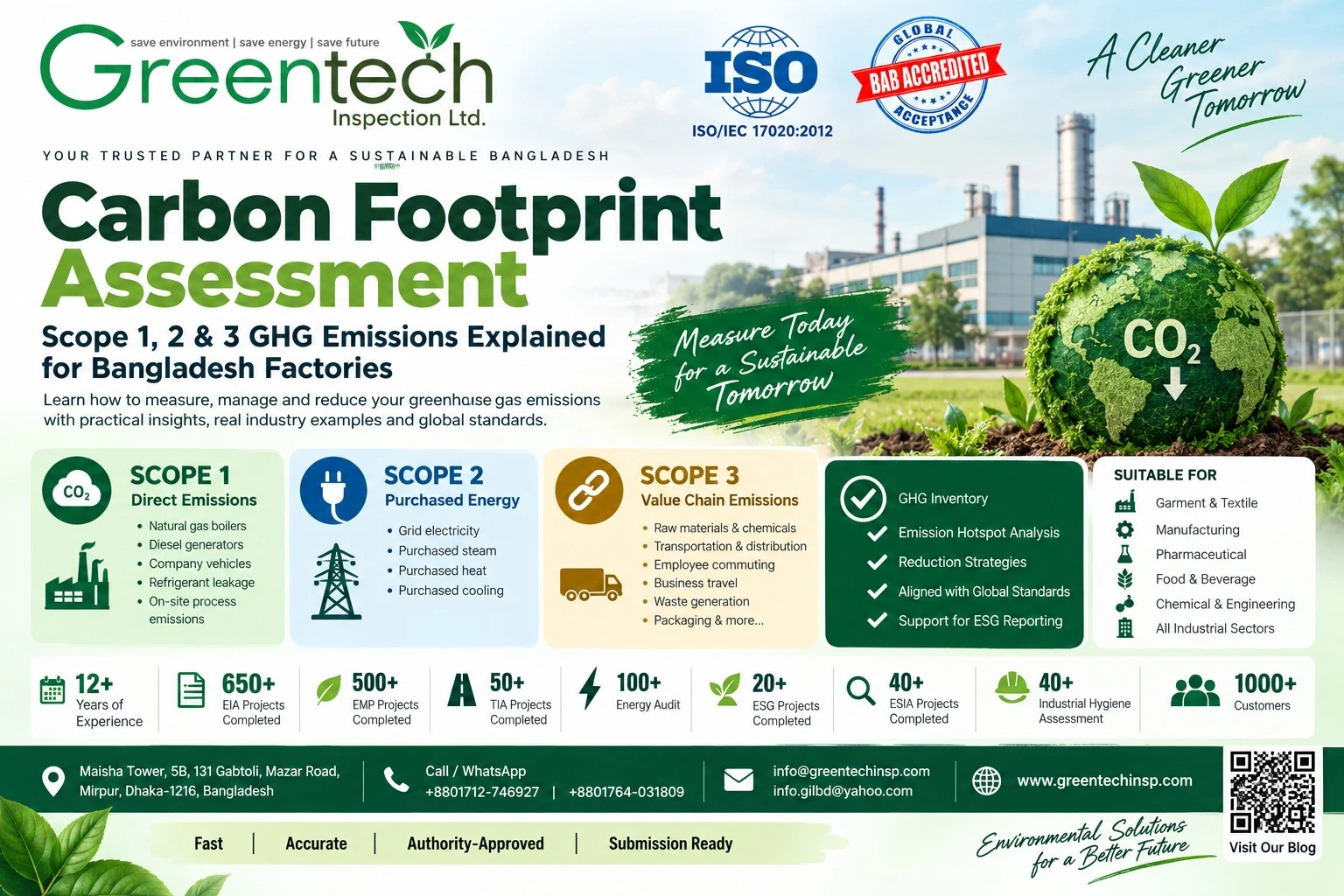
Carbon Footprint Assessment: A Practical Guide for Industries and Factories in Bangladesh
Climate change, international buyer expectations, ESG reporting requirements and supply-chain decarbonization are changing the way industries measure environmental performance. For factories and businesses in Bangladesh, understanding greenhouse gas emissions is increasingly becoming part of responsible environmental and sustainability management.
A Carbon Footprint Assessment measures the greenhouse gas emissions generated directly and indirectly by an organization, facility, product or activity. For companies, the assessment normally produces a structured GHG inventory, expressed in tonnes of carbon dioxide equivalent, or tCO₂e.
A properly prepared carbon footprint is much more than a calculation. It establishes an emissions baseline, identifies major emission sources, supports reduction planning and provides credible environmental information for customers, management, investors and other stakeholders.
The globally recognized GHG Protocol framework organizes corporate emissions into Scope 1, Scope 2 and Scope 3. Its Corporate Value Chain Standard further divides Scope 3 into 15 upstream and downstream categories.
What Is a Carbon Footprint Assessment?
A Carbon Footprint Assessment is the systematic process of identifying, collecting, calculating and reporting greenhouse gas emissions associated with an organization's activities.
The assessment generally starts by defining the organizational and operational boundaries. The company then collects activity data such as fuel consumption, electricity use, refrigerant losses, purchased materials, transportation, waste generation, employee travel and other relevant activities.
The fundamental calculation is generally:
GHG Emissions = Activity Data × Emission Factor
For example, electricity consumption can be multiplied by an applicable grid emission factor, while diesel, natural gas and other fuels require appropriate fuel-specific emission factors.
Different greenhouse gases are converted into a common unit—carbon dioxide equivalent (CO₂e)—using their applicable Global Warming Potential values.
The final inventory allows an organization to see both its total emissions and the activities responsible for those emissions.
Understanding Scope 1, Scope 2 and Scope 3 Emissions
The three scopes are fundamental to organizational GHG accounting.
| Emission Scope | Meaning | Typical Factory Examples |
|---|---|---|
| Scope 1 | Direct emissions from sources owned or controlled by the company | Natural gas boilers, diesel generators, company vehicles, refrigerant leakage |
| Scope 2 | Indirect emissions associated with purchased electricity, steam, heat or cooling | National grid electricity |
| Scope 3 | Other indirect emissions occurring throughout the company's value chain | Raw materials, transportation, waste, business travel, employee commuting, purchased goods |
GHG Protocol's Scope 2 Guidance specifically addresses emissions from purchased or acquired electricity, steam, heat and cooling and provides location-based and, where applicable, market-based approaches for reporting Scope 2 emissions.
Scope 1: Direct GHG Emissions
Scope 1 emissions originate from sources that an organization owns or controls.
For a typical manufacturing facility in Bangladesh, these can include natural gas used by boilers, diesel burned in generators, LPG or furnace fuel used in production, petrol and diesel used in company vehicles, and refrigerants lost from air-conditioning or cooling equipment.
Consider a factory operating several diesel generators. The quantity of diesel consumed during the reporting year is collected from purchase invoices, fuel registers or ERP records. That fuel quantity is then multiplied by an appropriate emission factor to determine the associated GHG emissions.
Good Scope 1 assessment therefore depends heavily on accurate operational records.
Scope 2: Purchased Electricity
For many Bangladesh factories, purchased grid electricity represents an important Scope 2 source.
The Department of Environment issued an official notice dated 23 January 2025 providing Bangladesh Grid Emission Factors of 0.61 tCO₂/MWh for 2019–20 and 0.62 tCO₂/MWh for 2020–21 and 2021–22. The notice refers users to Bangladesh's First Biennial Update Report to the UNFCCC for methodology and related information.
For illustration, if a facility consumes:
10,000 MWh of grid electricity
and an applicable factor of:
0.62 tCO₂/MWh
is used, the calculation would be:
10,000 × 0.62 = 6,200 tCO₂
This example demonstrates why electricity can represent a significant part of a factory's organizational carbon footprint.
For an actual inventory, however, the emission factor should be selected according to the relevant reporting period, methodology, contractual arrangements and reporting framework rather than automatically applying a single factor to every reporting year.
Scope 3: The Wider Value Chain
Scope 3 is usually the most complex part of a Carbon Footprint Assessment because the emissions occur outside the company's direct operational control.
GHG Protocol identifies 15 Scope 3 categories, covering both upstream and downstream activities. It notes that value-chain emissions can represent a substantial share of a company's total climate impact and provides methodology for identifying and accounting for these sources.
For a Bangladesh textile, garment, pharmaceutical, food, engineering or other manufacturing company, significant Scope 3 sources may include raw materials, chemicals, packaging, outsourced transportation, employee commuting, waste disposal, business travel and distribution of finished goods.
The relevance of each category varies by business model. A garment factory may have substantial emissions associated with fabric, yarn, chemicals and transportation, whereas another industrial facility may find capital goods or purchased services more significant.
A professional assessment should therefore conduct a Scope 3 screening exercise instead of assuming every category has equal importance.
What Data Is Required for a Carbon Footprint Assessment?
Most of the information required for organizational carbon accounting already exists within company departments such as accounts, administration, engineering, utility management, procurement, HR, logistics and sustainability.
A typical data-collection framework looks like this:
| Activity | Data to Collect | Typical Evidence |
|---|---|---|
| Electricity | kWh or MWh | Electricity bills, meter data |
| Natural gas | m³ | Gas bills, meter readings |
| Diesel | Litres | Purchase invoices, fuel records |
| Petrol | Litres | Vehicle/fuel records |
| LPG | kg or litres | Purchase records |
| Refrigerants | Refrigerant type and kg added/lost | Service records |
| Raw materials | kg or tonnes by material | Purchase/ERP records |
| Packaging | kg or tonnes | Procurement records |
| Waste | Weight and treatment method | Waste manifests |
| Transportation | Weight, distance and transport mode | Logistics records |
| Business travel | Distance and travel mode | Travel records |
| Employee commuting | Distance, mode and working days | Employee survey |
| Purchased services | Activity or expenditure | Procurement/accounts |
| Capital equipment | Equipment and purchase information | Asset register |
Data quality is critical. Estimates may sometimes be necessary, particularly for Scope 3, but all assumptions, calculation methods and limitations should be documented transparently.
Organizational and Operational Boundaries
One of the first technical decisions in a GHG assessment is determining what belongs inside the organization's inventory.
Depending on the applicable framework, companies may use approaches based on operational control, financial control or equity share.
This decision determines which facilities, subsidiaries, leased operations and activities are included.
The reporting period must also be defined clearly. In most cases, companies establish an annual inventory corresponding to a financial year or calendar year.
Consistency is important because carbon performance becomes much more useful when emissions can be compared from one reporting period to another.
Selecting Appropriate Emission Factors
An emission factor converts activity data into estimated GHG emissions.
Emission factors can come from national authorities, recognized international databases, IPCC methodologies or other accepted sources appropriate to the activity and reporting framework.
For Bangladesh grid electricity, the applicable national Grid Emission Factor should be considered where appropriate. For fuels and other activities, suitable recognized emission-factor datasets can be applied depending on the methodology and reporting objective.
The selection process should consider:
Geographic relevance → reporting year → technology → fuel/material type → unit consistency → methodology → source credibility.
Simply choosing an emission factor from an internet search is not good professional practice.
Every significant factor should be traceable to a documented source.
Standards Used for Carbon Footprint Assessment
One of the principal international standards is ISO 14064-1:2018, which specifies organization-level principles and requirements for quantifying and reporting greenhouse gas emissions and removals, including requirements relating to development, management, reporting and verification of organizational GHG inventories. ISO indicates that the 2018 edition was reviewed and confirmed in 2024 and remains current.
Corporate assessments can also reference the GHG Protocol Corporate Standard, Scope 2 Guidance and Corporate Value Chain Scope 3 Standard, depending on the reporting objective.
An important development is underway. In 2025, GHG Protocol and ISO announced collaboration toward harmonized corporate GHG accounting standards, and in July 2026 GHG Protocol confirmed ongoing development of a consolidated corporate standard covering Scope 1, Scope 2, Scope 3 and related areas together with ISO 14064-1. This is a future standard-development process, so companies should continue to identify the current standards and versions used in their present inventories.
Carbon Footprint Assessment Process
A professional organizational assessment typically follows the sequence:
Define reporting objective → determine organizational boundary → identify emission sources → classify Scope 1, 2 and 3 → prepare data collection templates → collect and validate activity data → select appropriate emission factors → calculate emissions → convert gases to CO₂e → perform quality checks → identify emission hotspots → prepare the GHG inventory → develop reduction recommendations → issue the final carbon footprint report.
This structured process makes the final inventory traceable and easier to review, update and potentially verify.
What Should a Professional Carbon Footprint Report Contain?
A professional report should go beyond presenting one total emissions number.
It should explain the organization, reporting period, organizational boundary, operational boundary, methodology, emission sources, activity data, emission factors, assumptions and limitations.
Results should normally be presented separately for Scope 1, Scope 2 and relevant Scope 3 categories.
Useful reporting also shows emissions by facility, activity or source so management can understand where intervention is most valuable.
For example:
| Emission Area | Annual Emissions |
|---|---|
| Scope 1 | 1,850 tCO₂e |
| Scope 2 | 5,400 tCO₂e |
| Scope 3 | 13,750 tCO₂e |
| Total Carbon Footprint | 21,000 tCO₂e |
These numbers are illustrative only, but this type of breakdown immediately shows where emissions are concentrated.
Carbon Footprint vs GHG Inventory
The terms are sometimes used interchangeably, but there can be differences depending on context.
A corporate GHG inventory is a structured accounting of greenhouse gas emissions and removals according to a defined organizational boundary and methodology.
A carbon footprint is commonly used to describe the overall climate impact expressed in CO₂e and can apply to an organization, product, project, event or activity.
For company-level sustainability management, a structured organizational GHG inventory provides the technical foundation for understanding the corporate carbon footprint.
Why Carbon Footprint Assessment Matters for Bangladesh Factories
Bangladesh industries operate within global supply chains where environmental information is increasingly requested by international customers and sustainability programs.
A credible assessment helps management understand energy and fuel dependency, identify major emissions sources, establish an emissions baseline and prioritize reduction opportunities.
It can also support ESG and sustainability reporting, buyer questionnaires, supply-chain engagement, climate-related disclosure and longer-term decarbonization planning.
Carbon accounting should therefore not be viewed simply as another compliance document.
When used properly, it becomes a management tool.
A factory may discover, for example, that purchased electricity dominates Scope 2 while purchased materials dominate Scope 3. Those findings lead to very different reduction strategies.
From Carbon Measurement to Carbon Reduction
Measurement is only the first stage.
Once emission hotspots are identified, companies can evaluate practical reduction opportunities such as improving boiler efficiency, reducing compressed-air losses, installing energy-efficient equipment, increasing renewable electricity, optimizing production, improving transport efficiency, reducing material waste and engaging high-emission suppliers.
The best reduction program prioritizes actions according to their carbon impact, technical feasibility, financial feasibility and implementation timeframe.
Organizations should also track progress against a consistent baseline.
This converts the carbon footprint from a static report into a measurable improvement program.
Common Carbon Footprint Assessment Mistakes
Common problems include incomplete Scope 1 sources, using outdated or inappropriate electricity factors, ignoring refrigerant leakage, counting the same emissions twice, incorrect unit conversion, weak Scope 3 screening, unsupported estimates, missing documentation and changing methodologies between reporting years without explanation.
Another mistake is calculating only electricity emissions and calling the result the company's entire carbon footprint.
A credible organizational assessment requires systematic consideration of all relevant emission sources within the defined boundary.
Carbon Footprint Assessment Services in Bangladesh
Greentech Inspection Ltd provides professional environmental, sustainability and GHG assessment support for industries and organizations in Bangladesh.
Our Carbon Footprint Assessment approach can support organizations with organizational-boundary determination, Scope 1 and Scope 2 assessment, Scope 3 screening and calculation, GHG data-collection templates, emission-factor selection, carbon-footprint calculations, emission hotspot analysis, documentation, reporting and development of practical carbon-reduction opportunities.
The objective is not simply to calculate emissions, but to develop a transparent, traceable and decision-useful GHG inventory that an organization can use for environmental management and sustainability planning.
Need a Carbon Footprint Assessment for Your Factory?
Whether you operate a garment, textile, pharmaceutical, food, chemical, engineering, manufacturing or other industrial facility, understanding your Scope 1, Scope 2 and Scope 3 emissions is an important first step toward effective carbon management.
Greentech Inspection Ltd also provides:
SREDA-Certified Energy Auditor Bangladesh
Energy Efficiency Assessment Bangladesh
Green Financing Support Bangladesh
Bangladesh Bank Green Financing Support
GTF Documentation Support Bangladesh
TDF Documentation Support Bangladesh
LTFF Documentation Support Bangladesh
IDCOL Energy Efficiency Support Bangladesh
BIFFL Energy Efficiency Support Bangladesh
Higg Index Energy Support Bangladesh
ESG Consultancy Support Bangladesh
Environmental Consultant Bangladesh
Environmental Monitoring Bangladesh
Environmental Testing Bangladesh
Environmental Inspection Bangladesh
Environmental Consultant Bangladesh
EIA Consultant Bangladesh
ESIA Consultant Bangladesh
IEE Consultant Bangladesh
Environmental Management Plan Bangladesh
Environmental Monitoring Bangladesh
Environmental Inspection Bangladesh
Environmental Testing Bangladesh
Ambient Air Monitoring Bangladesh
Stack Emission Monitoring Bangladesh
Noise Level Assessment Bangladesh
Light Level Assessment Bangladesh
Water Quality Testing Bangladesh
Indoor Air Quality Monitoring Bangladesh
Industrial Hygiene Assessment Bangladesh
Energy Audit Bangladesh
ESG Consultancy Support Bangladesh
Traffic Impact Assessment Bangladesh
Industrial Hygiene Assessment Bangladesh
Energy Audit Bangladesh
ESG Consultancy Support Bangladesh
Traffic Impact Assessment (TIA) Bangladesh
DoE Consultancy
Environmental Management Plan Bangladesh
Industrial Hygiene Assessment Bangladesh
Environmental Management Plan Bangladesh
Greentech Inspection Ltd
Address: Maisha Tower, 5B, 131 Gabtoli, Mazar Road, Mirpur, Dhaka-1216, Bangladesh
Call / WhatsApp: +8801712-746927 | +8801764-031809
Email: [email protected] | [email protected]
Website: www.greentechinsp.com
Carbon Footprint Assessment | GHG Inventory | Scope 1, 2 & 3 Assessment | ESG & Sustainability Consultancy | Bangladesh