Carbon Footprint Assessment, Scope 1, 2 & 3 GHG Emissions Explained for Bangladesh Factories.
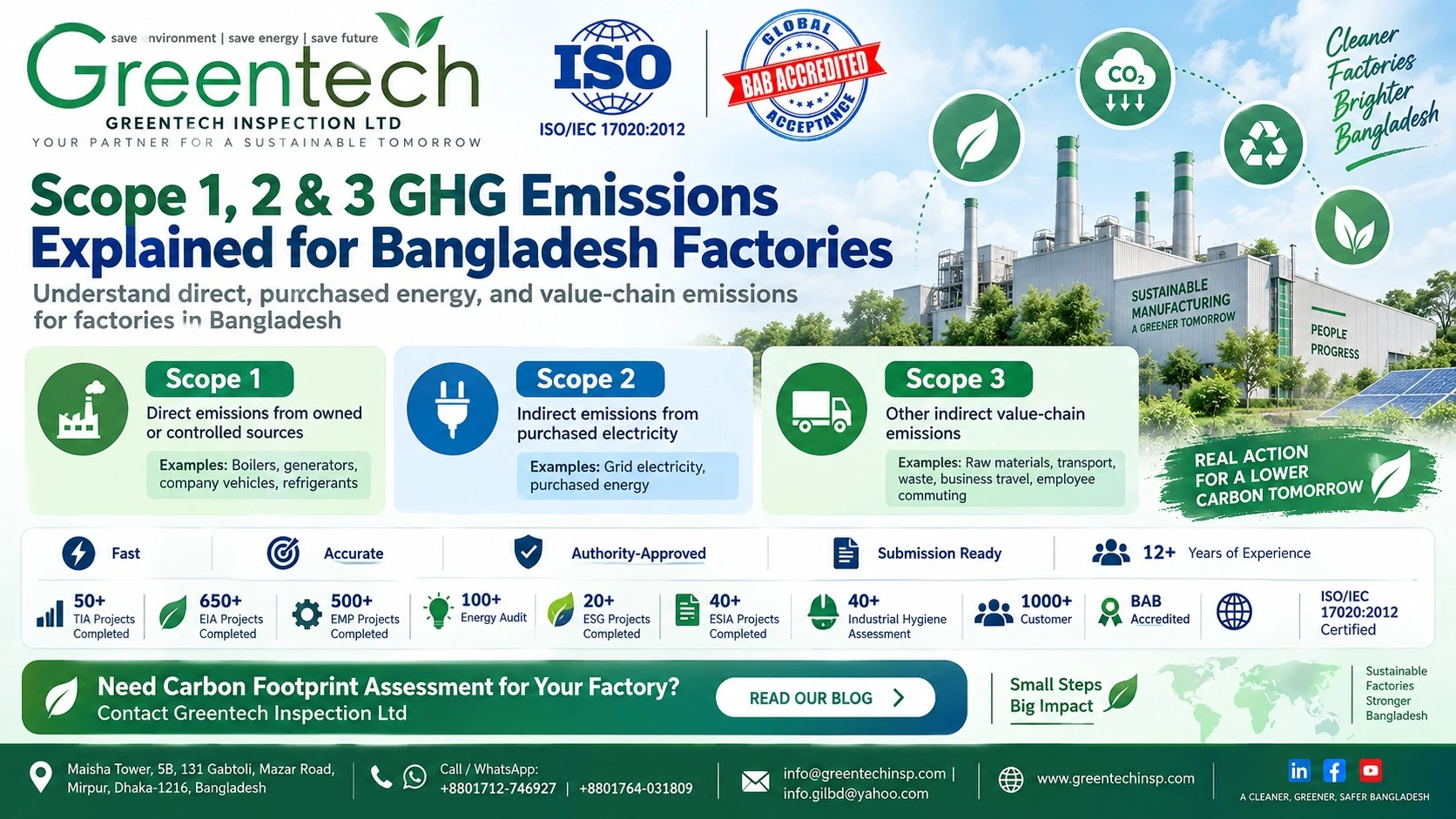
Scope 1, 2 & 3 GHG Emissions Explained for Bangladesh Factories
As pressure increases on industries to measure and reduce their climate impact, Greenhouse Gas (GHG) accounting is becoming increasingly important for factories in Bangladesh—particularly export-oriented manufacturers supplying international brands.
A corporate carbon footprint is generally divided into Scope 1, Scope 2 and Scope 3 emissions under the GHG Protocol framework. These categories help an organization understand where its greenhouse gas emissions originate and how they can be measured, reported and reduced.
The GHG Protocol Corporate Standard provides the internationally used framework for preparing corporate GHG inventories, while its Scope 2 Guidance covers purchased energy and its Scope 3 Standard addresses value-chain emissions.
For a factory in Bangladesh, the basic concept can be summarized as:
Scope 1 = Emissions from sources the factory owns or controls
Scope 2 = Emissions associated with purchased electricity, steam, heat or cooling
Scope 3 = Other indirect emissions throughout the factory's upstream and downstream value chain
What Are Scope 1 GHG Emissions?
Scope 1 covers direct greenhouse gas emissions from sources owned or controlled by the organization.
For a manufacturing facility in Bangladesh, common Scope 1 sources may include:
Natural gas used in boilers
Diesel used in generators
Furnace oil or other fuels used for thermal energy
LPG consumption
Petrol or diesel consumed by company-owned vehicles
Refrigerant leakage from air-conditioning and refrigeration systems
Fire-suppression gases
Process-related emissions where applicable
On-site wastewater treatment emissions where applicable
Example: Diesel Generator
Suppose a factory operates diesel generators during power interruptions.
The factory records:
Annual diesel consumption = 25,000 litres
GHG emissions are generally calculated using:
GHG Emissions = Activity Data × Applicable Emission Factor
The appropriate emission factor should be selected from an accepted and documented source consistent with the organization's chosen GHG accounting methodology.
For combustion activities, emissions may include:
Carbon dioxide (CO₂)
Methane (CH₄)
Nitrous oxide (N₂O)
These gases are converted into a common unit called:
tonnes of carbon dioxide equivalent — tCO₂e
What Are Scope 2 GHG Emissions?
Scope 2 represents indirect emissions associated with purchased or acquired electricity, steam, heat and cooling consumed by an organization.
For most factories in Bangladesh, purchased grid electricity will be the main Scope 2 source.
Bangladesh Factory Example
Suppose a garment factory purchases:
5,000 MWh of grid electricity per year
The Department of Environment issued a Bangladesh Grid Emission Factor notice dated 23 January 2025 stating:
2019–20: 0.61 tCO₂/MWh
2020–21: 0.62 tCO₂/MWh
2021–22: 0.62 tCO₂/MWh
The DoE notice refers to the Bangladesh First Biennial Update Report to the UNFCCC for the underlying methodology.
Using 0.62 tCO₂/MWh as an illustrative factor:
Scope 2 emissions = 5,000 MWh × 0.62 tCO₂/MWh
= 3,100 tCO₂
The emission factor selected for an actual corporate inventory should always correspond to the applicable reporting methodology, reporting year and available official or recognized data.
What Are Scope 3 GHG Emissions?
Scope 3 includes indirect emissions occurring across an organization's value chain that are not included within Scope 1 or Scope 2.
For many companies, Scope 3 represents the largest portion of the total corporate carbon footprint. The GHG Protocol organizes Scope 3 into 15 upstream and downstream categories.
For Bangladesh factories, Scope 3 can be particularly important because manufacturing operations depend heavily on raw materials, transportation, packaging, employee movement and international supply chains.
The 15 Scope 3 Categories
1. Purchased Goods and Services
This includes emissions associated with goods and services purchased by the company.
Examples for a garment or textile factory include:
Fabric
Yarn
Cotton
Dyes and chemicals
Accessories
Packaging materials
Office supplies
Outsourced professional services
For many manufacturing companies, this can be one of the largest Scope 3 categories.
2. Capital Goods
Emissions associated with manufacturing capital assets purchased by the company.
Examples include:
Production machinery
Boilers
Generators
Compressors
ETP equipment
Buildings
Electrical equipment
Vehicles
3. Fuel- and Energy-Related Activities
This includes certain upstream emissions associated with fuels and energy purchased by the company that are not already included in Scope 1 or Scope 2.
Examples may include upstream emissions associated with:
Natural gas
Diesel
LPG
Electricity generation and transmission
4. Upstream Transportation and Distribution
Emissions from transportation of purchased materials before they reach the factory.
Examples:
Port → Factory
Supplier → Factory
Warehouse → Factory
Transport modes may include:
Trucks
Covered vans
Ships
Rail
Air freight
5. Waste Generated in Operations
Examples include:
Fabric waste
Sludge
Chemical waste
Packaging waste
Plastic
Paper
Food waste
General solid waste
GHG emissions depend on how these wastes are treated—for example, recycling, landfill, incineration or biological treatment.
6. Business Travel
Examples:
Air travel
Hotel stays
Train travel
Bus travel
Rental vehicles
Taxi journeys
Travel information can often be collected through:
Origin + Destination + Travel Mode + Distance
7. Employee Commuting
This includes emissions from employees travelling between home and the workplace.
Relevant information may include:
Number of employees
Transportation method
Average travel distance
Working days
Bus usage
Motorcycle usage
Private car usage
CNG or other transport usage
Factories with thousands of workers may find this category significant.
8. Upstream Leased Assets
This category may apply where a company operates assets that it leases but whose emissions are not already accounted for within its Scope 1 or Scope 2 inventory boundary.
9. Downstream Transportation and Distribution
This includes transport and distribution of sold products after they leave the reporting company's operations, where applicable under the Scope 3 methodology.
For an export-oriented Bangladesh factory, this may include stages such as:
Factory → Port → Overseas customer/distribution centre
10. Processing of Sold Products
This category applies when products sold by the reporting company require further processing by another organization.
For example:
A textile manufacturer supplying unfinished fabric to another company for additional manufacturing may need to evaluate this category.
11. Use of Sold Products
This covers emissions generated during the use phase of products sold by the reporting company.
Its significance depends heavily on the product.
For some industrial products this can be very significant, while for other manufactured goods it may be relatively limited.
12. End-of-Life Treatment of Sold Products
This considers what happens when products and packaging reach the end of their useful lives.
Possible treatment routes include:
Recycling
Reuse
Landfill
Incineration
13. Downstream Leased Assets
This category can apply when an organization owns assets that it leases to other organizations or users and the associated emissions fall outside its Scope 1 and Scope 2 boundary.
14. Franchises
This applies primarily to organizations operating franchise business structures.
It may not be relevant to many Bangladesh manufacturing companies.
15. Investments
This category addresses emissions associated with investments and is particularly important for:
Banks
Financial institutions
Investment companies
Asset owners
It is generally less relevant to a factory unless the organization has material investment activities.
Scope 1 vs Scope 2 vs Scope 3: Simple Factory Example
Consider a textile factory in Gazipur.
Scope 1
The factory burns:
Natural gas in boilers
Diesel in generators
Diesel in company vehicles
These are generally Scope 1 emissions.
Scope 2
The factory purchases electricity from the national grid.
The emissions associated with generating this purchased electricity are generally Scope 2 emissions.
Scope 3
The factory purchases:
Cotton
Yarn
Chemicals
Packaging
Workers travel to the factory.
Finished garments are transported to Chattogram Port.
Employees travel internationally for business.
Waste is transported to third-party treatment facilities.
These activities can produce Scope 3 emissions.
What Data Should a Bangladesh Factory Collect?
A reliable GHG inventory starts with good activity data.
Typical data may include:
| Emission Source | Typical Data Required |
|---|---|
| Natural gas | m³ |
| Diesel | Litres |
| Petrol | Litres |
| LPG | kg/Litres |
| Grid electricity | kWh/MWh |
| Refrigerants | kg by refrigerant type |
| Raw materials | kg/tonnes |
| Chemicals | kg/tonnes |
| Packaging | kg/tonnes |
| Waste | kg/tonnes by treatment method |
| Freight | tonnes, km, vehicle type |
| Business travel | passenger-km |
| Employee commuting | km and transport type |
| Water | m³ |
| Purchased goods | quantity/mass/spend depending on method |
Supporting evidence should ideally be retained, such as:
Utility bills
Fuel purchase invoices
Meter records
Purchase records
ERP reports
Waste manifests
Transportation invoices
Travel records
Refrigerant servicing records
Supplier information
Basic GHG Calculation Formula
A common calculation structure is:
GHG Emissions = Activity Data × Emission Factor
For gases other than CO₂:
CO₂e = Quantity of GHG × Global Warming Potential (GWP)
Results are usually expressed as:
kg CO₂e or tCO₂e
A professional inventory should document:
Organizational boundary
Operational boundary
Reporting period
Base year
Activity data
Data sources
Emission factors
GWP values
Assumptions
Exclusions
Calculation methodology
Data-quality controls
Standards Commonly Used for GHG Accounting
Corporate GHG inventories may reference frameworks and data sources such as:
GHG Protocol Corporate Standard
GHG Protocol Scope 2 Guidance
GHG Protocol Corporate Value Chain (Scope 3) Standard
ISO 14064-1
IPCC Guidelines
Applicable national grid emission factors
Recognized emission-factor databases such as applicable UK Government conversion factors
Client, buyer or disclosure-program requirements
As of September 2026, GHG Protocol and ISO are developing a consolidated corporate GHG accounting standard combining the GHG Protocol corporate standards with ISO 14064-1. A consolidated public consultation is planned for Q2 2027, with publication of the joint standard currently targeted for Q4 2028.
Factories should therefore continue to clearly state the standards, versions, emission factors and methodologies applied to their current inventories rather than assuming a future standard is already effective.
Why Should Bangladesh Factories Measure Scope 1, 2 and 3?
Carbon accounting is increasingly relevant for Bangladesh manufacturers because international customers and supply chains increasingly request environmental and climate information.
A comprehensive GHG inventory can help a factory:
Identify major emission sources
Establish a carbon baseline
Respond to buyer sustainability requirements
Support ESG and sustainability reporting
Develop emission-reduction targets
Identify energy-saving opportunities
Improve supply-chain transparency
Monitor emissions year by year
Prepare for customer and disclosure requirements
Most importantly, measuring emissions allows management to identify where reductions can have the greatest impact.
How Greentech Inspection Ltd Can Support Your GHG Inventory
Greentech Inspection Ltd supports industries in Bangladesh with environmental, sustainability and carbon-management services.
Our GHG assessment approach can include:
Organizational and operational boundary determination
Scope 1 emission-source identification
Scope 2 electricity assessment
Scope 3 screening
Scope 3 category identification
Client data-collection templates
Activity-data verification
Selection and documentation of emission factors
GHG calculations
Carbon-footprint reporting
Emission hotspot identification
Reduction-opportunity assessment
GHG inventory documentation
Sustainability and ESG reporting support
A well-prepared GHG inventory should be transparent, traceable, consistent and supported by documented activity data and emission factors.
Need a Carbon Footprint Assessment for Your Factory?
Greentech Inspection Ltd can assist factories and organizations in Bangladesh in developing structured Scope 1, Scope 2 and Scope 3 GHG inventories aligned with applicable international methodologies and reporting requirements.
Contact Greentech Inspection Ltd for Carbon Footprint Assessment, GHG Inventory and Sustainability Consultancy Services in Bangladesh.
Greentech Inspection Ltd also provides:
SREDA-Certified Energy Auditor Bangladesh
Energy Efficiency Assessment Bangladesh
Green Financing Support Bangladesh
Bangladesh Bank Green Financing Support
GTF Documentation Support Bangladesh
TDF Documentation Support Bangladesh
LTFF Documentation Support Bangladesh
IDCOL Energy Efficiency Support Bangladesh
BIFFL Energy Efficiency Support Bangladesh
Higg Index Energy Support Bangladesh
ESG Consultancy Support Bangladesh
Environmental Consultant Bangladesh
Environmental Monitoring Bangladesh
Environmental Testing Bangladesh
Environmental Inspection Bangladesh
Environmental Consultant Bangladesh
EIA Consultant Bangladesh
ESIA Consultant Bangladesh
IEE Consultant Bangladesh
Environmental Management Plan Bangladesh
Environmental Monitoring Bangladesh
Environmental Inspection Bangladesh
Environmental Testing Bangladesh
Ambient Air Monitoring Bangladesh
Stack Emission Monitoring Bangladesh
Noise Level Assessment Bangladesh
Light Level Assessment Bangladesh
Water Quality Testing Bangladesh
Indoor Air Quality Monitoring Bangladesh
Industrial Hygiene Assessment Bangladesh
Energy Audit Bangladesh
ESG Consultancy Support Bangladesh
Traffic Impact Assessment Bangladesh
Industrial Hygiene Assessment Bangladesh
Energy Audit Bangladesh
ESG Consultancy Support Bangladesh
Traffic Impact Assessment (TIA) Bangladesh
DoE Consultancy
Environmental Management Plan Bangladesh
Industrial Hygiene Assessment Bangladesh
Environmental Management Plan Bangladesh
Address: Maisha Tower, 5B, 131 Gabtoli, Mazar Road, Mirpur, Dhaka-1216, Bangladesh
Call / WhatsApp: +8801712-746927 | +8801764-031809
Email: [email protected] | [email protected]
Website: www.greentechinsp.com
👉Fast | Accurate | Authority-Approved | Submission Ready | 12+ Years of Experience | 50+ TIA Projects Completed | 650+ EIA Projects Completed | 500+ EMP Projects Completed | 100+ Energy Audit | 20+ ESG Projects Completed | 40+ ESIA Projects Completed | 40+ Industrial Hygiene Assessment | 1000+ Customer | BAB Accredited | ISO/IEC 17020:2012 Certified |