Environmental Testing Services in Bangladesh: Air, Water, Noise, Stack Emission and Compliance Testing
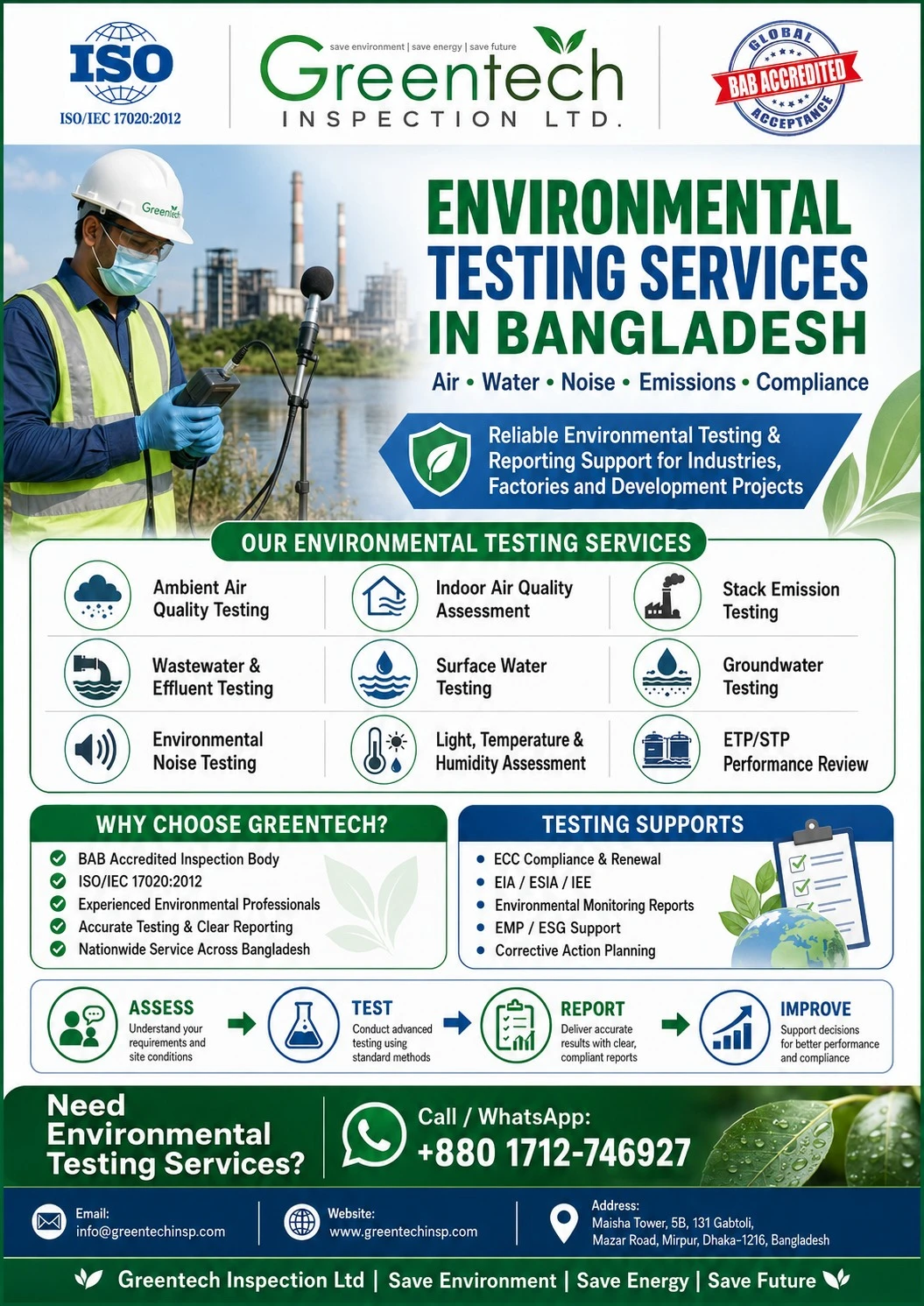
Environmental Testing Services in Bangladesh: Air, Water, Noise, Stack Emission and Compliance Testing
Industries and development projects need reliable environmental information to understand pollution risks, evaluate working conditions, maintain compliance and improve environmental performance.
Professional environmental testing provides measurable data about air quality, industrial emissions, wastewater, water resources, environmental noise and other conditions surrounding a facility or project.
In Bangladesh, environmental testing may support:
- Environmental Clearance Certificate applications and renewals
- Environmental Impact Assessment
- Environmental and Social Impact Assessment
- Initial Environmental Examination
- Environmental Management Plans
- Environmental monitoring reports
- Environmental compliance inspections
- Buyer and lender requirements
- ESG and sustainability reporting
- Corrective-action planning
Bangladesh’s current environmental regulatory framework includes the Environment Conservation Rules, 2023. The Department of Environment also lists regulatory instruments covering air pollution, waste management, hazardous waste, electronic waste and other environmental matters. The applicable testing requirements depend on the facility’s activities, pollution sources, location, environmental approvals and specific conditions.
Environmental testing should therefore be designed for the actual factory or project rather than performed using one standard package for every client.
What Is Environmental Testing?
Environmental testing is the measurement, sampling and analysis of environmental conditions associated with a facility, industrial process, construction project or surrounding area.
It may involve:
- Direct field measurement
- Instrument-based inspection
- Sample collection
- Laboratory analysis
- Operational observations
- Review of pollution-control systems
- Comparison with applicable criteria
- Preparation of a technical report
Testing provides data at a particular location and time.
For example:
- An air-quality instrument measures pollutants around a factory.
- A stack-emission assessment evaluates gases released from a boiler or generator.
- A wastewater sample helps assess ETP-outlet quality.
- A sound-level meter measures environmental noise.
- Water testing evaluates physical, chemical or microbiological quality.
The results should be interpreted together with the operating conditions, sampling location, testing method and intended purpose.
Why Environmental Testing Is Important
Environmental testing helps organizations replace assumptions with measurable evidence.
A professional testing program can help a company:
- Identify pollution sources
- Evaluate environmental conditions
- Assess pollution-control performance
- Detect abnormal emissions or discharges
- Support ECC compliance
- Establish EIA or ESIA baseline data
- Prepare environmental monitoring reports
- Investigate complaints
- Compare performance over time
- Plan corrective actions
- Support ESG environmental information
- Improve management decisions
Greentech’s existing environmental-service information connects testing and inspection with ECC support, EIA, ESIA, EMP, ESG documentation and industrial compliance.
Testing is particularly valuable when it is part of a continuing management process rather than a one-time activity completed only for document submission.
Main Environmental Testing Services
Ambient Air-Quality Testing
Ambient air-quality testing evaluates outdoor air conditions around an industrial facility, construction site, commercial development or infrastructure project.
Possible parameters may include:
- PM2.5
- PM10
- Carbon monoxide
- Sulphur dioxide
- Nitrogen dioxide
- Ozone
- Volatile organic compounds
- Temperature and relative humidity
- Process-specific pollutants
Monitoring locations may include:
- Factory boundaries
- Main entrances
- Production surroundings
- Downwind areas
- Background locations
- Nearby communities
- Schools and hospitals
- Construction boundaries
- High-traffic areas
The monitoring plan should explain why each location was selected.
Ambient air testing may support EIA baseline studies, construction monitoring, operational compliance, complaint investigations and environmental-performance reporting.
Indoor Air-Quality Assessment
Indoor air quality can affect employees, visitors and building occupants.
Assessment may include:
- Particulate matter
- Carbon dioxide
- Carbon monoxide
- Temperature
- Relative humidity
- Ventilation conditions
- Volatile organic compounds
- Odour or process-related concerns
Indoor air-quality assessment may be relevant for:
- Factories
- Offices
- Hospitals
- Schools
- Laboratories
- Warehouses
- Commercial buildings
- Production areas
- Enclosed workspaces
The findings should be evaluated together with ventilation, occupancy, processes, chemical use and building conditions.
Stack-Emission Testing
Stack-emission testing evaluates pollutants released from combustion or industrial-process equipment.
Potential sources include:
- Boilers
- Generators
- Furnaces
- Kilns
- Incinerators
- Thermal-oil heaters
- Process exhausts
- Industrial chimneys
Possible measurements may include:
- Particulate matter
- Carbon monoxide
- Carbon dioxide
- Oxygen
- Sulphur dioxide
- Nitrogen oxides
- Flue-gas temperature
- Gas-flow velocity
- Combustion efficiency
- Process-specific pollutants
The report should identify:
- Equipment type
- Rated capacity
- Fuel used
- Operating load
- Stack location
- Testing method
- Instrument details
- Results
- Comparison criteria
- Corrective recommendations
Testing under an unrepresentative operating condition may produce misleading results. Equipment load and production status should therefore be recorded.
Wastewater and Effluent Testing
Industries that generate process wastewater may require assessment of untreated and treated effluent.
Relevant industries may include:
- Textile and dyeing
- Washing and printing
- Pharmaceuticals
- Food processing
- Chemicals
- Paper and packaging
- Metal finishing
- Leather processing
- Utility operations
Depending on the process, parameters may include:
- pH
- Biochemical Oxygen Demand
- Chemical Oxygen Demand
- Total Suspended Solids
- Total Dissolved Solids
- Dissolved oxygen
- Colour
- Temperature
- Oil and grease
- Relevant metals
- Process-specific chemicals
The final test package should reflect the production process and wastewater characteristics.
The report should clearly identify whether the sample was taken from:
- ETP inlet
- ETP outlet
- Final discharge point
- Process drain
- Reuse-water point
- Another specified location
ETP Performance Assessment
A wastewater test provides only part of the compliance picture.
An ETP performance assessment may also review:
- Treatment capacity
- Wastewater generation
- Operating hours
- Inlet and outlet flow
- Equalization
- Chemical dosing
- Aeration
- pH control
- Equipment condition
- Sludge management
- Operator records
- Maintenance
- Bypass risks
One satisfactory result does not prove that the treatment plant performs consistently throughout the year. Routine operational monitoring and recordkeeping remain important.
Surface-Water Testing
Surface-water testing may cover:
- Rivers
- Canals
- Ponds
- Lakes
- Wetlands
- Drainage channels
- Water near an industrial discharge point
Possible sampling locations include:
- Upstream or background locations
- Near the discharge point
- Downstream locations
- Community-use locations
The assessment should consider nearby land use, existing pollution sources, seasonal conditions and how the water body is used.
Groundwater Testing
Groundwater assessment may be relevant where:
- Groundwater is used for production
- Workers use tube-well water
- Nearby communities depend on groundwater
- Fuel or chemicals are stored onsite
- Soil contamination is possible
- An EIA or ESIA requires groundwater data
- A pollution incident has occurred
The required parameters depend on the source, intended use and potential contamination pathway.
Drinking-Water Testing
Drinking-water testing evaluates the suitability of water supplied for consumption.
A testing plan may consider:
- Water source
- Treatment arrangements
- Storage tanks
- Distribution lines
- Chemical quality
- Physical quality
- Microbiological quality
Drinking-water testing should not be confused with industrial-water, surface-water or wastewater testing because the intended uses and assessment criteria differ.
Environmental Noise Testing
Environmental noise testing measures sound levels around a facility, project or sensitive location.
Monitoring may be conducted at:
- Factory boundaries
- Generator areas
- Boiler rooms
- Production areas
- Loading and unloading zones
- Construction sites
- Nearby residences
- Schools
- Hospitals
- Commercial areas
The report should record:
- Monitoring location
- Date and time
- Measurement duration
- Daytime or nighttime period
- Instrument information
- Weather conditions
- Facility operating status
- Nearby noise sources
- Results and observations
Environmental noise should be distinguished from occupational noise exposure, which focuses on worker exposure inside the workplace.
Light-Level Assessment
Light-level or lux assessment evaluates whether illumination is suitable for the task and working area.
Possible locations include:
- Production floors
- Inspection tables
- Warehouses
- Offices
- Corridors
- Stairways
- Emergency routes
- Outdoor work areas
Lighting conditions may affect visual comfort, work quality and safety.
Temperature and Humidity Assessment
Temperature and relative-humidity assessment may be useful in:
- Production areas
- Warehouses
- Laboratories
- Offices
- Chemical-storage areas
- Food-processing areas
- Pharmaceutical facilities
- Enclosed workplaces
The findings should be interpreted according to the process, occupancy and intended environmental conditions.
Soil and Sludge Assessment
Soil or sludge testing may be required when a site handles:
- Chemicals
- Fuel
- Used oil
- Hazardous materials
- ETP sludge
- Contaminated waste
- Industrial residue
It may also be relevant after:
- A spill
- Leakage
- Improper waste disposal
- Industrial-site redevelopment
- Closure or decommissioning
- Long-term chemical storage
Environmental Testing for ECC Compliance
Environmental testing may support an ECC application, compliance review or renewal by providing current information about:
- Air emissions
- Wastewater quality
- Environmental noise
- Pollution-control systems
- Water quality
- Environmental conditions
- Corrective actions
However, not every ECC applicant requires the same testing package.
The scope should be determined by reviewing:
- Facility category
- Production processes
- ECC conditions
- EIA or IEE commitments
- Environmental Management Plan
- Pollution sources
- Department of Environment instructions
- Previous monitoring results
Environmental testing does not itself guarantee an ECC or renewal. It provides technical evidence for the wider assessment and regulatory process.
Environmental Testing for EIA and ESIA
Testing is an important part of environmental baseline studies.
Before project development begins, testing may establish existing conditions for:
- Ambient air
- Surface water
- Groundwater
- Environmental noise
- Soil
- Existing pollution sources
Baseline data allows the assessment team to compare future environmental conditions against the pre-project situation.
The results can help:
- Identify sensitive receptors
- Predict project impacts
- Develop mitigation measures
- Select monitoring locations
- Prepare an EMP or ESMP
- Evaluate construction and operational changes
The testing scope should be based on the proposed project, surrounding environment, approved Terms of Reference and expected impact pathways.
Testing, Monitoring and Inspection: The Difference
These services are connected but not identical.
Environmental testing
Testing measures a parameter or analyzes a sample at a particular time.
Examples:
- Wastewater testing
- Stack-emission testing
- Noise measurement
- Groundwater analysis
Environmental monitoring
Monitoring tracks environmental conditions or performance repeatedly over time.
Examples:
- Quarterly effluent monitoring
- Construction dust monitoring
- Periodic stack assessment
- Monthly ETP-performance review
Environmental inspection
Inspection evaluates the overall facility, equipment, conditions, records and management practices.
Examples:
- ETP inspection
- Waste-storage inspection
- Chemical-store assessment
- ECC compliance inspection
- Pollution-source identification
Testing produces data, monitoring identifies trends and inspection evaluates the wider environmental condition.
Which Organizations May Need Environmental Testing?
Environmental testing may be relevant for:
- Garment factories
- Textile mills
- Dyeing and washing plants
- Pharmaceutical industries
- Food and beverage facilities
- Chemical industries
- Plastic and packaging factories
- Steel and engineering plants
- Power and energy projects
- Hospitals
- Universities
- Commercial buildings
- Economic zones
- Industrial parks
- Construction projects
- Roads and bridges
- Warehouses and logistics facilities
- Real-estate developments
- Export-oriented industries
The actual scope should reflect each organization’s pollution sources and environmental responsibilities.
Professional Environmental Testing Process
1. Requirement review
The consultant reviews the client’s objective, facility activities, ECC, EIA, EMP and applicable project requirements.
2. Site visit
Environmental professionals inspect the site and identify:
- Pollution sources
- Emission points
- Discharge points
- Sensitive receptors
- Pollution-control systems
- Suitable testing locations
3. Testing-plan preparation
The plan defines:
- Parameters
- Locations
- Number of measurements or samples
- Methods
- Equipment
- Operating conditions
- Reporting requirements
4. Field testing and sampling
Measurements and samples are collected using suitable procedures and equipment.
5. Analysis and technical review
Results are reviewed together with:
- Facility operations
- Applicable criteria
- Previous results
- Environmental conditions
- Potential sources
- Study limitations
6. Report preparation
The report presents:
- Scope
- Methodology
- Locations
- Equipment
- Results
- Interpretation
- Photographs
- Findings
- Corrective recommendations
7. Corrective-action support
Where an issue is identified, the consultant may support:
- Root-cause investigation
- Pollution-control improvement
- Follow-up testing
- Monitoring-plan revision
- Corrective-action reporting
What Should an Environmental Testing Report Include?
A professional report may contain:
- Client and facility information
- Testing objectives
- Facility description
- Testing date
- Operating condition
- Parameters
- Locations and coordinates
- Methods
- Instruments
- Calibration or verification information
- Results
- Units
- Applicable criteria
- Compliance evaluation
- Photographs
- Limitations
- Findings
- Recommendations
- Authorized review
When laboratory reports are included, they should be connected clearly to the sampling locations and field information.
How Often Should Environmental Testing Be Conducted?
There is no universal frequency for all industries.
Testing frequency may depend on:
- ECC conditions
- DoE instructions
- Environmental risk
- EIA or EMP requirements
- Production variability
- Previous results
- Pollution-control performance
- Buyer requirements
- Lender conditions
- Environmental complaints
- Operational changes
Additional testing may be appropriate after:
- Production expansion
- Fuel changes
- New machinery installation
- ETP modification
- Abnormal emissions
- An environmental incident
- Community complaints
- Unsatisfactory previous results
How to Select an Environmental Testing Company
Before appointing a service provider, review:
- Relevant technical experience
- Scope of services
- Professional competence
- Suitable instruments
- Testing methodology
- Reporting quality
- Quality-control procedures
- Sector experience
- Ability to interpret results
- Corrective-action support
- Applicable accreditation scope
Accreditation claims should be checked carefully. An inspection-body accreditation and a laboratory-testing accreditation are not automatically the same.
The Bangladesh Accreditation Board’s published scope lists Greentech Inspection Limited as a Type A inspection body accredited under ISO/IEC 17020:2012, with the certificate valid until 8 June 2028. The listed inspection scope includes areas such as noise, light, temperature, humidity, stack-air emissions and air-quality assessment.
Common Environmental Testing Mistakes
Organizations should avoid:
- Selecting parameters without reviewing the process
- Choosing convenient but unrepresentative locations
- Testing while the facility is not operating normally
- Omitting equipment load or production information
- Using outdated results
- Comparing data with an incorrect criterion
- Using inconsistent units
- Failing to document sampling locations
- Missing coordinates and photographs
- Attaching results without interpretation
- Ignoring unsatisfactory findings
- Confusing testing with continuous monitoring
- Assuming one package applies to every industry
- Making unsupported accreditation claims
- Treating one test as proof of permanent compliance
A good testing program should be technically justified, traceable and connected to corrective actions.
Environmental Testing Services by Greentech Inspection Ltd
Greentech Inspection Ltd provides environmental inspection, testing, monitoring and compliance-support services for industries and development projects across Bangladesh.
Available support may include:
- Ambient air-quality assessment
- Indoor air-quality assessment
- Stack-emission assessment
- Wastewater and effluent assessment
- Surface-water assessment
- Groundwater assessment
- Environmental noise assessment
- Light-level assessment
- Temperature and humidity assessment
- ETP and STP performance review
- Environmental compliance inspection
- Environmental Monitoring Report preparation
- EIA, IEE and ESIA support
- EMP and ESMP monitoring
- ECC application and renewal support
- ESG environmental-data support
Greentech’s website states that it serves industrial, commercial, infrastructure, energy and development projects and provides nationwide environmental inspection, testing, monitoring and reporting support.
Frequently Asked Questions
What is environmental testing?
Environmental testing is the measurement or analysis of environmental parameters such as air quality, emissions, water quality, wastewater, noise, light, temperature and humidity.
Which environmental tests does a factory need?
The required tests depend on the factory’s processes, emissions, wastewater, fuel, chemicals, location, ECC conditions and assessment objectives.
Is testing required for ECC renewal?
Testing or a compliance-monitoring report may be required depending on the ECC conditions, project category and Department of Environment requirements.
Is environmental testing the same as an environmental audit?
No. Testing produces measurements. An audit or inspection evaluates the overall environmental condition, records, management systems and compliance status.
Can environmental testing support an EIA?
Yes. Testing can establish baseline air, water, noise and soil conditions for impact assessment.
Can environmental data support ESG reporting?
Yes. Testing results can support environmental information concerning emissions, pollution, wastewater and compliance. A complete ESG report also requires governance, resource, risk and performance data.
Does every industry need stack-emission testing?
No. Stack testing is relevant when the facility operates boilers, generators, furnaces, process stacks or other applicable emission sources.
What happens when a result is unsatisfactory?
The facility should investigate the source, implement corrective action and arrange follow-up testing when appropriate.
Can one test report be used permanently?
No. Operations and environmental conditions change. Current results may be needed for monitoring, renewal, assessment or stakeholder reporting.
Conclusion
Environmental testing helps industries understand actual environmental conditions and make evidence-based compliance decisions.
A professional testing program should:
- Reflect the facility’s real activities
- Address relevant pollution sources
- Use appropriate parameters and locations
- Record operational conditions
- Apply suitable methods
- Interpret the results properly
- Identify corrective actions
- Support continuous monitoring
Environmental testing is most valuable when it is integrated with environmental inspection, monitoring, EIA, ESIA, EMP implementation, ECC compliance and ESG reporting.
Need Environmental Testing Services in Bangladesh?
Greentech Inspection Ltd provides professional environmental testing, inspection, monitoring and compliance support throughout Bangladesh.
Greentech Inspection Ltd also provides:
SREDA-Certified Energy Auditor Bangladesh
Energy Efficiency Assessment Bangladesh
Green Financing Support Bangladesh
Bangladesh Bank Green Financing Support
GTF Documentation Support Bangladesh
TDF Documentation Support Bangladesh
LTFF Documentation Support Bangladesh
IDCOL Energy Efficiency Support Bangladesh
BIFFL Energy Efficiency Support Bangladesh
Higg Index Energy Support Bangladesh
ESG Consultancy Support Bangladesh
Environmental Consultant Bangladesh
Environmental Monitoring Bangladesh
Environmental Testing Bangladesh
Environmental Inspection Bangladesh
Environmental Consultant Bangladesh
EIA Consultant Bangladesh
ESIA Consultant Bangladesh
IEE Consultant Bangladesh
Environmental Management Plan Bangladesh
Environmental Monitoring Bangladesh
Environmental Inspection Bangladesh
Environmental Testing Bangladesh
Ambient Air Monitoring Bangladesh
Stack Emission Monitoring Bangladesh
Noise Level Assessment Bangladesh
Light Level Assessment Bangladesh
Water Quality Testing Bangladesh
Indoor Air Quality Monitoring Bangladesh
Industrial Hygiene Assessment Bangladesh
Energy Audit Bangladesh
ESG Consultancy Support Bangladesh
Traffic Impact Assessment Bangladesh
Industrial Hygiene Assessment Bangladesh
Energy Audit Bangladesh
ESG Consultancy Support Bangladesh
Traffic Impact Assessment (TIA) Bangladesh
DoE Consultancy
Environmental Management Plan Bangladesh
Industrial Hygiene Assessment Bangladesh
Environmental Management Plan Bangladesh
Address: Maisha Tower, 5B, 131 Gabtoli, Mazar Road, Mirpur, Dhaka-1216, Bangladesh
Call / WhatsApp: +8801712-746927 | +8801764-031809
Email: [email protected] | [email protected]
Website: www.greentechinsp.com
👉Fast | Accurate | Authority-Approved | Submission Ready | 12+ Years of Experience | 50+ TIA Projects Completed | 650+ EIA Projects Completed | 500+ EMP Projects Completed | 100+ Energy Audit | 20+ ESG Projects Completed | 40+ ESIA Projects Completed | 40+ Industrial Hygiene Assessment | 1000+ Customer | BAB Accredited | ISO/IEC 17020:2012 Certified |