Electrical Audit, Single-Line Diagram (SLD) and Electrical Layout Drawing (ELD) for RSC Requirements and NIRAPON Safety Programs in Bangladesh
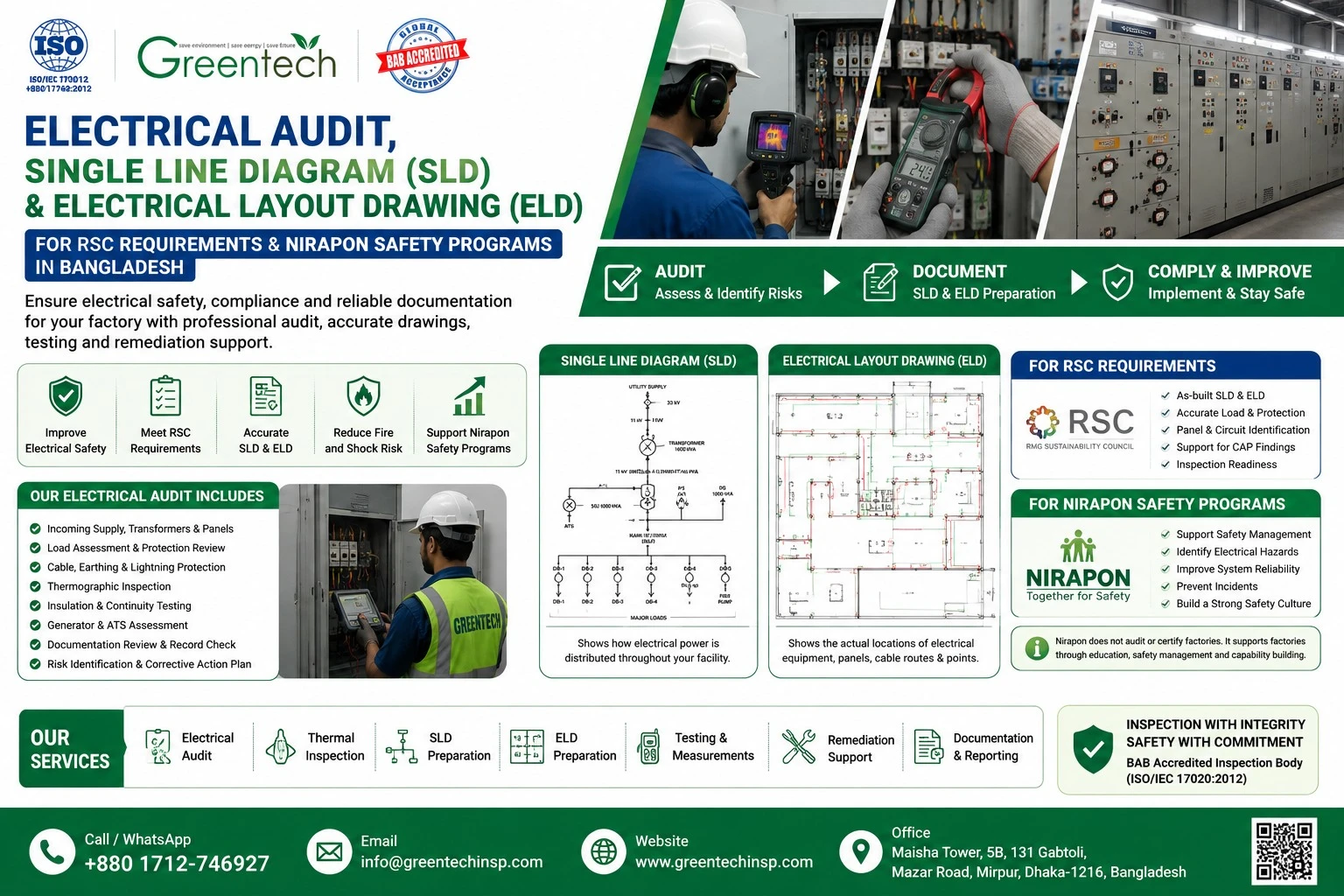
Electrical Audit, Single-Line Diagram and Electrical Layout Drawing for RSC Requirements and NIRAPON Safety Programs in Bangladesh.
Electrical safety is one of the most important compliance and operational issues for garment factories, textile facilities and other industrial establishments in Bangladesh.
Factories frequently modify their electrical systems by adding machinery, replacing generators, extending production floors, installing new distribution boards or changing transformer capacity. When these modifications are not properly assessed and documented, the actual installation may no longer match the approved drawings.
This can create serious risks, including:
- Electrical overloading
- Short circuits
- Cable overheating
- Electric shock
- Incorrect protective-device operation
- Equipment damage
- Production interruption
- Electrical fire
- Difficulty during emergency isolation
A professional electrical-safety program should therefore combine:
- Electrical audit and site assessment
- Single-Line Diagram preparation or updating
- Electrical Layout Drawing preparation
- Electrical testing and load verification
- Corrective Action Plan support
- Follow-up inspection and documentation
These services are particularly important for factories covered by RSC electrical-safety requirements and factories participating in buyer or Nirapon safety-management programs.
Understanding RSC and Nirapon
RMG Sustainability Council
The RMG Sustainability Council, commonly known as RSC, conducts inspections covering structural, electrical, fire and life safety, and boiler safety at covered factories in Bangladesh. Its Electrical Safety Engineering department conducts different types of electrical inspections and follows up on remediation requirements.
RSC technical guidance requires electrical drawings to represent the actual factory installation. Its technical standard states that a Single-Line Diagram should be maintained and continuously updated to reflect as-built conditions.
Nirapon
Nirapon is an industry-led organization working with brands, retailers and factories to strengthen workplace-safety culture in Bangladesh.
However, Nirapon does not directly conduct audits or certify factories. It focuses on education, safety-management systems, regular reporting, safety-support visits and capability development.
Nirapon advises factories to conduct regular preventive maintenance and inspections, commission professional risk assessments, and engage qualified electrical engineers to identify improvements in electrical systems.
Therefore, the correct service wording is:
Electrical audit, SLD and ELD support for RSC requirements and Nirapon factory-safety programs
It should not be advertised as a “Nirapon-approved audit” unless a specific written authorization exists.
What Is an Electrical Audit?
An electrical audit is a systematic examination of a factory’s electrical installation, equipment, drawings, load condition, protective systems and maintenance practices.
The objective is to identify electrical hazards and determine whether the installation is:
- Properly designed
- Safely installed
- Adequately protected
- Correctly maintained
- Accurately documented
- Suitable for the existing electrical load
- Prepared for future expansion
- Consistent with applicable safety requirements
An electrical audit normally combines document review, visual inspection, technical measurements and engineering evaluation.
Main areas of an electrical audit
Incoming electrical supply
The audit may examine:
- Utility connection
- Incoming voltage
- Sanctioned or approved load
- Main protective device
- Metering arrangement
- Transformer supply
- Generator connection
- Solar or alternative supply
Transformer and substation
The assessment may review:
- Transformer capacity
- Existing connected load
- Transformer protection
- Cable sizing
- Busbar arrangement
- Earthing
- Ventilation
- Oil leakage
- Safety clearance
- Access control
- Warning signs
- Fire-protection arrangements
Main and sub-distribution boards
The engineer may check:
- Panel identification
- Breaker ratings
- Cable sizes
- Busbar ratings
- Phase balance
- Neutral arrangement
- Earthing and bonding
- Cable termination
- Exposed live parts
- Unused openings
- Internal cleanliness
- Working clearance
- Thermal condition
Production machinery
The audit may review:
- Machine connection
- Motor protection
- Local isolators
- Cable routing
- Equipment earthing
- Emergency-stop arrangements
- Overload protection
- Temporary or unauthorized wiring
Generator and emergency supply
The assessment may cover:
- Generator capacity
- Connected emergency load
- Automatic Transfer Switch
- Changeover system
- Generator earthing
- Cable sizing
- Protection arrangement
- Emergency-lighting supply
- Fire-pump supply
- Maintenance records
What Is a Single-Line Diagram?
A Single-Line Diagram, commonly abbreviated as SLD, is a simplified technical drawing showing how electrical power is received and distributed throughout a factory.
Instead of drawing every conductor separately, standardized symbols and single lines are used to represent the three-phase electrical system.
An SLD acts as the electrical system’s main reference drawing.
Information generally shown in an SLD
A professional as-built SLD may include:
- Utility incoming supply
- Transformer
- Generator
- Automatic Transfer Switch
- HT panel
- LT panel
- Main distribution boards
- Sub-main distribution boards
- Distribution boards
- Bus couplers
- Capacitor banks
- UPS systems
- Solar-power systems
- Major production loads
- Fire-pump supply
- Emergency-power circuits
- Breaker types and ratings
- Fuse ratings
- Cable sizes
- Busbar ratings
- Connected and demand loads
- Earthing arrangements
- Panel and equipment references
RSC’s Electrical Single-Line Diagram Guidance indicates that an SLD package should include an index, legend, page references and appropriate electrical symbols.
Why RSC Requires an Updated SLD
RSC technical guidance requires the SLD to reflect the actual electrical installation rather than an old or theoretical design.
An updated SLD helps engineers and safety personnel:
- Understand the complete power-distribution system
- Locate the source of each circuit
- Identify upstream and downstream protection
- Isolate equipment safely
- Review cable and breaker coordination
- Check transformer and generator loading
- Identify emergency-power circuits
- Plan factory expansion
- Investigate electrical incidents
- Implement corrective actions
- Conduct future electrical inspections
An inaccurate SLD can delay troubleshooting and create confusion during an emergency.
As-designed SLD and as-built SLD
An as-designed SLD represents the electrical system originally planned before installation.
An as-built SLD represents the installation that actually exists at the factory.
Differences may occur when:
- Machinery is added
- Panels are relocated
- Generator capacity changes
- Transformer capacity changes
- Breakers are replaced
- Cables are changed
- Production areas are expanded
- New floors are occupied
- Solar or UPS systems are installed
- Emergency circuits are modified
For factory-safety purposes, the final drawing should represent the current as-built installation.
What Is an Electrical Layout Drawing?
An Electrical Layout Drawing, abbreviated as ELD, shows the physical locations of electrical equipment and electrical installations within the building.
While an SLD explains how electricity is connected, an ELD explains where the equipment and electrical points are located.
RSC’s technical standard refers to electrical layout drawings for new and interim construction after the proper locations of lamps, fans, fixed equipment and transportable appliances have been determined.
An ELD may show
- Main electrical panels
- Distribution boards
- Sub-distribution boards
- Transformers
- Generators
- Cable trays
- Busbar trunking
- Cable routes
- Switches and socket outlets
- Lighting points
- Emergency lights
- Exhaust fans
- Production machinery
- Motor-control panels
- Isolators
- Earthing points
- Electrical rooms
- UPS and battery rooms
- Fire-pump electrical panels
The ELD should be prepared floor by floor where necessary.
Difference Between SLD and ELD
| Item | Single-Line Diagram | Electrical Layout Drawing |
|---|---|---|
| Main purpose | Shows electrical connections | Shows physical locations |
| Main focus | Power-distribution sequence | Equipment and wiring arrangement |
| Drawing type | Schematic | Floor-plan based |
| Shows breaker ratings | Yes | May show references |
| Shows cable sizes | Yes | May show cable routes |
| Shows panel location | By system reference | By actual building location |
| Used for load analysis | Yes | Limited |
| Used for physical inspection | Yes | Yes |
| Needs as-built updating | Yes | Yes |
Both drawings should agree with each other.
For example, when an SLD identifies a panel as “DB-3F-02,” the ELD should show the physical position of that panel on the third-floor layout.
Electrical Audit Process for RSC Readiness
Step 1: Collect available documents
The consultant should review:
- Existing SLD
- Existing electrical layouts
- Transformer information
- Generator information
- Panel schedules
- Cable schedules
- Utility bills
- Approved electrical load
- Previous inspection reports
- Corrective Action Plan
- Machinery list
- Floor layouts
- Fire-safety drawings
Step 2: Conduct a physical survey
The engineering team traces the electrical distribution system from:
Incoming supply → transformer → main panel → sub-panel → distribution board → machinery and final loads
The team records:
- Equipment ratings
- Breaker ratings
- Cable sizes
- Panel names
- Circuit destinations
- Generator connections
- ATS arrangement
- Earthing connections
- Existing load information
Step 3: Compare drawings with the installation
The team identifies differences such as:
- Missing panels
- Incorrect panel names
- Changed breaker ratings
- Added machinery
- Incorrect cable information
- New generator connections
- Unrecorded production-floor extensions
- Missing emergency circuits
Step 4: Conduct technical testing
Depending on the scope, testing may include:
- Thermographic inspection
- Insulation-resistance testing
- Earthing-resistance testing
- Earth-continuity testing
- Load-current measurement
- Phase-balance assessment
- Voltage measurement
- Generator-load assessment
- Lightning-protection testing
Step 5: Identify safety gaps
Findings may include:
- Electrical overloading
- Improper breaker selection
- Undersized cable
- Loose connection
- Missing earthing
- Exposed conductor
- Open panel penetration
- Poor cable termination
- Combustible storage near panels
- Temporary wiring
- Missing panel labels
- Unavailable or outdated SLD
- Layout drawings that do not match the site
Step 6: Prepare the audit report
The report should contain:
- Executive summary
- Factory and building information
- Scope and methodology
- Electrical-system description
- Observations
- Test results
- Photographs
- Thermal images
- Risk classification
- Corrective recommendations
- Updated SLD and ELD status
- Action priorities
Step 7: Complete corrective actions
Qualified personnel should complete the identified remedial work.
The factory should maintain:
- Work-completion records
- Revised drawings
- Test certificates
- Photographic evidence
- Purchase documents
- Engineer verification
- Corrective-action closure records
Important Information for an RSC-Ready SLD
An RSC-ready SLD should normally be:
- Based on a complete site survey
- Consistent with the actual installation
- Clearly indexed
- Properly numbered
- Supported by a legend
- Prepared using recognized symbols
- Legible when printed
- Cross-referenced between pages
- Consistent with panel labels
- Updated after modifications
- Reviewed by a competent electrical engineer
The drawing should avoid:
- Unidentified panels
- Missing cable sizes
- Missing breaker ratings
- Conflicting panel names
- Unclear generator connections
- Incorrect transformer information
- Unverified load information
- Unconnected drawing sections
- Outdated equipment details
Nirapon Safety-Management Considerations
Nirapon emphasizes that workplace safety depends on maintaining effective systems and not only closing one-time corrective actions.
Its Safety Management Program encourages factories to:
- Identify hazards
- Maintain risk registers
- Establish safety policies
- Create operating procedures
- Conduct regular reporting
- Engage workers
- Provide safety training
- Maintain engineered safety solutions
- Review performance continuously
For electrical safety, factories should therefore integrate their audit, SLD and ELD into routine management.
Recommended practices include:
- Review electrical load periodically
- Update drawings after every modification
- Conduct preventive maintenance
- Record breaker trips and electrical incidents
- Inspect panels and cables regularly
- Train electrical-maintenance personnel
- Maintain qualified specialist support
- Include electrical hazards in the risk register
- Track corrective actions
- Review electrical safety through the factory safety committee
Nirapon’s electrical-load guidance specifically recommends regular inspections, professional risk assessments and support from electrical engineering specialists.
Common Factory Documentation Mistakes
Factories should avoid:
- Using “NEROPON” instead of “Nirapon”
- Calling an ELD an “Electrical Line Diagram”
- Advertising a “Nirapon-approved audit”
- Claiming that Nirapon certifies factories
- Submitting an SLD without a site survey
- Copying drawings from another factory
- Keeping old panel names in the drawing
- Omitting generator and ATS connections
- Omitting emergency circuits
- Failing to update drawings after expansion
- Preparing drawings that cannot be read when printed
- Showing proposed conditions as completed work
- Submitting drawings that do not match panel labels
- Closing findings without supporting evidence
Benefits of Professional Electrical Audit, SLD and ELD Services
Professional support can help factories:
- Improve electrical safety
- Prepare for RSC inspection
- Address RSC Corrective Action Plan findings
- Maintain accurate as-built drawings
- Identify overloaded circuits
- Improve protection coordination
- Reduce electrical-fire risk
- Improve emergency isolation
- Support factory expansion
- Improve preventive maintenance
- Demonstrate safety-management commitment
- Support brand and buyer requirements
- Strengthen Nirapon safety-management practices
- Protect workers and production assets
Greentech Inspection Ltd Services
Greentech Inspection Ltd provides electrical-safety and engineering-documentation support for factories across Bangladesh.
Our services may include:
- Electrical safety audit
- RSC electrical-readiness assessment
- Electrical site survey
- As-built SLD preparation
- Existing SLD review and updating
- Electrical Layout Drawing preparation
- Panel and circuit schedule preparation
- Electrical load assessment
- Transformer and generator assessment
- Thermographic inspection
- Insulation-resistance testing
- Earthing testing
- Lightning-protection assessment
- Corrective Action Plan support
- Electrical remediation verification
- Fire-safety assessment and drawing support
- Factory electrical-safety documentation
Frequently Asked Questions
Is Nirapon the correct spelling?
Yes. The correct name is Nirapon, not NEROPON.
Does Nirapon audit factories?
Nirapon states that it does not conduct audits. It provides education, capability building and safety-management support.
Does Nirapon certify factories?
No. Nirapon states that it does not certify factories.
Does RSC conduct electrical inspections?
Yes. RSC conducts electrical-safety inspections at covered factories through its Electrical Safety Engineering department.
What does SLD mean?
SLD means Single-Line Diagram.
What does ELD mean?
In this context, ELD means Electrical Layout Drawing.
Is an SLD required to match the factory?
Yes. RSC’s technical standard requires the SLD to be maintained and continuously updated to represent as-built conditions.
When should an SLD be updated?
It should be updated after significant electrical modifications, machinery additions, panel changes, generator or transformer changes, production expansion or cable modifications.
Is an SLD enough without an ELD?
No. The drawings serve different purposes. The SLD shows system connections, while the ELD shows the physical locations and arrangements.
Can drawings be prepared without a physical survey?
That is not recommended for as-built drawings. The electrical installation should first be surveyed and verified onsite.
Conclusion
Electrical audits, Single-Line Diagrams and Electrical Layout Drawings are essential components of factory electrical-safety management.
For RSC-covered factories, the SLD should accurately represent the existing installation and remain updated as the electrical system changes. The ELD should identify the physical locations and layout of panels, equipment, circuits and electrical points.
For factories participating in Nirapon safety programs, professional electrical assessment and accurate documentation support the wider objective of maintaining safe systems, identifying hazards and managing risk continuously.
Factories should therefore:
- Conduct professional electrical assessments
- Maintain accurate as-built SLDs
- Prepare floor-wise electrical layouts
- Verify loads, cables and protective devices
- Update drawings after every major change
- Correct electrical hazards promptly
- Maintain supporting evidence
- Integrate electrical safety into routine management
Need Electrical Audit, SLD or ELD Services?
Greentech Inspection Ltd provides professional electrical audits, RSC-readiness assessments, SLD preparation, ELD preparation, electrical testing and corrective-action support across Bangladesh.
Greentech Inspection Ltd also provides:
SREDA-Certified Energy Auditor Bangladesh
Energy Efficiency Assessment Bangladesh
Green Financing Support Bangladesh
Bangladesh Bank Green Financing Support
GTF Documentation Support Bangladesh
TDF Documentation Support Bangladesh
LTFF Documentation Support Bangladesh
IDCOL Energy Efficiency Support Bangladesh
BIFFL Energy Efficiency Support Bangladesh
Higg Index Energy Support Bangladesh
ESG Consultancy Support Bangladesh
Environmental Consultant Bangladesh
Environmental Monitoring Bangladesh
Environmental Testing Bangladesh
Environmental Inspection Bangladesh
Environmental Consultant Bangladesh
EIA Consultant Bangladesh
ESIA Consultant Bangladesh
IEE Consultant Bangladesh
Environmental Management Plan Bangladesh
Environmental Monitoring Bangladesh
Environmental Inspection Bangladesh
Environmental Testing Bangladesh
Ambient Air Monitoring Bangladesh
Stack Emission Monitoring Bangladesh
Noise Level Assessment Bangladesh
Light Level Assessment Bangladesh
Water Quality Testing Bangladesh
Indoor Air Quality Monitoring Bangladesh
Industrial Hygiene Assessment Bangladesh
Energy Audit Bangladesh
ESG Consultancy Support Bangladesh
Traffic Impact Assessment Bangladesh
Industrial Hygiene Assessment Bangladesh
Energy Audit Bangladesh
ESG Consultancy Support Bangladesh
Traffic Impact Assessment (TIA) Bangladesh
DoE Consultancy
Environmental Management Plan Bangladesh
Industrial Hygiene Assessment Bangladesh
Environmental Management Plan Bangladesh
Address: Maisha Tower, 5B, 131 Gabtoli, Mazar Road, Mirpur, Dhaka-1216, Bangladesh
Call / WhatsApp: +8801712-746927 | +8801764-031809
Email: [email protected] | [email protected]
Website: www.greentechinsp.com
👉Fast | Accurate | Authority-Approved | Submission Ready | 12+ Years of Experience | 50+ TIA Projects Completed | 650+ EIA Projects Completed | 500+ EMP Projects Completed | 100+ Energy Audit | 20+ ESG Projects Completed | 40+ ESIA Projects Completed | 40+ Industrial Hygiene Assessment | 1000+ Customer | BAB Accredited | ISO/IEC 17020:2012 Certified |