Electrical Testing, Electrical Safety Audits, single-line diagrams (SLD), thermographic inspections and fire safety services for industries in Bangladesh.
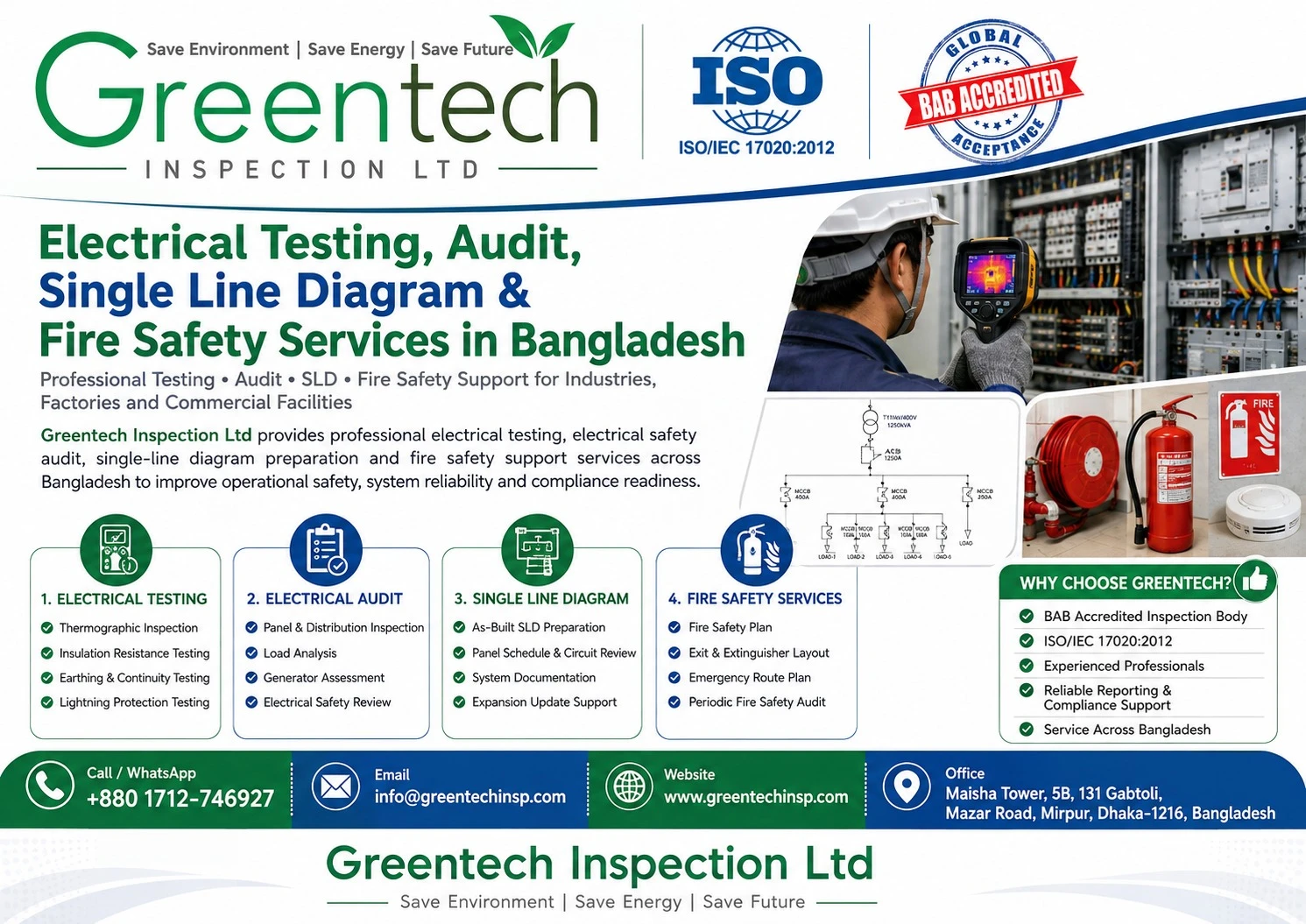
Electrical Testing, Audit, Single-Line Diagram and Fire Safety Services in Bangladesh.
Electrical faults are among the most serious operational and safety risks faced by factories, commercial buildings, hospitals, warehouses and infrastructure facilities in Bangladesh.
Loose electrical connections, overloaded circuits, damaged insulation, ineffective earthing, incorrect protective devices and outdated drawings can increase the risk of electrical shock, equipment failure, production interruption and fire.
A professional electrical safety program should therefore combine four connected activities:
- Electrical testing
- Electrical safety auditing
- Single-line diagram preparation
- Fire safety assessment and planning
Testing provides measurable information about the condition of an electrical installation. An audit reviews the complete electrical system, documentation and operating practices. A single-line diagram records how the power-distribution system is connected. Fire safety services evaluate how effectively the building prevents, detects and responds to a fire emergency.
Bangladesh’s electrical-safety framework includes the Electricity Act, 2018, while the Bangladesh National Building Code 2020 provides national building requirements covering electrical installations, fire protection and means of escape. BNBC 2020 was formally published through the government gazette.
The final testing, audit and fire-safety scope should always be selected according to the facility type, electrical load, building use, equipment, applicable approval conditions and instructions from the relevant authorities.
Why Electrical Safety Is Important for Industries
Industrial facilities use electrical systems that are significantly more complex than ordinary residential installations.
A factory may operate:
- Transformers
- HT and LT switchgear
- Main distribution boards
- Sub-distribution boards
- Motors and production machinery
- Boilers and utility equipment
- Generators
- Automatic transfer switches
- Capacitor banks
- UPS and battery systems
- Fire pumps
- Emergency lighting
- Lightning-protection systems
A weakness in one part of the system can affect several areas of the facility.
For example, an overloaded circuit may create excessive heat. A loose terminal can produce a localized hotspot. Poor earthing can increase electric-shock risk. An incorrectly selected protective device may fail to isolate a fault effectively.
Official DIFE electrical-assessment reports have identified recurring factory deficiencies such as unavailable single-line diagrams, improper cable joints, combustible materials near distribution boards, missing overcurrent protection and inadequate emergency-power arrangements.
A planned electrical testing and audit program helps a facility identify these problems before they result in a serious incident.
What Is Electrical Testing?
Electrical testing is the use of suitable instruments and technical methods to evaluate the safety, condition and performance of an electrical installation.
International electrical-installation guidance treats verification as a combination of inspection, testing and reporting. IEC 60364-6 specifically addresses initial and periodic verification of low-voltage electrical installations.
Electrical testing may be conducted:
- After a new installation
- After an extension or modification
- Before commissioning
- During periodic maintenance
- After equipment failure
- Before a buyer or safety audit
- Following abnormal heating or tripping
- After a fire, flood or major electrical incident
- Before factory expansion
- When updating the electrical SLD
Testing should be conducted by competent personnel using suitable equipment and appropriate isolation, access and safety procedures.
Main Electrical Testing Services
1. Thermographic Electrical Inspection
Thermographic inspection uses an infrared camera to identify abnormal heat patterns in energized electrical equipment.
Typical inspection locations include:
- Main electrical panels
- Distribution boards
- Busbar connections
- Circuit breakers
- Cable terminals
- Motor-control centres
- Transformers
- Generator connections
- Capacitor banks
- Automatic transfer switches
Thermography may help identify:
- Loose connections
- Unbalanced loads
- Overloaded circuits
- Defective breakers
- Deteriorating cable terminals
- Abnormal contact resistance
- Overheating electrical components
The inspection report should include thermal images, visible-light photographs, temperature observations, equipment identification, risk classification and recommended corrective actions.
Thermal findings should be interpreted carefully. A higher temperature does not automatically identify the root cause. The engineer should consider equipment load, surrounding temperature, phase balance, connection condition and equipment specifications.
2. Cable Insulation Resistance Testing
Cable insulation protects conductors from unintended contact with earth, equipment bodies and other conductors.
Insulation can deteriorate because of:
- Age
- Heat
- Moisture
- Mechanical damage
- Chemical exposure
- Dust and contamination
- Incorrect installation
- Repeated overloading
Insulation-resistance testing helps evaluate whether the insulation condition is suitable for continued service.
Depending on the system, testing may cover:
- Power cables
- Distribution circuits
- Motor circuits
- Control cables
- Generator circuits
- Lighting circuits
- Fixed electrical equipment
Testing normally requires appropriate isolation. Sensitive electronic equipment may need to be disconnected or protected before the test is conducted.
3. Earthing Resistance Testing
An earthing system provides a controlled path for fault current and supports the operation of electrical-protection systems.
Earthing tests may cover:
- Main electrical earthing
- Transformer earthing
- Generator earthing
- Equipment-body earthing
- Panel-body and panel-door earthing
- Lightning-protection earthing
- Fire-pump earthing
- Separate functional earthing arrangements
DIFE assessment records have highlighted factory issues such as missing generator-frame earthing, inadequate equipment earthing and unavailable earthing connections for distribution-panel doors.
An earthing report should identify:
- Test-point location
- Electrode or earthing-system identification
- Testing method
- Instrument used
- Weather and soil condition, where relevant
- Measured result
- Applicable project criterion
- Corrective recommendation
4. Earth-Continuity Testing
Earth-continuity testing checks whether exposed conductive parts are connected continuously to the protective-earthing system.
Possible testing locations include:
- Electrical panels
- Panel doors
- Machines
- Cable trays
- Metal conduits
- Motor bodies
- Generator frames
- Metal enclosures
- Socket outlets
A visually connected earth conductor may still have a loose, damaged or high-resistance connection. Testing provides stronger evidence than visual inspection alone.
5. Lightning-Protection System Testing
A lightning-protection system may include:
- Air terminals
- Down conductors
- Bonding connections
- Test joints
- Earth electrodes
- Surge-protection devices
The assessment should review both physical condition and electrical continuity.
Common concerns include:
- Broken down conductors
- Corroded connections
- Inadequate bonding
- Damaged earth pits
- Missing test links
- Building modifications that affect coverage
- New rooftop equipment not connected to the system
The required design and testing criteria should be based on the applicable building, project and engineering requirements.
6. Voltage, Current and Load Measurement
Operational measurements can help determine whether an electrical system is being used within its intended capacity.
Measurements may include:
- Phase voltage
- Line voltage
- Phase current
- Neutral current
- Frequency
- Demand
- Power factor
- Phase imbalance
- Equipment loading
The results can help identify:
- Overloaded circuits
- Uneven phase loading
- Excessive neutral current
- Low power factor
- Voltage variation
- Capacity limitations
- Need for load redistribution
Load measurement is especially useful before installing additional machinery or increasing production capacity.
7. Protective-Device Assessment
Protective devices are intended to isolate electrical faults and protect cables, equipment and users.
The audit may review:
- Fuse ratings
- MCB ratings
- MCCB ratings
- Relay settings
- Overload protection
- Short-circuit protection
- Earth-leakage protection
- Selectivity and coordination
- Breaker condition
- Labelling and circuit identification
The rating of a breaker should be reviewed together with cable size, expected load and fault-protection requirements. Installing a larger breaker without confirming cable capacity can create a serious risk.
8. Generator Testing and Efficiency Assessment
Generators are essential for production continuity, emergency lighting, fire pumps and other critical loads.
Generator assessment may include:
- Nameplate and rated capacity
- Connected emergency load
- Loading condition
- Voltage and frequency
- Fuel-consumption data
- Exhaust condition
- Changeover or ATS operation
- Cable and protection arrangement
- Earthing
- Ventilation
- Maintenance records
- Emergency supply adequacy
The capacity should be reviewed against essential loads rather than only the generator’s rated output.
Greentech Inspection Ltd currently lists generator-efficiency assessment, generator layouts and electrical testing among its industrial electrical services.
What Is an Electrical Safety Audit?
An electrical safety audit is a structured review of the electrical installation, documents, equipment, maintenance practices and safety controls of a facility.
Testing is one part of the audit, but an audit covers a wider scope.
A complete audit may evaluate:
- Electrical drawings and records
- Utility supply and sanctioned load
- Transformers and substations
- HT and LT panels
- Main and sub-distribution boards
- Cable selection and installation
- Protection systems
- Earthing and bonding
- Generator and ATS arrangements
- Electrical rooms
- Machinery connections
- Emergency power
- Maintenance procedures
- Electrical worker competency
- Permit-to-work arrangements
- Lockout and isolation procedures
- Previous incidents and corrective actions
Electrical panel inspection
The auditor may check:
- Panel enclosure condition
- Accessibility and working space
- Cable entry and exit sealing
- Unused openings
- Breaker condition
- Busbar protection
- Circuit labels
- Danger signs
- Internal cleanliness
- Loose or exposed conductors
- Combustible materials
- Panel-door earthing
- Thermographic condition
Official DIFE observations have included missing danger signs, unavailable circuit diagrams, unsealed cable openings and inadequate panel earthing.
Cable installation inspection
The audit may examine:
- Cable size
- Cable loading
- Routing
- Mechanical protection
- Cable-tray support
- Bend radius
- Termination quality
- Cable joints
- Identification
- Separation from heat or water
- Fire stopping at wall and floor penetrations
Electrical-room inspection
Transformer, generator and switchgear rooms should be reviewed for:
- Restricted access
- Adequate working clearance
- Ventilation
- Lighting
- Emergency lighting
- Housekeeping
- Water leakage
- Combustible storage
- Fire-protection equipment
- Warning signs
- Updated drawings
- Safe access and escape
What Is a Single-Line Diagram?
A Single-Line Diagram, usually abbreviated as SLD, is a simplified technical drawing showing how electrical power flows through a facility.
It uses standardized symbols and a single line to represent a three-phase electrical system.
A properly prepared SLD may show:
- Incoming utility supply
- Transformers
- Generators
- ATS or changeover arrangements
- HT switchgear
- LT switchgear
- Bus couplers
- Main distribution boards
- Sub-distribution boards
- Capacitor banks
- UPS systems
- Solar or alternative supplies
- Major electrical loads
- Circuit breakers and fuses
- Cable sizes
- Equipment ratings
- Earthing arrangements
Why an Updated SLD Is Important
An SLD helps engineers and maintenance teams understand:
- Where electrical power enters the facility
- How each panel receives power
- Which breaker controls each circuit
- How generators and utility supplies are interconnected
- Where isolation should occur
- Whether equipment ratings are coordinated
- Which systems receive emergency power
- How future expansion will affect the installation
DIFE assessment reports repeatedly identify unavailable or outdated SLDs as electrical-safety deficiencies. The corrective recommendations commonly require an updated, as-built SLD matching the actual factory installation.
As-designed SLD vs as-built SLD
An as-designed SLD shows the system originally planned by the engineer.
An as-built SLD shows the system that actually exists after installation and subsequent modification.
Factories often install new machinery, relocate panels, replace generators or modify circuits without updating the drawing. This creates a difference between the document and the real installation.
The SLD should therefore be updated when:
- New machinery is installed
- A transformer is added or replaced
- Generator capacity changes
- A panel is relocated
- Breaker ratings change
- Production capacity increases
- Solar or UPS systems are added
- Emergency circuits are modified
- Major rewiring is completed
An SLD is not the same as an electrical layout drawing. The SLD shows system connections, while the layout drawing shows the physical positions of equipment, panels, cable routes and electrical points.
Fire Safety Services in Bangladesh
Electrical safety and fire safety are closely connected.
Electrical overheating, short circuits, damaged cables and overloaded equipment can become ignition sources. However, a complete fire-safety assessment must also consider building layout, occupancy, materials, detection, alarm, firefighting systems and emergency evacuation.
BNBC 2020 is the principal national building code used for building, electrical and fire-safety considerations in Bangladesh. DIFE fire-safety assessments also refer to BNBC and other relevant standards when evaluating industrial buildings.
Fire-safety services may include
Fire risk assessment
The assessment identifies:
- Possible ignition sources
- Combustible materials
- Flammable liquids
- High-risk processes
- Electrical hazards
- Occupancy risks
- Storage conditions
- Fire spread routes
- Existing fire controls
- Emergency-response limitations
Fire-safety plan preparation
A fire-safety plan may show:
- Building layout
- Occupancy areas
- Fire exits
- Exit routes
- Stairways
- Assembly points
- Fire extinguishers
- Hose reels or hydrants
- Fire-alarm devices
- Smoke or heat detectors
- Fire pumps
- Water reservoirs
- Emergency lighting
- Exit signs
- Fire-control room
- High-risk rooms
Greentech’s listed fire-safety services include fire-safety plans, fire-exit and extinguisher layouts, emergency routes, authority coordination and periodic fire-safety audits.
Means-of-escape assessment
The assessment may review:
- Number and location of exits
- Exit width
- Travel route
- Stair condition
- Exit-door operation
- Obstructions
- Exit signs
- Emergency lighting
- Assembly arrangements
- Accessibility of escape routes
Exit doors and routes should remain available during occupancy. A technically correct drawing is not enough when actual routes are locked, blocked or used for storage.
Fire detection and alarm assessment
The review may cover:
- Fire-alarm control panel
- Manual call points
- Smoke detectors
- Heat detectors
- Alarm sounders
- Visual alarms
- Zone identification
- Backup power
- Testing records
- Maintenance condition
Firefighting-system assessment
Depending on the facility, the assessment may review:
- Portable fire extinguishers
- Hose reels
- Yard hydrants
- Landing valves
- Sprinklers
- Fire pumps
- Fire-water reservoir
- Pump-control arrangements
- Pressure condition
- Fire-department connection
- Inspection and testing records
The required system depends on building use, height, area, occupancy, materials and applicable approval requirements.
Fire License and Fire Safety Plan Support
Bangladesh Fire Service and Civil Defence provides services for fire-safety plans, no-objection certificates and fire licences.
The department launched its e-fire-licence system on 1 May 2026 and is progressively bringing fire licences into the electronic system during the 2026–27 financial year. Its current notice also explains that previously issued licences will be brought into the system through reassessment.
Professional consultancy support may include:
- Review of the building and operation
- Preparation of required drawings
- Identification of fire-protection requirements
- Application-document support
- Coordination during observations
- Corrective-action planning
- Preparation for inspection
- Renewal or reassessment support
Final approval, certification or licensing remains the responsibility of the relevant government authority.
Integrated Electrical and Fire Safety Audit Process
Step 1: Collect project information
The consultant reviews:
- Building drawings
- Existing SLD
- Electrical load information
- Equipment list
- Generator and transformer information
- Previous audit reports
- Fire-safety drawings
- Fire licence or NOC records
- Incident history
- Maintenance records
Step 2: Conduct a site survey
The team inspects:
- Substation
- Generator room
- Electrical panels
- Production machinery
- Cable routes
- Earthing system
- Lightning-protection system
- Fire exits
- Fire-alarm system
- Firefighting equipment
- Storage and utility areas
Step 3: Conduct applicable testing
Testing may include:
- Thermographic inspection
- Insulation-resistance testing
- Earthing-resistance testing
- Continuity testing
- Voltage and load measurement
- Generator assessment
- Lightning-protection testing
Step 4: Review existing drawings
The consultant compares the SLD and layout drawings with the actual installation.
Step 5: Identify risks and non-compliance
Findings may be classified as:
- Immediate or critical
- High priority
- Medium priority
- Routine improvement
Step 6: Prepare the report
The report may include:
- Executive summary
- Scope and methodology
- Electrical-system description
- Test results
- Photographs and thermal images
- SLD review
- Fire-safety observations
- Risk classification
- Corrective actions
- Recommended completion periods
Step 7: Correct and verify
The facility completes the corrective actions and arranges follow-up verification where necessary.
Common Electrical and Fire Safety Problems
Frequently observed problems include:
- Missing or outdated SLD
- Incorrect breaker and cable coordination
- Loose electrical connections
- Non-standard cable joints
- Damaged cable insulation
- Overloaded circuits
- Common neutrals for multiple circuits
- Missing panel-door earthing
- Inadequate machine earthing
- Open cable-entry points
- Combustible materials near panels
- Electrical rooms used for storage
- Missing circuit labels
- Inadequate emergency power
- Blocked fire exits
- Missing or damaged exit signs
- Unmaintained extinguishers
- Inoperative alarm devices
- Insufficient emergency lighting
- Incomplete fire-safety records
These problems should be addressed through competent engineering review rather than temporary cosmetic correction.
How Often Should Testing and Auditing Be Conducted?
There is no single frequency suitable for every facility.
The schedule should consider:
- Equipment type and age
- Manufacturer recommendations
- Installation condition
- Operating load
- Environmental exposure
- Previous results
- Incident history
- Facility risk level
- Buyer or insurer requirements
- Regulatory or approval conditions
- Changes to the installation
Testing or review should also be considered after:
- Major electrical modification
- Factory expansion
- Transformer or generator replacement
- Repeated breaker tripping
- Flooding or water intrusion
- Electrical fire
- Significant overheating
- Lightning damage
- Long shutdown
- Change of building use
Which Facilities May Need These Services?
Electrical testing, SLD and fire-safety services may be relevant for:
- Garment factories
- Textile and dyeing facilities
- Pharmaceutical plants
- Food-processing facilities
- Chemical industries
- Plastic and packaging factories
- Engineering industries
- Steel plants
- Warehouses
- Hospitals
- Universities
- Shopping centres
- Hotels
- Commercial buildings
- Residential developments
- Data centres
- Power and utility facilities
- Construction and infrastructure projects
Electrical Testing and Fire Safety Services by Greentech Inspection Ltd
Greentech Inspection Ltd provides electrical testing and fire-safety support for factories, industrial facilities and commercial projects across Bangladesh.
Its listed services include:
- Thermographic electrical inspection
- Cable insulation testing
- LPS and system-earthing testing
- Single-line diagram preparation
- Generator-layout preparation
- Generator-efficiency assessment
- Industrial electrical inspection
- Fire-safety plan preparation
- Fire-exit and emergency-route layouts
- Fire-prevention guidance
- Periodic fire-safety audits
- Authority-coordination support
These services are presented on Greentech’s dedicated Electrical Testing & Fire Safety Services page. Greentech separately states that its BAB accreditation under ISO/IEC 17020:2012 is in the field of environmental inspection.
Frequently Asked Questions
What is an electrical safety audit?
It is a structured assessment of an electrical installation, including panels, cables, protection, earthing, generators, documentation and maintenance practices.
What is the difference between electrical testing and an electrical audit?
Testing measures specific electrical conditions. An audit examines the complete system, records, practices and risks.
Why is thermographic inspection useful?
It can identify abnormal heat patterns in energized electrical equipment and help prioritize further investigation and corrective action.
What is an electrical single-line diagram?
An SLD is a simplified drawing showing how electrical power is distributed from the incoming source to panels and major loads.
Should an SLD match the actual installation?
Yes. An as-built SLD should reflect the electrical system that currently exists at the facility.
Is an SLD the same as an electrical layout?
No. An SLD shows electrical connections. A layout drawing shows the physical location of electrical equipment and routes.
Does every factory need the same electrical tests?
No. The scope depends on the electrical system, facility risk, equipment, operating condition and applicable requirements.
Can thermography replace electrical testing?
No. Thermography is one diagnostic method. Insulation, earthing, continuity and other conditions may require separate tests.
What does a fire-safety audit cover?
It may cover fire hazards, exits, alarm systems, firefighting equipment, emergency lighting, fire water, documentation and preparedness.
Can a consultant issue the government fire licence?
No. Consultants may prepare plans and support the application process, but final licences and approvals are issued by the relevant authority.
Conclusion
Electrical testing, electrical safety audits, single-line diagrams and fire-safety planning should be managed as parts of one integrated safety system.
Testing identifies measurable weaknesses. Auditing evaluates the full installation and operating practices. An updated SLD allows engineers to understand and isolate the electrical system safely. Fire-safety assessment helps ensure that the facility can prevent, detect and respond to emergencies.
Industries should therefore:
- Maintain updated electrical drawings
- Conduct risk-based electrical testing
- Inspect panels, cables and protection systems
- Maintain effective earthing
- Review generator and emergency-power capacity
- Correct thermal hotspots
- Keep electrical rooms free from combustible storage
- Maintain fire detection and firefighting systems
- Protect all emergency exits
- Record corrective actions
- Review systems after expansion or modification
A proactive electrical and fire-safety program protects people, equipment, production and business continuity.
Need Electrical Testing or Fire Safety Support in Bangladesh?
Greentech Inspection Ltd provides professional electrical testing, thermographic inspection, earthing testing, SLD preparation, generator assessment and fire-safety support across Bangladesh.
Greentech Inspection Ltd also provides:
SREDA-Certified Energy Auditor Bangladesh
Energy Efficiency Assessment Bangladesh
Green Financing Support Bangladesh
Bangladesh Bank Green Financing Support
GTF Documentation Support Bangladesh
TDF Documentation Support Bangladesh
LTFF Documentation Support Bangladesh
IDCOL Energy Efficiency Support Bangladesh
BIFFL Energy Efficiency Support Bangladesh
Higg Index Energy Support Bangladesh
ESG Consultancy Support Bangladesh
Environmental Consultant Bangladesh
Environmental Monitoring Bangladesh
Environmental Testing Bangladesh
Environmental Inspection Bangladesh
Environmental Consultant Bangladesh
EIA Consultant Bangladesh
ESIA Consultant Bangladesh
IEE Consultant Bangladesh
Environmental Management Plan Bangladesh
Environmental Monitoring Bangladesh
Environmental Inspection Bangladesh
Environmental Testing Bangladesh
Ambient Air Monitoring Bangladesh
Stack Emission Monitoring Bangladesh
Noise Level Assessment Bangladesh
Light Level Assessment Bangladesh
Water Quality Testing Bangladesh
Indoor Air Quality Monitoring Bangladesh
Industrial Hygiene Assessment Bangladesh
Energy Audit Bangladesh
ESG Consultancy Support Bangladesh
Traffic Impact Assessment Bangladesh
Industrial Hygiene Assessment Bangladesh
Energy Audit Bangladesh
ESG Consultancy Support Bangladesh
Traffic Impact Assessment (TIA) Bangladesh
DoE Consultancy
Environmental Management Plan Bangladesh
Industrial Hygiene Assessment Bangladesh
Environmental Management Plan Bangladesh
Address: Maisha Tower, 5B, 131 Gabtoli, Mazar Road, Mirpur, Dhaka-1216, Bangladesh
Call / WhatsApp: +8801712-746927 | +8801764-031809
Email: [email protected] | [email protected]
Website: www.greentechinsp.com
👉Fast | Accurate | Authority-Approved | Submission Ready | 12+ Years of Experience | 50+ TIA Projects Completed | 650+ EIA Projects Completed | 500+ EMP Projects Completed | 100+ Energy Audit | 20+ ESG Projects Completed | 40+ ESIA Projects Completed | 40+ Industrial Hygiene Assessment | 1000+ Customer | BAB Accredited | ISO/IEC 17020:2012 Certified |