Environmental Management Plan in Bangladesh for EIA, ESIA & ECC
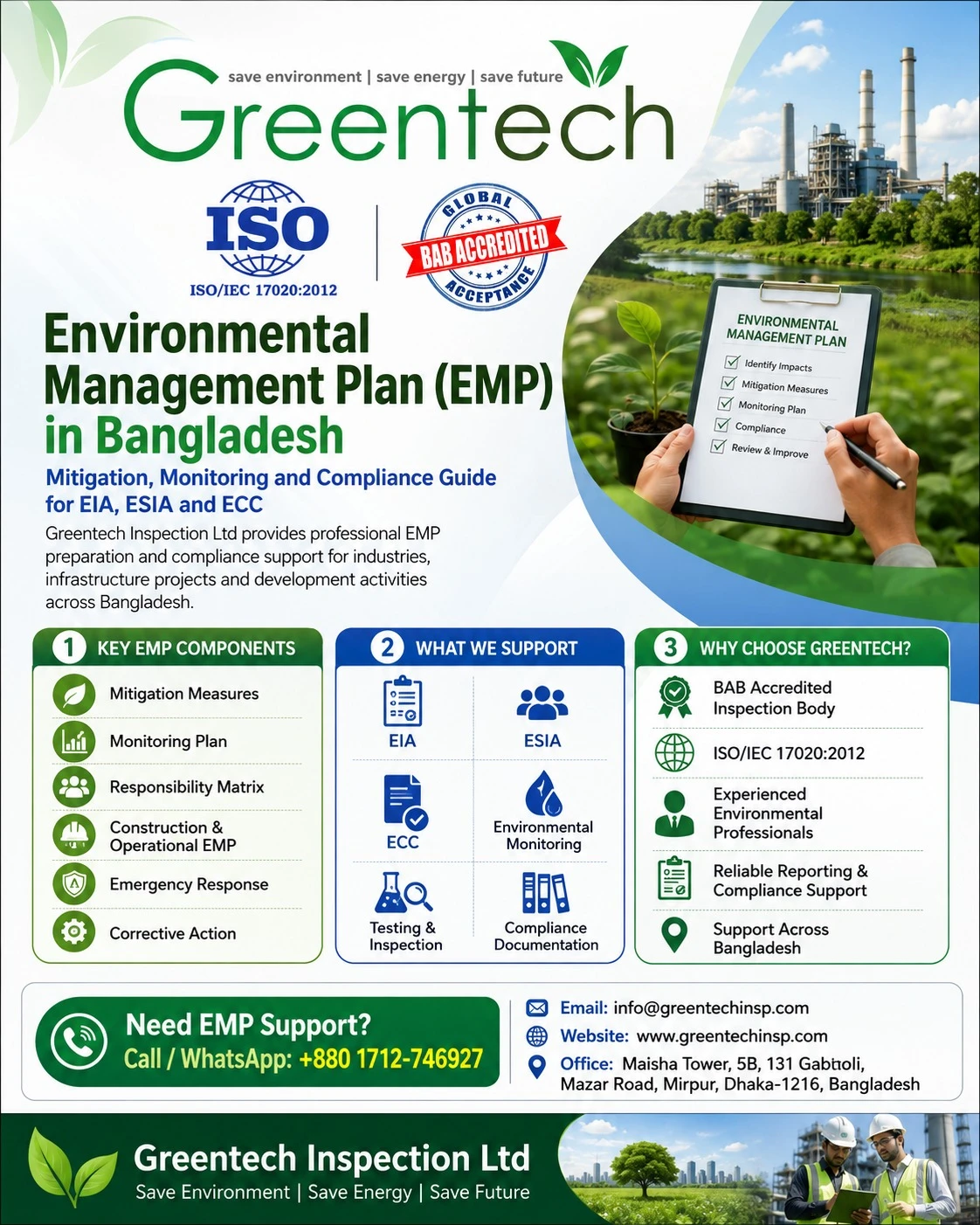
Environmental Management Plan in Bangladesh: Mitigation, Monitoring and Compliance Guide for EIA, ESIA and ECC
An Environmental Management Plan, commonly known as an EMP, converts environmental risks and assessment findings into practical actions.
An EIA or ESIA may identify how a proposed factory, infrastructure development, commercial building or industrial project could affect air quality, water resources, noise levels, soil, biodiversity and surrounding communities. The EMP then explains what the project owner will do to prevent, minimize, control and monitor those impacts.
A professionally prepared EMP normally defines:
Environmental impacts and risks
Mitigation and pollution-control measures
Environmental monitoring requirements
Monitoring locations and frequency
Responsible departments and personnel
Implementation schedules
Reporting procedures
Emergency-response measures
Corrective-action requirements
Implementation budgets
In Bangladesh, an EMP may support an Initial Environmental Examination, Environmental Impact Assessment, Environmental and Social Impact Assessment, Environmental Clearance Certificate application, ECC renewal, construction monitoring, industrial expansion or lender-financed project.
However, the same EMP cannot be used for every project. Its scope should reflect the project category, location, activities, pollution sources, environmental sensitivity, approved Terms of Reference, assessment findings and conditions imposed by the Department of Environment.
What Is an Environmental Management Plan?
An Environmental Management Plan is a structured document describing how environmental impacts will be managed throughout a project’s life cycle.
It may cover:
Planning and design
Site preparation
Construction
Commissioning
Operation
Expansion
Maintenance
Decommissioning
Site closure and restoration
An EMP should not be only a list of general environmental promises.
A strong plan should clearly answer six questions:
What environmental impact may occur?
What action will control that impact?
Who will implement the action?
When and how frequently will it be implemented?
How will performance be monitored?
What will happen if the control measure does not work?
International good practice treats environmental management as an ongoing “plan, do, check and act” process. IFC Performance Standard 1, for example, describes environmental and social management as a continuous process that includes risk identification, management programs, organizational capacity, emergency preparedness, stakeholder engagement, monitoring and review.
Why Is an EMP Important in Bangladesh?
Industrial and development projects can create different environmental impacts during construction and operation.
Potential issues include:
Construction dust
Stack emissions
Generator and boiler emissions
Wastewater and effluent discharge
ETP or STP performance
Environmental noise
Solid and hazardous waste
Chemical and fuel spills
Drainage obstruction
Soil contamination
Surface-water pollution
Groundwater risks
Traffic congestion
Community safety
Biodiversity disturbance
Excessive use of water and energy
An EMP helps translate these risks into specific management controls.
It can help a project owner:
Support EIA, ESIA or IEE documentation
Demonstrate environmental planning during the ECC process
Implement mitigation commitments
Establish an environmental monitoring program
Assign responsibilities to departments and contractors
Prepare for environmental inspections
Maintain evidence of compliance
Respond to environmental complaints
Manage unexpected environmental incidents
Prepare for ECC renewal
Support buyer, lender and ESG requirements
Greentech Inspection Ltd already identifies EMP preparation as part of its environmental consultancy, EIA, ESIA, ECC and compliance-support services in Bangladesh. (greentechinsp.com)
EMP and Bangladesh’s Environmental Regulatory Framework
Bangladesh’s principal environmental framework includes the Bangladesh Environment Conservation Act, 1995 and the Environment Conservation Rules, 2023. The Department of Environment also lists regulatory instruments relating to air pollution, solid waste, hazardous waste and other environmental matters.
The Department of Environment provides online services for:
Site Clearance Certificate
Environmental Clearance Certificate
ECC renewal
Terms of Reference approval
EIA approval
Zero-discharge approval
ETP and STP design approval
Laboratory reports
These services demonstrate that environmental assessment, pollution-control planning, monitoring information and clearance documentation are connected parts of the wider compliance process. (Department of Environment)
An EMP may be required or requested through:
An approved Terms of Reference
An IEE or EIA
An ESIA
ECC application documentation
Conditions included in an ECC
Environmental monitoring requirements
A lender or investor’s environmental framework
A project expansion or modification review
A response to regulatory observations
Not every facility will require the same format or level of detail. The project owner should confirm the final scope based on current DoE instructions and project-specific conditions.
Difference Between EIA, ESIA, EMP, EMS and ECC
These terms are related, but they do not mean the same thing.
Environmental Impact Assessment
An EIA identifies, predicts and evaluates the potential environmental impacts of a project.
It may cover:
Baseline environmental conditions
Project alternatives
Air, water and noise impacts
Waste and wastewater
Ecology and land use
Impact significance
Mitigation recommendations
Environmental and Social Impact Assessment
An ESIA considers both environmental and social risks.
In addition to environmental issues, it may evaluate:
Community health and safety
Employment and working conditions
Livelihoods
Land use
Vulnerable groups
Stakeholder concerns
Cultural heritage
Traffic and access
Community infrastructure
Environmental Management Plan
An EMP translates identified environmental impacts into mitigation, monitoring and management actions.
Environmental and Social Management Plan
An ESMP includes both environmental and social management measures. It is often used for infrastructure or internationally financed projects where community, labour and stakeholder issues are significant.
Environmental Management System
An EMS is a wider organizational system for managing environmental performance continuously. It may include policies, procedures, objectives, audits, training, legal registers and management reviews.
Environmental Clearance Certificate
An ECC is an environmental approval issued through the applicable Department of Environment process. The EMP can support the assessment and compliance documentation connected with that approval.
A simple way to understand the relationship is:
EIA or ESIA identifies the impacts. The EMP or ESMP explains how those impacts will be managed. Monitoring checks whether the plan is working.
Main Objectives of an Environmental Management Plan
A project-specific EMP should aim to:
Prevent avoidable environmental damage
Minimize impacts that cannot be completely avoided
Control emissions, discharges and waste
Protect workers and surrounding communities
Maintain pollution-control systems
Monitor important environmental parameters
Define clear environmental responsibilities
Establish reporting and documentation systems
Prepare for emergencies
Correct deficiencies quickly
Support regulatory and stakeholder compliance
Improve environmental performance over time
The mitigation approach should prioritize avoidance wherever practical. Where avoidance is not possible, impacts should be minimized, controlled, restored or otherwise managed. IFC’s mitigation hierarchy similarly prioritizes avoidance, minimization and management of remaining impacts.
When Should an EMP Be Prepared?
An EMP is most useful when prepared early enough to influence project design and budgeting.
It may be prepared during:
Project planning
The plan can help identify site constraints, pollution-control requirements and environmental costs before final decisions are made.
EIA or ESIA preparation
The EMP normally converts assessment findings into specific implementation actions.
ECC application
A project may need to demonstrate how identified environmental impacts will be controlled.
Construction planning
A Construction Environmental Management Plan can define controls for dust, noise, waste, drainage, worker camps, traffic and community safety.
Commissioning
The plan can establish procedures for testing pollution-control equipment before full operation.
Industrial operation
An operational EMP can guide ETP operation, emission control, waste management, environmental testing and compliance reporting.
Expansion or process modification
The EMP should be reviewed when production, machinery, fuel, raw materials, wastewater, emissions or site layout changes.
ECC renewal
Monitoring results, compliance findings and operational changes may require the EMP to be updated.
Project closure
A closure EMP may address dismantling, waste removal, contaminated soil, chemical removal and site restoration.
Main Components of an Environmental Management Plan
1. Project description
The EMP should begin with a clear description of the project.
It may include:
Project name and location
Project owner
Site area
Proposed activities
Production capacity
Construction activities
Machinery and equipment
Raw materials
Chemicals and fuels
Water and energy demand
Wastewater-generation sources
Emission sources
Waste streams
Project schedule
Surrounding land uses
The environmental plan cannot be accurate if the project description is incomplete or outdated.
2. Legal and compliance requirements
The EMP should identify applicable:
Environmental laws and rules
ECC conditions
Approved Terms of Reference
EIA or ESIA commitments
Discharge or emission requirements
Waste-management obligations
Buyer or lender requirements
Contractual environmental conditions
A legal and compliance register can help track each obligation.
3. Environmental impact register
The plan should list important environmental aspects and potential impacts.
For example:
| Project activity | Environmental aspect | Potential impact |
|---|---|---|
| Site excavation | Dust and exposed soil | Reduced air quality and erosion |
| Generator operation | Exhaust emissions and noise | Air and noise pollution |
| Wet processing | Industrial wastewater | Surface-water contamination |
| Chemical storage | Leakage or spill | Soil and drainage pollution |
| Vehicle movement | Traffic, dust and noise | Community disturbance |
| Waste handling | Improper storage | Odour, contamination and safety risks |
The register should reflect actual project activities rather than generic environmental issues.
4. Mitigation measures
Every significant impact should have practical control measures.
Good mitigation actions should be:
Specific
Technically appropriate
Measurable
Assigned to a responsible person
Scheduled
Budgeted
Verifiable through records or inspection
“Control pollution” is not an adequate mitigation measure.
A stronger action would be:
Operate the ETP whenever process wastewater is generated, maintain daily inlet and outlet flow records, inspect chemical dosing each shift and conduct effluent testing at the frequency required by the approved plan or ECC conditions.
5. Environmental monitoring plan
Monitoring determines whether mitigation measures are working.
The monitoring plan should state:
Parameter
Monitoring location
Method
Frequency
Applicable limit or criterion
Responsible person
Reporting format
Corrective-action procedure
Monitoring may cover:
Ambient air quality
Stack emissions
Wastewater and effluent
Surface water
Groundwater
Environmental noise
Dust
ETP or STP performance
Waste generation
Fuel and water consumption
Spills and incidents
Community complaints
6. Roles and responsibilities
The plan should identify who is responsible for implementation.
Responsibilities may be assigned to:
Project director
Factory manager
Environmental manager
EHS team
Construction contractor
Production department
Utility department
ETP or STP operator
Maintenance department
Chemical store
Waste contractor
Laboratory or inspection body
Management review committee
A named position is more effective than writing only “the company will be responsible.”
7. Implementation schedule
Mitigation actions should be linked to project phases and deadlines.
The schedule may include:
Before construction
During excavation
Throughout construction
Before commissioning
During every operating shift
Weekly inspection
Monthly review
Periodic environmental testing
Annual management review
Before ECC renewal
During closure
8. Environmental budget
Environmental actions require resources.
The budget may cover:
Pollution-control equipment
ETP and STP operation
Environmental testing
Monitoring instruments
Waste handling
Training
Emergency equipment
Environmental consultants
Corrective action
Site restoration
Without an assigned budget, important actions may remain unimplemented.
9. Training and awareness
Training may be required for:
ETP and STP operators
Chemical handlers
Waste-management personnel
Construction workers
Generator and boiler operators
Security personnel
Emergency-response teams
Contractors and subcontractors
Environmental monitoring staff
Training records should document:
Training topic
Date
Trainer
Participants
Attendance
Evaluation or follow-up
10. Emergency preparedness and response
The EMP should consider credible environmental emergencies.
Possible events include:
Chemical spills
Fuel leakage
ETP failure
Accidental wastewater discharge
Firewater contamination
Hazardous-waste leakage
Gas release
Flooding
Drainage failure
Major community complaint
Pollution-control equipment breakdown
The emergency plan should define:
Immediate containment measures
Responsible personnel
Internal communication
Emergency equipment
External contacts
Reporting requirements
Cleanup and disposal procedures
Investigation
Corrective and preventive action
11. Communication and complaint management
Projects near communities should maintain a method for receiving and responding to environmental complaints.
The complaint register may contain:
Date received
Complainant or location
Nature of the complaint
Responsible department
Investigation findings
Action taken
Closure date
Follow-up communication
Stakeholder engagement and grievance management are also important elements of IFC Performance Standard 1 for projects with affected communities.
12. Reporting and recordkeeping
The EMP should state which records must be maintained.
These may include:
Inspection checklists
Environmental test reports
ETP and STP logbooks
Waste registers
Fuel and water records
Equipment-maintenance records
Training records
Incident reports
Complaint records
Corrective-action trackers
Monthly monitoring reports
Contractor compliance reports
Management-review minutes
Example Environmental Monitoring Matrix
The following is a general example. Actual parameters and frequency must be project-specific.
| Environmental issue | Monitoring indicator | Suggested location | Frequency | Responsible party |
|---|---|---|---|---|
| Construction dust | Visible dust and applicable air parameters | Site boundary and sensitive locations | Daily inspection and periodic testing | Contractor/EHS team |
| Construction noise | Noise level | Boundary and nearby receptors | Periodically and during noisy work | EHS team |
| Wastewater | Applicable effluent parameters | ETP outlet or discharge point | According to approved requirements | ETP manager |
| Stack emissions | Relevant emission parameters | Boiler, generator or process stack | According to applicable requirements | Utility manager |
| Solid waste | Quantity, segregation and storage | Waste-storage area | Weekly inspection | Environment team |
| Hazardous waste | Labelling, containment and records | Hazardous-waste store | Weekly inspection | Store/EHS team |
| Chemical spills | Leakage and containment condition | Chemical and fuel stores | Daily or weekly inspection | Store manager |
| Community complaints | Number, type and resolution | Project influence area | Continuous recording | Community liaison/EHS |
| Water use | Consumption data | Main meter or process meter | Daily or monthly | Utility team |
| Corrective actions | Completion status | Entire facility | Monthly review | Management |
This table should be revised based on the approved EIA, ESIA, ECC conditions and actual project risks.
Construction-Phase Environmental Management Plan
Construction activities can create short-term but significant environmental impacts.
A Construction EMP may address:
Site clearing
Earthwork
Excavation
Piling
Concrete work
Material storage
Heavy-vehicle movement
Worker camps
Waste generation
Drainage
Dust and noise
Community safety
Dust and air-quality controls
Possible measures include:
Water spraying on dusty surfaces
Covering trucks carrying loose materials
Limiting vehicle speed
Maintaining construction equipment
Covering stockpiles
Cleaning access roads
Avoiding unnecessary idling
Installing barriers near sensitive locations
Monitoring complaints and visible dust
Construction-noise controls
Measures may include:
Maintaining equipment
Using silencers or acoustic enclosures
Scheduling noisy work appropriately
Limiting unnecessary horn use
Informing nearby stakeholders before major noisy activities
Installing temporary noise barriers
Conducting noise monitoring near sensitive receptors
Drainage and water protection
The contractor should:
Prevent construction materials from entering drains
Control sediment runoff
Maintain temporary drainage
Protect nearby water bodies
Store fuel and chemicals away from drainage paths
Provide spill containment
Manage dewatering appropriately
Inspect the site after heavy rainfall
Construction-waste management
Waste should be:
Identified
Segregated
Stored safely
Reused or recycled where practical
Removed through appropriate arrangements
Documented
Protected from wind and rain
Open dumping and open burning should be prevented.
Contractor management
Environmental requirements should be included in:
Tender documents
Contractor agreements
Method statements
Site-induction training
Inspection checklists
Monthly progress reports
Payment and performance review
The project owner remains responsible for ensuring that contracted activities are controlled within the project’s environmental commitments. IFC Performance Standard 1 treats contractors acting on behalf of the client as being under the client’s direct control for these purposes.
Operational Environmental Management Plan
An operational EMP focuses on ongoing industrial or commercial activities.
It may include controls for:
Production emissions
Boilers and generators
Wastewater generation
ETP and STP operation
Chemical handling
Solid and hazardous waste
Environmental noise
Water use
Energy use
Emergency incidents
Community complaints
ECC compliance
ETP and STP management
The plan should identify:
Wastewater sources
Treatment capacity
Operating procedures
Responsible operators
Chemical-dosing controls
Flow records
Maintenance schedule
Sludge-management procedure
Testing requirements
Response to non-compliant results
Emergency arrangements during breakdown
Stack-emission management
The plan may include:
Identification of all emission sources
Fuel specifications
Preventive maintenance
Stack condition checks
Visible-emission observations
Emission-testing schedule
Filter or scrubber inspection
Corrective actions
Operational records
Solid and hazardous waste
The plan should explain:
Waste classification
Waste segregation
Storage requirements
Container labelling
Secondary containment
Waste-transfer records
Recycling arrangements
Hazardous-waste controls
Responsible contractors
Spill-response arrangements
Chemical and fuel management
Controls may include:
Updated chemical inventory
Safety Data Sheets
Compatible storage
Labelling
Restricted access
Secondary containment
Spill kits
Tank and pipe inspection
Training
Emergency procedures
EMP for Industrial Expansion
A facility should review its EMP before expanding production or changing operations.
Changes may include:
Increased production capacity
New production lines
New raw materials
New chemicals
Additional boilers or generators
Fuel changes
Increased wastewater
New discharge points
ETP or STP capacity changes
Additional buildings
Increased traffic
New waste streams
The updated EMP should evaluate whether:
Existing pollution-control systems remain adequate
Monitoring locations are still representative
New parameters require testing
Existing emergency procedures remain effective
New permits or approvals may be needed
The responsibility structure requires revision
Additional budget and training are necessary
Environmental and Social Management Plan for ESIA
Projects involving communities, workers, land, infrastructure or international financing may require an ESMP rather than an environment-only EMP.
An ESMP may add measures covering:
Labour and working conditions
Occupational health and safety
Community health and safety
Worker accommodation
Traffic safety
Land and livelihood impacts
Stakeholder engagement
Grievance mechanisms
Security arrangements
Vulnerable groups
Cultural heritage
Contractor labour practices
IFC Performance Standard 1 requires an environmental and social management system proportionate to the project’s nature, scale and risks, including management programs, organizational capacity, emergency response, stakeholder engagement and monitoring.
How to Implement an EMP
Step 1: Review the approved documents
Review the:
ECC
IEE
EIA or ESIA
EMP or ESMP
Approved ToR
DoE observations
Design and process information
Lender conditions
Step 2: Convert commitments into actions
Create an action tracker that identifies:
Requirement
Responsible person
Deadline
Required evidence
Current status
Step 3: Assign resources
Provide:
Personnel
Equipment
Monitoring instruments
Environmental budget
Training
Consultant support
Laboratory or inspection services
Step 4: Communicate requirements
Relevant environmental controls should be communicated to:
Employees
Contractors
Suppliers
Security staff
Maintenance workers
ETP or STP operators
Project management
Step 5: Conduct inspections and monitoring
Inspect implementation regularly and conduct required environmental testing.
Step 6: Review results
Compare results against:
ECC conditions
Approved assessment commitments
Applicable requirements
Internal performance targets
Previous monitoring results
Step 7: Correct deficiencies
Assign corrective actions with:
Root cause
Responsible person
Completion date
Evidence required
Follow-up verification
Step 8: Conduct management review
Management should periodically review:
Monitoring results
Environmental incidents
Complaints
Compliance status
Corrective actions
Resource requirements
Changes in operations
Corrective and Preventive Action
When monitoring or inspection identifies a problem, the project should not only correct the immediate symptom.
A proper process should include:
Record the finding.
Control the immediate environmental risk.
Investigate the root cause.
Define corrective action.
Assign responsibility.
Establish a deadline.
Verify completion.
Conduct follow-up monitoring where necessary.
Update procedures or training.
Prevent recurrence.
For example, an unsatisfactory wastewater result may require more than repeating the test. The project may need to examine production load, ETP capacity, chemical dosing, equipment condition, operator performance and sludge management.
When Should an EMP Be Updated?
An EMP should be treated as a working document.
Review or update may be needed when:
Project design changes
Production increases
New machinery is installed
Fuel type changes
Raw materials or chemicals change
A new pollution source is identified
Monitoring results show repeated problems
An environmental incident occurs
Community complaints increase
Regulatory requirements change
The ECC is renewed
The EIA or ESIA is revised
A lender requests additional controls
Project ownership or responsibility changes
Construction moves into operation
The facility prepares for closure
International management practice also expects monitoring to be adjusted based on performance experience and corrective actions.
Common Mistakes in EMP Preparation
Project owners should avoid:
Copying an EMP from an unrelated project
Using an outdated project description
Listing general promises without measurable actions
Failing to assign responsible personnel
Omitting monitoring frequency
Omitting implementation costs
Using incorrect monitoring parameters
Ignoring construction impacts
Ignoring operational impacts
Failing to include contractors
Omitting emergency procedures
Failing to connect the EMP with EIA findings
Ignoring community complaints
Providing no corrective-action process
Preparing the EMP only for submission
Failing to update the plan after expansion
Keeping monitoring results without reviewing them
Reporting activities that are not implemented onsite
An EMP should accurately represent the facility and be practical enough for daily implementation.
Benefits of a Professional EMP
A well-prepared and properly implemented EMP can help:
Improve environmental compliance
Strengthen EIA and ESIA documentation
Support ECC applications and renewal
Reduce pollution and waste
Improve ETP and STP performance
Clarify employee and contractor responsibilities
Reduce environmental incidents
Improve emergency readiness
Maintain organized compliance records
Respond to environmental inspections
Strengthen buyer and lender confidence
Support ESG environmental information
Improve community relationships
Reduce operational and reputational risk
Support responsible industrial expansion
Which Projects May Need an EMP?
An EMP may be relevant for:
Garment and textile factories
Dyeing and washing plants
Pharmaceutical facilities
Food and beverage industries
Chemical industries
Steel and engineering plants
Cement and ceramic industries
Power and energy projects
Economic zones
Industrial parks
Roads and bridges
Real-estate developments
Commercial buildings
Hospitals
Universities
Warehouses and logistics projects
Water-supply projects
Wastewater-treatment projects
Waste-management facilities
Renewable-energy projects
Internationally financed developments
The required scope should be proportional to the project’s actual impacts and risks.
Environmental Management Plan Services by Greentech Inspection Ltd
Greentech Inspection Ltd provides Environmental Management Plan preparation, environmental assessment, monitoring, inspection and compliance support for industrial, commercial and infrastructure projects across Bangladesh.
Our services may include:
Project and regulatory review
Site environmental assessment
Environmental-impact identification
EMP and ESMP preparation
Construction EMP preparation
Operational EMP preparation
Environmental mitigation planning
Environmental monitoring-plan preparation
Responsibility matrix development
Environmental inspection checklist
Emergency-response planning
Corrective-action planning
Environmental testing and monitoring
EIA, IEE and ESIA preparation
ECC application and renewal support
ETP and STP compliance review
Environmental reporting
ESG environmental-data support
Greentech Inspection Ltd’s environmental consultancy page identifies EMP and EMS services covering the project life cycle, alongside EIA, ESIA, baseline assessment, monitoring and compliance support. The company also states that it operates as a Bangladesh Accreditation Board-accredited environmental inspection body under ISO/IEC 17020:2012. (greentechinsp.com)
Frequently Asked Questions
What is an Environmental Management Plan?
An EMP is a structured plan defining how environmental impacts will be prevented, minimized, monitored and managed during a project.
Is an EMP the same as an EIA?
No. An EIA identifies and evaluates environmental impacts. The EMP defines actions for managing those impacts.
What is the difference between EMP and ESMP?
An EMP focuses mainly on environmental issues. An ESMP includes both environmental and social impacts and management actions.
Is an EMP required for every ECC application?
Not necessarily in the same format for every project. The requirement depends on the project category, assessment scope, approved ToR, ECC process and DoE instructions.
What should an EMP contain?
It should contain identified impacts, mitigation measures, monitoring requirements, responsibilities, schedules, budget, reporting, emergency procedures and corrective-action arrangements.
Who implements the EMP?
Implementation may involve the project owner, management, environmental team, contractors, production department, utility team, ETP/STP operators and other responsible personnel.
Does the EMP cover construction and operation?
It can cover the entire project life cycle. Separate construction and operational plans may be prepared when the risks and responsibilities differ substantially.
How often should an EMP be reviewed?
It should be reviewed periodically and whenever significant project, operational, regulatory or environmental changes occur.
Can an old EMP be used for factory expansion?
It should first be reviewed and updated. Expansion may create new pollution sources, waste streams, monitoring requirements and compliance obligations.
Does EMP implementation support ECC renewal?
Yes. Monitoring records, inspections, pollution-control performance and corrective actions generated through EMP implementation can support compliance review and renewal preparation.
Can an EMP support ESG reporting?
Yes. EMP records can support environmental data related to emissions, water, waste, incidents, monitoring and environmental-risk management. A complete ESG report will normally require additional governance and performance information.
Conclusion
An Environmental Management Plan is the practical link between environmental assessment and actual project performance.
An EIA or ESIA may identify environmental risks, but those risks will not be controlled unless clear measures, responsibilities, monitoring procedures, budgets and corrective actions are implemented.
A professional EMP should therefore:
Reflect the real project and site conditions
Address construction and operational impacts
Define specific mitigation measures
Establish a practical monitoring plan
Assign responsibilities
Include implementation schedules and budgets
Prepare for environmental emergencies
Maintain reliable records
Establish corrective-action procedures
Be reviewed and updated regularly
The EMP should not remain only inside an assessment report. It should be used by management, environmental teams, contractors and operational departments as a working environmental-compliance document.
Need an Environmental Management Plan in Bangladesh?
Greentech Inspection Ltd provides professional EMP and ESMP preparation, EIA, ESIA, IEE, ECC, environmental monitoring, testing, inspection and compliance-support services across Bangladesh.
Greentech Inspection Ltd also provides:
SREDA-Certified Energy Auditor Bangladesh
Energy Efficiency Assessment Bangladesh
Green Financing Support Bangladesh
Bangladesh Bank Green Financing Support
GTF Documentation Support Bangladesh
TDF Documentation Support Bangladesh
LTFF Documentation Support Bangladesh
IDCOL Energy Efficiency Support Bangladesh
BIFFL Energy Efficiency Support Bangladesh
Higg Index Energy Support Bangladesh
ESG Consultancy Support Bangladesh
Environmental Consultant Bangladesh
Environmental Monitoring Bangladesh
Environmental Testing Bangladesh
Environmental Inspection Bangladesh
Environmental Consultant Bangladesh
EIA Consultant Bangladesh
ESIA Consultant Bangladesh
IEE Consultant Bangladesh
Environmental Management Plan Bangladesh
Environmental Monitoring Bangladesh
Environmental Inspection Bangladesh
Environmental Testing Bangladesh
Ambient Air Monitoring Bangladesh
Stack Emission Monitoring Bangladesh
Noise Level Assessment Bangladesh
Light Level Assessment Bangladesh
Water Quality Testing Bangladesh
Indoor Air Quality Monitoring Bangladesh
Industrial Hygiene Assessment Bangladesh
Energy Audit Bangladesh
ESG Consultancy Support Bangladesh
Traffic Impact Assessment Bangladesh
Industrial Hygiene Assessment Bangladesh
Energy Audit Bangladesh
ESG Consultancy Support Bangladesh
Traffic Impact Assessment (TIA) Bangladesh
DoE Consultancy
Environmental Management Plan Bangladesh
Industrial Hygiene Assessment Bangladesh
Environmental Management Plan Bangladesh
Address: Maisha Tower, 5B, 131 Gabtoli, Mazar Road, Mirpur, Dhaka-1216, Bangladesh
Call / WhatsApp: +8801712-746927 | +8801764-031809
Email: [email protected] | [email protected]
Website: www.greentechinsp.com
👉Fast | Accurate | Authority-Approved | Submission Ready | 12+ Years of Experience | 50+ TIA Projects Completed | 650+ EIA Projects Completed | 500+ EMP Projects Completed | 100+ Energy Audit | 20+ ESG Projects Completed | 40+ ESIA Projects Completed | 40+ Industrial Hygiene Assessment | 1000+ Customer | BAB Accredited | ISO/IEC 17020:2012 Certified |