How to Obtain an Environmental Clearance Certificate (ECC) in Bangladesh – Complete Guide
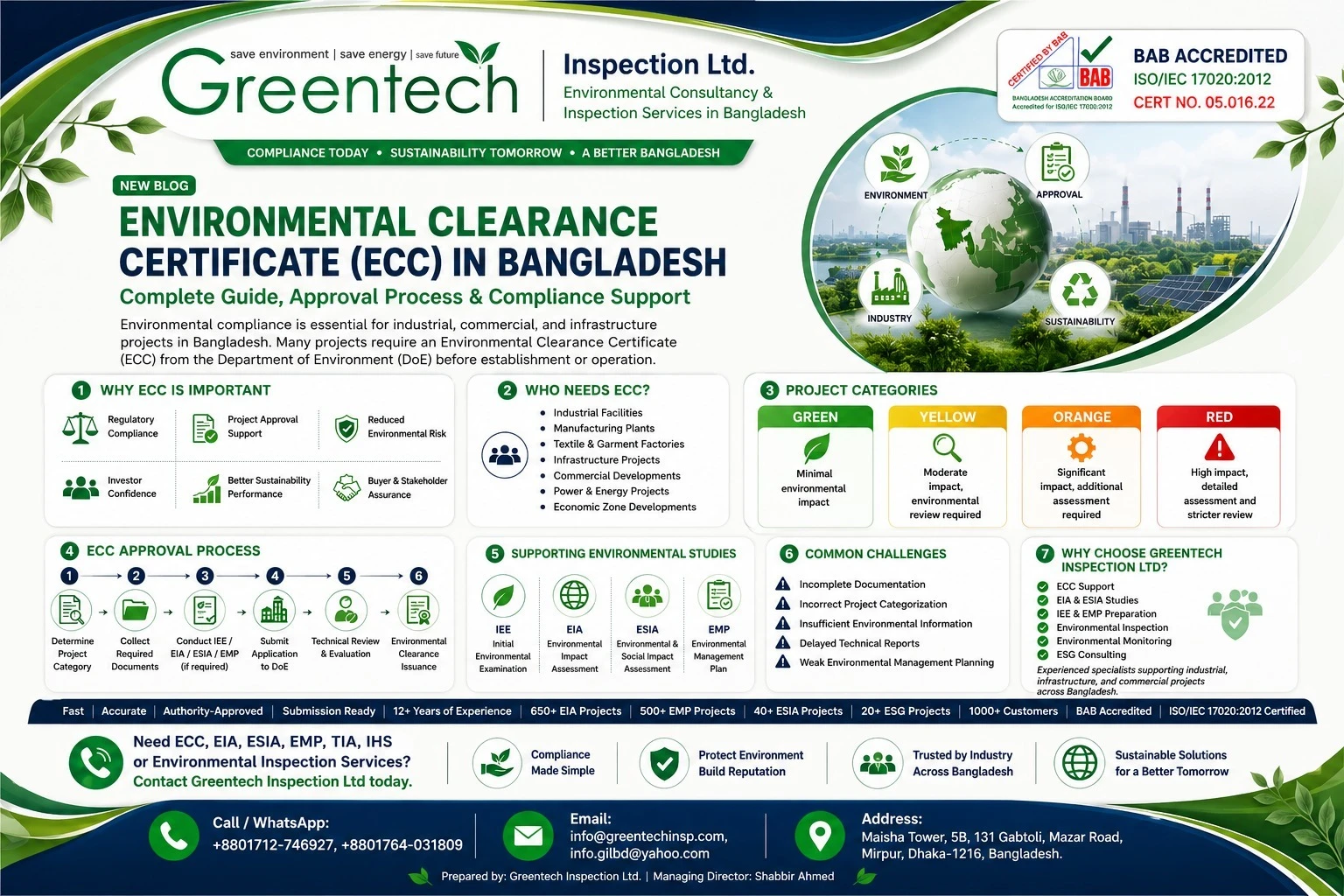
Environmental compliance is a critical requirement for industrial, commercial, and infrastructure projects in Bangladesh. Before establishing or operating many types of industries and development projects, organizations must obtain an Environmental Clearance Certificate (ECC) from the Department of Environment (DoE).
This guide explains the Environmental Clearance Certificate process in Bangladesh, applicable regulations, required documents, and practical steps for obtaining environmental approval.
What is an Environmental Clearance Certificate (ECC)?
An Environmental Clearance Certificate (ECC) is an official approval issued by the Department of Environment (DoE) that confirms a project or industrial facility has met the required environmental compliance requirements.
The ECC is one of the most important environmental approvals for:
- Industrial facilities
- Manufacturing plants
- Textile and garment factories
- Infrastructure projects
- Commercial developments
- Power and energy projects
- Economic zone developments
Environmental clearance helps ensure that development activities are carried out responsibly while minimizing environmental impacts. Bangladesh's environmental framework classifies industries and projects according to their potential environmental impact and requires environmental clearance accordingly.
Why is ECC Important in Bangladesh?
Obtaining an Environmental Clearance Certificate provides several benefits:
- Compliance with environmental regulations
- Support for project approvals and licensing
- Reduced environmental risk
- Improved investor confidence
- Better sustainability performance
- Support for international buyer requirements
Many financial institutions, buyers, and stakeholders require evidence of environmental compliance before approving projects or business relationships.
Which Projects Require an ECC?
Under Bangladesh environmental regulations, industries and projects are classified according to their environmental impact into four categories:
Green Category
Projects with minimal environmental impacts.
Examples may include:
- Small service facilities
- Low-impact commercial operations
- Certain low-risk manufacturing activities
Green category projects generally have a simplified clearance process.
Yellow Category
Projects with moderate environmental impacts that require environmental review and approval.
Orange Category
Projects that may have significant environmental impacts and require additional environmental documentation and review.
Red Category
Projects with potentially substantial environmental impacts requiring detailed environmental assessment and stricter review procedures.
Industries Commonly Requiring Environmental Clearance
Environmental Clearance Certificates are commonly required for:
- Garment and textile industries
- Dyeing and washing plants
- Pharmaceutical industries
- Food processing industries
- Chemical industries
- Steel and engineering industries
- Cement industries
- Power plants
- Industrial parks
- Economic zone projects
- Infrastructure developments
Many expansion and modernization projects also require environmental clearance.
Step-by-Step ECC Approval Process
Step 1: Determine the Project Category
The first step is identifying whether the project falls under Green, Yellow, Orange, or Red categories according to applicable environmental regulations. Environmental requirements vary depending on the category.
Step 2: Collect Required Documents
Typical documents may include:
- Company information
- Project description
- Process flow diagram
- Layout plan
- Land ownership or lease documents
- Trade license
- Location map
- Environmental management information
- Relevant technical reports
Required documentation depends on the project category.
Step 3: Conduct Environmental Studies (If Required)
Depending on the project type, the following studies may be required:
- Initial Environmental Examination (IEE)
- Environmental Impact Assessment (EIA)
- Environmental & Social Impact Assessment (ESIA)
- Environmental Management Plan (EMP)
These studies help identify environmental impacts and recommend mitigation measures.
Step 4: Submit Application to DoE
The application and supporting documents are submitted to the Department of Environment for review and processing.
Step 5: Technical Review and Evaluation
The DoE reviews the submitted documents and may request additional information, clarification, or supporting studies.
Step 6: Environmental Clearance Issuance
Upon satisfactory review, the Environmental Clearance Certificate is issued, allowing the project to proceed in accordance with applicable requirements.
Environmental Studies Supporting ECC Applications
Initial Environmental Examination (IEE)
An IEE provides a preliminary environmental assessment of a proposed project.
Environmental Impact Assessment (EIA)
An EIA evaluates potential environmental impacts in greater detail and recommends mitigation measures.
Environmental & Social Impact Assessment (ESIA)
An ESIA evaluates both environmental and social impacts and is commonly required by international lenders and development institutions.
Environmental Management Plan (EMP)
An EMP outlines environmental monitoring and management measures during project implementation and operation.
Common Challenges During ECC Approval
Many organizations experience delays due to:
- Incomplete documentation
- Incorrect project categorization
- Insufficient environmental information
- Delayed submission of technical reports
- Lack of environmental management planning
Engaging experienced environmental consultants can significantly improve the efficiency of the approval process.
Benefits of Professional Environmental Consultancy
Professional environmental consultants can assist with:
- Project categorization
- ECC application preparation
- EIA and ESIA studies
- EMP development
- Environmental monitoring
- Regulatory compliance support
This helps reduce approval delays and improve compliance outcomes.
Why Choose Greentech Inspection Ltd?
Greentech Inspection Ltd provides professional environmental consultancy services throughout Bangladesh.
Our services include:
- Environmental Clearance Certificate (ECC) Support
- Environmental Impact Assessment (EIA)
- Environmental & Social Impact Assessment (ESIA)
- Initial Environmental Examination (IEE)
- Environmental Management Plan (EMP)
- Environmental Inspection
- ESG Consulting
- Environmental Monitoring
Our experienced environmental specialists support industrial, infrastructure, and commercial projects from planning through approval and operation.
Conclusion
Obtaining an Environmental Clearance Certificate (ECC) is an essential step for many industrial and development projects in Bangladesh. A well-prepared application supported by appropriate environmental studies can help organizations achieve compliance, reduce risks, and support sustainable project development.
Organizations planning new projects, expansions, or environmental compliance activities should evaluate their environmental obligations early and ensure all requirements are addressed before project implementation.
Contact Greentech Inspection Ltd
Prepared by: Greentech Inspection Ltd.
Managing Director: Shabbir Ahmed
Call / WhatsApp: +8801712-746927, +8801764-031809
Email: [email protected], [email protected]
Frequently Asked Questions (FAQs)
What is an Environmental Clearance Certificate (ECC)?
An ECC is an approval issued by the Department of Environment confirming that a project meets applicable environmental requirements.
Is ECC mandatory in Bangladesh?
Many industrial, infrastructure, and development projects require environmental clearance before operation or implementation.
Which industries require ECC?
Garments, textiles, pharmaceuticals, chemicals, food processing, power generation, and many industrial projects commonly require environmental clearance.
What is the difference between ECC and EIA?
An EIA is an environmental study, while an ECC is the regulatory approval issued by the Department of Environment.
Can Greentech Inspection Ltd help obtain ECC?
Yes. Greentech Inspection Ltd provides professional support for ECC applications, EIA studies, ESIA studies, environmental inspections, and environmental compliance services.
👉Fast | Accurate | Authority-Approved | Submission Ready | 12+ Years of Experience | 50+ TIA Projects Completed | 650+ EIA Projects Completed | 500+ EMP Projects Completed | 100+ Energy Audit | 20+ ESG Projects Completed | 40+ ESIA Projects Completed | 40+ Industrial Hygiene Assessment | 1000+ Customer | BAB Accredited | ISO/IEC 17020:2012 Certified |
Contact Greentech Inspection Ltd for professional EIA/TIA/ESIA/IHS/ESG/EMP/EA study and Environmental Inspection services in Dhaka, Bangladesh.
📞 Call / WhatsApp: +8801712-746927., +8801764-031809
📧 Email: [email protected], [email protected]