EIA Services in Bangladesh | Environmental Impact Assessment Consultant | Environmental Consultancy
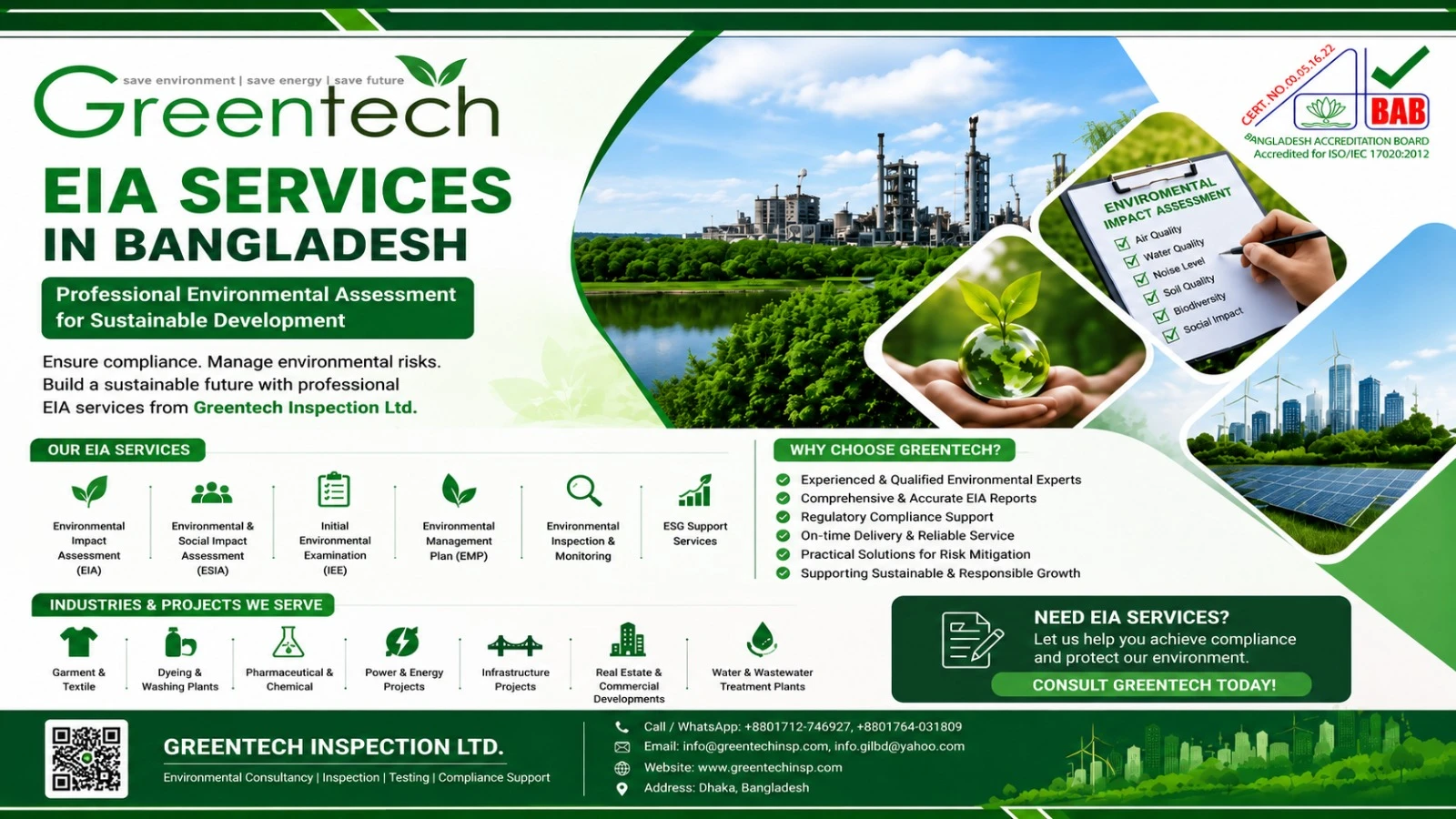
Complete Guide for Industries, Developers and Project Owners
Environmental compliance is now a major requirement for industries, infrastructure projects, real estate developments, power plants, and manufacturing facilities in Bangladesh. Before starting a new project or expanding an existing facility, project owners often need to assess environmental risks and obtain the necessary approvals from the Department of Environment.
This is where professional EIA services in Bangladesh become essential.
An Environmental Impact Assessment, commonly known as EIA, helps identify how a proposed project may affect air, water, land, noise levels, biodiversity, surrounding communities, and overall environmental quality. It also provides practical mitigation measures to reduce negative impacts and support regulatory compliance.
In Bangladesh, environmental rules categorize industrial units and projects based on their potential environmental impact. The Department of Environment lists the Environment Conservation Rules, 2023 as the current regulatory framework, and legal summaries of the 2023 rules describe project categories such as green, yellow, orange, and red, with higher-impact projects requiring stronger clearance requirements.
What is an Environmental Impact Assessment?
Environmental Impact Assessment is a systematic study conducted before project implementation. Its purpose is to evaluate possible environmental effects and recommend suitable control measures.
A professional EIA report usually covers:
- Project description
- Baseline environmental condition
- Air, water, noise and soil quality assessment
- Impact identification and prediction
- Pollution control measures
- Waste management plan
- Environmental Management Plan
- Monitoring and reporting framework
The goal is not only to meet regulatory requirements. A good EIA also helps project owners reduce operational risks, avoid approval delays, improve sustainability, and build confidence among regulators, investors, buyers, and local stakeholders.
Why EIA Services Are Important in Bangladesh
Bangladesh is growing rapidly in industrial production, infrastructure development, energy generation, logistics, housing, and export-oriented manufacturing. This growth creates economic opportunities, but it can also increase pollution, resource pressure, traffic impact, waste generation, and community concerns.
Professional EIA services help project owners manage these risks before they become expensive problems.
For industries and developers in Bangladesh, EIA is important because it helps to:
- Support environmental clearance procedures
- Identify pollution risks early
- Reduce project approval delays
- Improve project planning and design
- Meet buyer, investor and lender requirements
- Protect surrounding communities
- Strengthen long-term sustainability
- Avoid regulatory complications
Under the 2023 rules, yellow, orange, and red category projects generally require both location clearance and environmental clearance from the Department of Environment, while green category projects require environmental clearance; the rules also restrict infrastructure establishment without location clearance.
When is EIA Required in Bangladesh?
EIA is generally required when a proposed project may create significant environmental impacts. The requirement depends on the project type, size, location, pollution potential, and applicable environmental category.
Projects that commonly require environmental assessment include:
Industrial Projects
Industrial developments often require EIA, IEE, EMP, environmental monitoring, or environmental clearance support. Common examples include:
- Textile and garment factories
- Dyeing and washing plants
- Chemical industries
- Pharmaceutical factories
- Steel and engineering industries
- Cement manufacturing facilities
- Food processing industries
- Plastic, packaging and manufacturing units
These projects may involve wastewater discharge, air emissions, chemical handling, boiler emissions, noise generation, solid waste, hazardous waste, and worker/community safety issues.
Infrastructure Projects
Large infrastructure projects can significantly affect land use, traffic, drainage, air quality, noise, and surrounding communities. Environmental assessment may be needed for:
- Roads and highways
- Bridges and flyovers
- Railways
- Ports and terminals
- Airports
- Urban development projects
- Industrial zones and economic zones
Energy and Power Projects
Power generation and energy-related projects often require detailed environmental study because of air emissions, fuel use, noise, water consumption, land use and community impacts.
Examples include:
- Power plants
- Renewable energy projects
- Transmission lines
- Substations
- Fuel storage facilities
- Energy infrastructure
Water and Wastewater Projects
Water resource and treatment projects may require environmental review to assess impacts on water quality, drainage, ecology, public health and local communities.
Examples include:
- Water treatment plants
- Wastewater treatment plants
- Effluent treatment plants
- Irrigation projects
- Flood control projects
- Drainage improvement projects
Real Estate and Commercial Developments
Large commercial or mixed-use projects may require environmental assessment depending on project size, location and potential impacts.
Examples include:
- Shopping malls
- Large residential developments
- Commercial complexes
- Hospitals
- Hotels and resorts
- Mixed-use buildings
- Large parking and traffic-generating developments
Key Components of Professional EIA Services
A reliable EIA consultant in Bangladesh should provide a complete technical and compliance-focused service, not just a basic report. A strong EIA study should include the following components.
1. Project Screening and Category Identification
The first step is to understand the project type, location, size, process, utility requirements, waste generation, emission sources, and applicable environmental category.
This helps determine whether the project may require EIA, IEE, EMP, environmental monitoring, site clearance, or environmental clearance support.
2. Baseline Environmental Study
Baseline study documents the existing environmental condition before project implementation. This may include:
- Ambient air quality
- Surface water quality
- Groundwater quality
- Noise level
- Soil condition
- Land use
- Ecological condition
- Socio-economic condition
Baseline data is important because it helps compare future environmental changes and identify project-specific risks.
3. Impact Assessment
The EIA report identifies possible environmental impacts during different project stages, including:
- Pre-construction
- Construction
- Operation
- Expansion
- Decommissioning
Impacts may include air pollution, noise, wastewater discharge, traffic congestion, waste generation, occupational risks, community disturbance and ecological disturbance.
4. Mitigation Measures
Mitigation measures are practical solutions to reduce or control negative impacts. These may include:
- Effluent Treatment Plant
- Air pollution control system
- Noise control measures
- Solid waste management
- Hazardous waste handling
- Greenbelt development
- Drainage management
- Emergency response planning
- Occupational health and safety measures
5. Environmental Management Plan
An Environmental Management Plan, or EMP, is one of the most important parts of an EIA report. It explains how environmental risks will be managed during project implementation and operation.
An EMP usually includes:
- Monitoring schedule
- Responsible personnel
- Pollution control measures
- Reporting requirements
- Emergency response plan
- Compliance management system
- Corrective action process
Benefits of Hiring a Professional EIA Consultant in Bangladesh
Choosing the right EIA consultant can save time, reduce risk and improve the quality of project approval documentation.
A professional consultant helps with:
- Proper project assessment
- Accurate environmental data collection
- Better report preparation
- Compliance-focused recommendations
- Coordination with relevant requirements
- Practical mitigation planning
- Investor and lender confidence
- Reduced approval delays
For export-oriented industries, environmental documentation is also becoming more important because international buyers and financial institutions increasingly focus on ESG, sustainability, pollution control, occupational safety and responsible sourcing.
Why Choose Greentech Inspection Ltd for EIA Services in Bangladesh?
Greentech Inspection Ltd provides professional environmental consultancy and inspection services for industries, developers, investors and infrastructure projects in Bangladesh.
Our team supports clients with practical, compliance-focused and industry-relevant environmental solutions.
Our services include:
- Environmental Impact Assessment
- Environmental & Social Impact Assessment
- Initial Environmental Examination
- Environmental Management Plan
- Environmental Inspection
- Environmental Monitoring
- Environmental Consultancy
- ESG Support Services
- Air Quality Assessment
- Noise Level Assessment
- Water Quality Testing Support
- Industrial Environmental Compliance Support
We work with industries and project owners to identify environmental risks, prepare professional documentation, improve compliance and support sustainable project development.
Who Needs EIA Services in Bangladesh?
You may need professional EIA services if you are planning or operating:
- A new industrial factory
- A textile, dyeing or washing plant
- A pharmaceutical or chemical facility
- A power or energy project
- A real estate or commercial project
- An infrastructure development project
- An industrial expansion project
- A project requiring environmental clearance
- A project seeking investor or lender approval
- A project facing environmental compliance requirements
If your project may affect air, water, land, noise, waste, traffic, ecology or surrounding communities, it is better to conduct environmental assessment early.
Conclusion
EIA services in Bangladesh are essential for responsible industrial development, infrastructure growth and environmental compliance. A professional Environmental Impact Assessment helps project owners identify risks, prepare mitigation measures, support regulatory approval and improve long-term sustainability.
For industries, developers and investors, EIA is not just a compliance document. It is a strategic planning tool that helps reduce delays, protect investment, improve environmental performance and build stakeholder trust.
Greentech Inspection Ltd provides professional EIA, ESIA, IEE, EMP, environmental inspection and environmental monitoring services across Bangladesh.
For reliable environmental consultancy support, contact Greentech Inspection Ltd today.
Contact Greentech Inspection Ltd
Prepared by: Greentech Inspection Ltd.
Managing Director: Shabbir Ahmed
Call / WhatsApp: +8801712-746927, +8801764-031809
Email: [email protected], [email protected]
What are EIA services in Bangladesh?
EIA services include environmental studies, impact assessment, mitigation planning, environmental management planning, monitoring recommendations and compliance support for projects that may affect the environment.
When is EIA required in Bangladesh?
EIA is generally required for projects with significant environmental impact potential, especially industrial, infrastructure, power, energy, chemical, textile, real estate and large development projects.
Who provides EIA services in Bangladesh?
Environmental consultancy firms such as Greentech Inspection Ltd provide EIA, ESIA, IEE, EMP, environmental inspection and environmental monitoring services for industries and projects.
Why is EIA important for industries?
EIA helps industries identify pollution risks, plan mitigation measures, support environmental clearance, improve compliance and reduce project delays.
What is included in an EIA report?
An EIA report generally includes project description, baseline environmental data, impact assessment, mitigation measures, environmental management plan and monitoring recommendations.