When is Environmental Impact Assessment (EIA) Required in Bangladesh? – Complete 2026 Guide
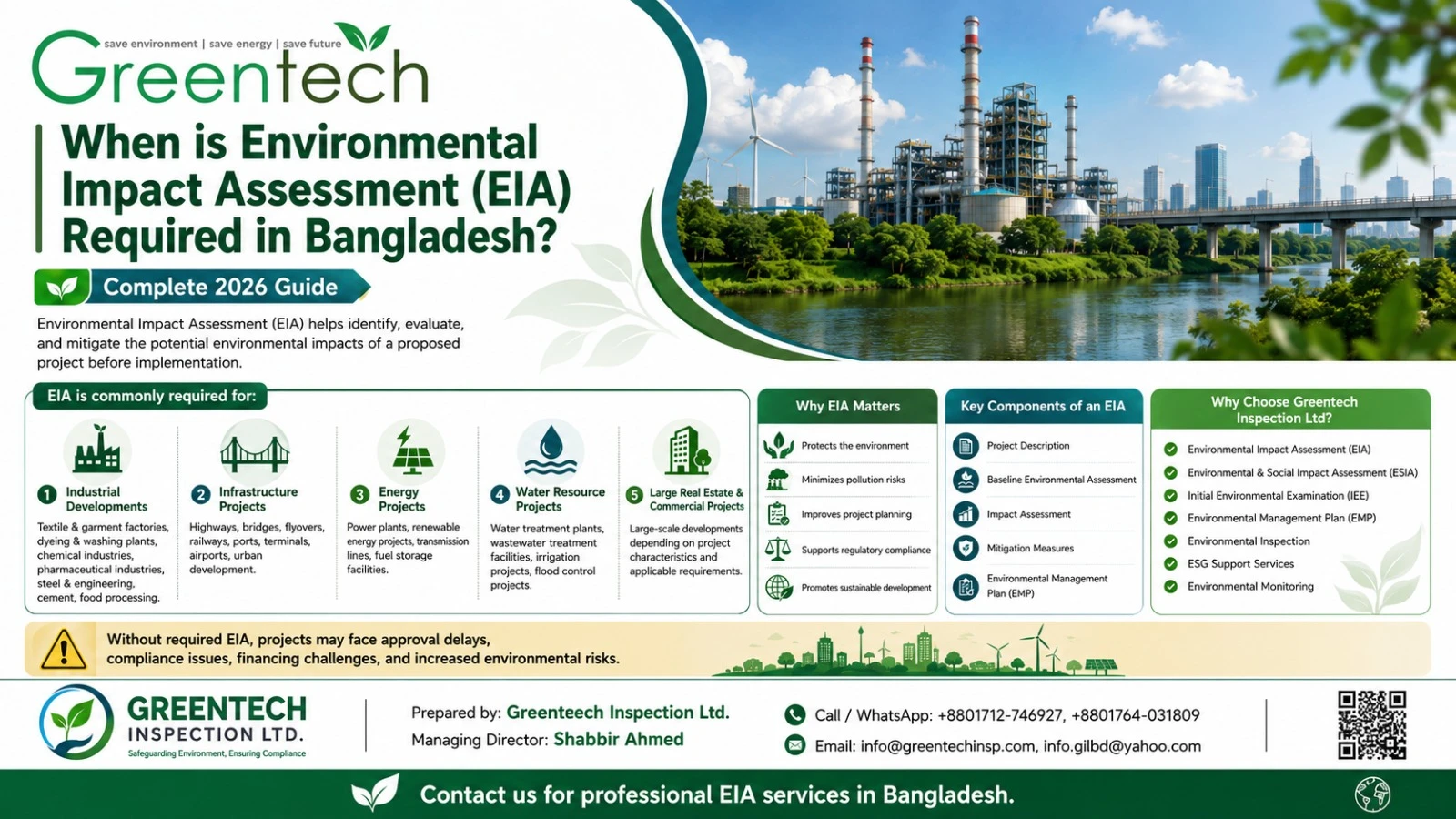
When is Environmental Impact Assessment (EIA) Required in Bangladesh? – Complete 2026 Guide
Environmental protection has become a critical component of sustainable development in Bangladesh. Before establishing industrial facilities, infrastructure projects, power plants, and large-scale developments, project proponents must evaluate potential environmental impacts and obtain the necessary environmental approvals.
One of the most important environmental compliance requirements is the Environmental Impact Assessment (EIA).
This guide explains when EIA is required in Bangladesh, which industries require EIA, and how organizations can comply with environmental regulations.
Need EIA, IEE, EMP or environmental clearance support for your project? Contact Greentech Inspection Ltd for professional environmental consultancy in Bangladesh.
What is an Environmental Impact Assessment (EIA)?
Environmental Impact Assessment (EIA) is a systematic process used to identify, predict, evaluate, and mitigate the potential environmental impacts of a proposed project before implementation.
The primary objectives of an EIA are:
- Protect the environment
- Support sustainable development
- Minimize environmental risks
- Improve project planning
- Ensure regulatory compliance
- Assist government decision-making
An EIA helps project developers understand how a project may affect air quality, water resources, land use, biodiversity, noise levels, and nearby communities.
Why is EIA Important in Bangladesh?
Bangladesh is experiencing rapid industrialization and infrastructure development. While these developments contribute to economic growth, they may also create environmental challenges if not properly managed.
EIA helps:
- Prevent environmental degradation
- Identify pollution risks
- Protect natural resources
- Improve environmental performance
- Support responsible investment
- Enhance project sustainability
Government agencies, investors, lenders, and international buyers increasingly require environmental assessments before approving projects.
When is EIA Required in Bangladesh?
EIA is generally required when a proposed project may have significant environmental impacts.
In Bangladesh, environmental requirements are administered by the Department of Environment under environmental regulations and environmental clearance procedures.
Typically, EIA may be required for projects involving:
Industrial Developments
- Textile and garment factories
- Dyeing and washing plants
- Chemical industries
- Pharmaceutical industries
- Steel and engineering industries
- Cement manufacturing facilities
- Food processing industries
Infrastructure Projects
- Highways and roads
- Bridges and flyovers
- Railways
- Ports and terminals
- Airports
- Urban development projects
Energy Projects
- Power plants
- Renewable energy projects
- Transmission lines
- Fuel storage facilities
Water Resource Projects
- Water treatment plants
- Wastewater treatment facilities
- Irrigation projects
- Flood control projects
Real Estate and Commercial Projects
Large-scale commercial and mixed-use developments may require environmental assessment depending on project characteristics and applicable requirements.
Which Industries Commonly Require EIA?
The following sectors frequently conduct Environmental Impact Assessments in Bangladesh:
Garment & Textile Industry
The Ready-Made Garment (RMG) sector often requires environmental studies due to:
- Wastewater generation
- Air emissions
- Energy consumption
- Waste management requirements
Textile Dyeing & Washing Plants
Environmental concerns include:
- Chemical handling
- Effluent discharge
- Water consumption
- Air emissions
Pharmaceutical Industries
Environmental assessment helps manage:
- Chemical storage
- Hazardous waste
- Air emissions
- Wastewater treatment
Power Plants
Power generation facilities require assessment of:
- Air emissions
- Noise impacts
- Water use
- Community impacts
Industrial Parks and Economic Zones
Large-scale industrial developments require comprehensive environmental evaluation due to their cumulative impacts.
What Are the Main Components of an EIA?
A professional EIA generally includes:
1. Project Description
Details regarding:
- Project location
- Size and capacity
- Operational activities
- Infrastructure requirements
2. Baseline Environmental Assessment
Evaluation of:
- Air quality
- Water quality
- Noise levels
- Soil conditions
- Ecological conditions
3. Impact Assessment
Identification of potential impacts during:
- Construction
- Operation
- Expansion
- Decommissioning
4. Mitigation Measures
Measures designed to minimize or eliminate adverse environmental impacts.
5. Environmental Management Plan (EMP)
An EMP outlines:
- Environmental monitoring
- Pollution control measures
- Management responsibilities
- Compliance requirements
What Happens if an EIA Is Not Conducted?
Failure to complete required environmental assessments may result in:
- Regulatory complications
- Delays in project approvals
- Increased environmental risks
- Financing challenges
- Compliance issues
Conducting environmental assessments early in project planning helps avoid costly delays and supports smoother project implementation.
EIA and International Financing Requirements
Many international financial institutions require environmental assessment before funding approval.
Examples include:
- World Bank
- International Finance Corporation
- Asian Development Bank
Projects seeking international financing often require detailed environmental studies and environmental management plans.
Benefits of Conducting an EIA
Organizations that conduct EIA studies can achieve several benefits:
Improved Regulatory Compliance
Supports environmental approval and compliance processes.
Better Project Planning
Environmental risks can be identified and addressed before implementation.
Reduced Environmental Risks
Potential impacts can be minimized through effective mitigation measures.
Enhanced Investor Confidence
Environmental due diligence supports financing and investment decisions.
Improved Sustainability
Projects can operate with reduced environmental impacts and improved long-term performance.
Why Choose Greentech Inspection Ltd for EIA Services?
Greentech Inspection Ltd provides professional environmental consultancy services across Bangladesh.
Our services include:
- Environmental Impact Assessment (EIA)
- Environmental & Social Impact Assessment (ESIA)
- Initial Environmental Examination (IEE)
- Environmental Management Plan (EMP)
- Environmental Inspection
- ESG Support Services
- Environmental Monitoring
Our team assists industries, developers, investors, and infrastructure projects in meeting environmental requirements and sustainability objectives.
Conclusion
Environmental Impact Assessment (EIA) is an essential tool for responsible development in Bangladesh. Projects with potential environmental impacts should carefully evaluate environmental risks and implement effective mitigation measures before implementation.
By conducting a professional EIA, organizations can improve compliance, reduce environmental risks, strengthen stakeholder confidence, and support sustainable development.
As Bangladesh continues its industrial and infrastructure growth, EIA will remain a key component of environmentally responsible project planning and management.
Frequently Asked Questions (FAQs)
What is an Environmental Impact Assessment (EIA)?
EIA is a process used to evaluate the potential environmental impacts of a proposed project before implementation.
When is EIA required in Bangladesh?
EIA is generally required for projects that may have significant environmental impacts, particularly industrial, infrastructure, energy, and large development projects.
Which industries commonly require EIA?
Garment, textile, pharmaceutical, chemical, power generation, manufacturing, and infrastructure sectors commonly conduct EIA studies.
What is the purpose of an Environmental Management Plan (EMP)?
An EMP provides measures for managing environmental impacts and ensuring compliance during project implementation and operation.
Can EIA help obtain project approvals?
Yes. Environmental assessments often support regulatory review, environmental clearance processes, financing requirements, and project planning.
Prepared by:
Greentech Inspection Ltd.
Managing Director: Shabbir Ahmed
+88 01764-031809
📞 Call / WhatsApp: +8801712-746927., +8801764-031809
📧 Email: [email protected], [email protected]