What is ESG Reporting?
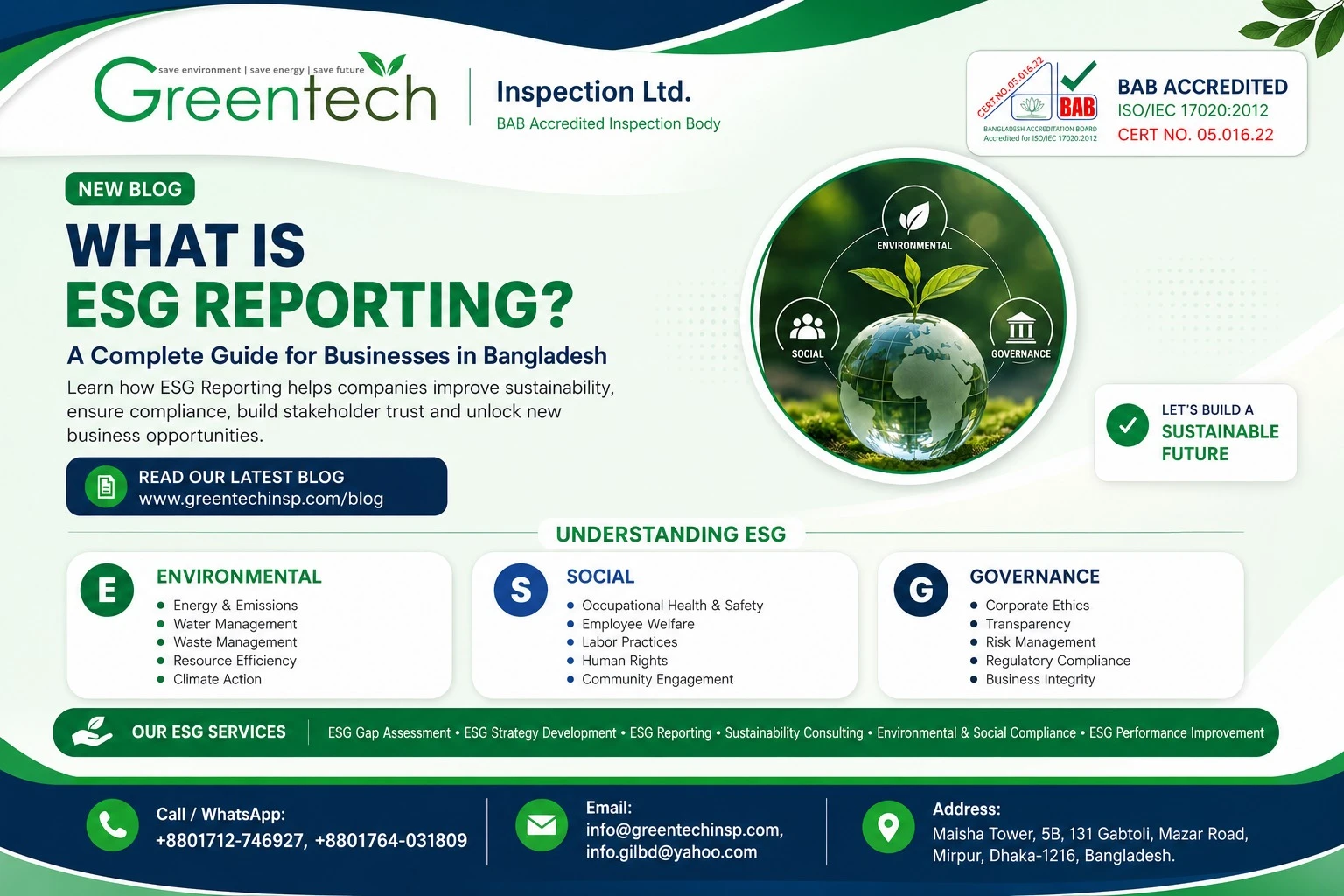
What is ESG Reporting?
ESG Reporting is the process of measuring, documenting, and disclosing a company's performance related to Environmental, Social, and Governance (ESG) factors. It helps organizations demonstrate their commitment to sustainability, responsible business practices, and long-term value creation.
Today, ESG reporting is becoming increasingly important for companies in Bangladesh, especially those involved in export-oriented manufacturing, garments, textiles, construction, infrastructure, energy, and industrial development.
As global buyers, investors, and financial institutions place greater emphasis on sustainability and responsible business conduct, ESG reporting has become a strategic business requirement rather than a voluntary exercise.
Understanding ESG
Environmental (E)
Environmental factors assess how a company manages its impact on the environment.
Examples include:
- Energy consumption
- Greenhouse gas emissions
- Air quality management
- Water consumption
- Waste management
- Wastewater treatment
- Climate change mitigation
- Resource efficiency
For manufacturing industries in Bangladesh, environmental performance is often a key concern for international buyers and regulators.
Social (S)
Social factors focus on how a company manages relationships with employees, communities, suppliers, and other stakeholders.
Examples include:
- Occupational health and safety
- Employee welfare
- Labor practices
- Human rights
- Diversity and inclusion
- Community engagement
- Worker training and development
For garment and textile industries, social performance is often a critical component of buyer compliance programs.
Governance (G)
Governance refers to the systems and processes used to manage and control an organization.
Examples include:
- Corporate ethics
- Transparency
- Risk management
- Board oversight
- Regulatory compliance
- Anti-corruption measures
- Business integrity
Strong governance helps build trust among investors, customers, and stakeholders.
Why is ESG Reporting Important in Bangladesh?
Bangladesh has become one of the world's leading manufacturing and export destinations. International buyers increasingly require suppliers to demonstrate sustainability performance through ESG reporting.
ESG reporting helps businesses:
Improve Buyer Confidence
Global brands often evaluate suppliers based on ESG performance before awarding contracts.
Strengthen Corporate Reputation
Organizations with transparent ESG reporting are often viewed as more responsible and trustworthy.
Enhance Risk Management
ESG assessments help identify environmental, social, and operational risks before they become major issues.
Attract Investors
Investors increasingly consider ESG performance when making investment decisions.
Support Regulatory Compliance
ESG reporting can help organizations align with environmental and social compliance requirements.
Which Industries Need ESG Reporting in Bangladesh?
ESG reporting is particularly beneficial for:
Garment & Textile Industries
Export-oriented factories often face ESG-related requirements from international buyers.
Manufacturing Industries
Factories seeking sustainability improvements and compliance support.
Real Estate & Infrastructure Projects
Large developments increasingly require sustainability reporting.
Energy & Power Projects
Investors and lenders often evaluate ESG risks and performance.
Food Processing Industries
Supply chain transparency and sustainability reporting are becoming increasingly important.
Financial Institutions
Banks and financial institutions are increasingly integrating ESG considerations into their operations.
Key Components of an ESG Report
A professional ESG report typically includes:
Environmental Performance
- Energy consumption analysis
- Carbon emissions inventory
- Water management assessment
- Waste management performance
- Environmental compliance review
Social Performance
- Workforce profile
- Occupational health and safety performance
- Employee training programs
- Community engagement initiatives
- Labor standards compliance
Governance Performance
- Corporate governance structure
- Risk management framework
- Ethical business practices
- Compliance systems
- Internal controls
ESG Reporting Process
Step 1: ESG Gap Assessment
Evaluate current sustainability performance and identify improvement opportunities.
Step 2: Data Collection
Gather environmental, social, and governance data from relevant departments.
Step 3: Materiality Assessment
Identify ESG issues that are most important to the organization and stakeholders.
Step 4: Performance Analysis
Assess ESG performance against recognized standards and benchmarks.
Step 5: Report Preparation
Develop a structured ESG report with key findings, indicators, and recommendations.
Step 6: Continuous Improvement
Implement action plans and monitor progress over time.
Benefits of ESG Reporting for Bangladeshi Businesses
Increased Export Opportunities
Many international buyers prefer suppliers with strong ESG performance.
Better Access to Finance
Banks and investors increasingly evaluate ESG factors.
Improved Operational Efficiency
Sustainability initiatives often reduce costs and improve resource efficiency.
Enhanced Brand Reputation
Transparent ESG reporting strengthens stakeholder trust.
Long-Term Business Sustainability
ESG helps organizations prepare for future regulatory and market expectations.
Common ESG Challenges in Bangladesh
Organizations often face challenges such as:
- Limited ESG data availability
- Lack of internal reporting systems
- Difficulty measuring sustainability performance
- Understanding international ESG frameworks
- Integrating ESG into business operations
Professional ESG consulting can help address these challenges effectively.
Why Choose Professional ESG Consulting Services?
Professional ESG consultants can assist organizations with:
- ESG gap assessments
- Sustainability strategy development
- ESG reporting preparation
- Environmental and social performance evaluation
- Stakeholder engagement
- Compliance support
- ESG performance improvement plans
Conclusion
ESG reporting is rapidly becoming an essential business practice for organizations in Bangladesh. Companies that proactively adopt ESG principles can strengthen their reputation, improve compliance, attract investment, and meet the growing expectations of international buyers and stakeholders.
As sustainability continues to shape global business decisions, ESG reporting provides a structured framework for demonstrating responsible and sustainable business performance.
Need ESG Reporting Services in Bangladesh?
Greentech Inspection Ltd provides professional:
- ESG Reporting
- ESG Gap Assessment
- Sustainability Consulting
- Environmental Compliance Services
- Environmental Inspection
- Industrial Hygiene Assessment
- Environmental Impact Assessment (EIA)
- Environmental & Social Impact Assessment (ESIA) for load or World bank
- ESG Performance Evaluation
Contact our ESG specialists today to discuss your sustainability and reporting requirements.
👉Fast | Accurate | Authority-Approved | Submission Ready | 12+ Years of Experience | 50+ TIA Projects Completed | 650+ EIA Projects Completed | 500+ EMP Projects Completed | 100+ Energy Audit | 20+ ESG Projects Completed | 40+ ESIA Projects Completed | 40+ Industrial Hygiene Assessment | 1000+ Customer | BAB Accredited | ISO/IEC 17020:2012 Certified |
Contact Greentech Inspection Ltd for professional EIA/TIA/ESIA/IHS/ESG/EMP/EA study and Environmental Inspection services in Dhaka, Bangladesh.
📞 Call / WhatsApp: +8801712-746927., +8801764-031809
📧 Email: [email protected], [email protected]